
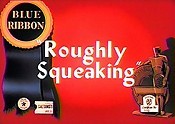
Roughly Squeaking
- Studio
- Warner Bros. Cartoons, Inc.
- Distributor
- Warner Bros.
Synopsis
Hubie and Bertie shave a cat and try to convince him that he's a lion. And if he's a lion, there are other things to hunt than mice. The troublemaking mice satisfy their sadistic enjoyment of watching the poor cat getting constantly beaten by the family bulldog!
Characters
Hubie, Bertie, Cat, Bulldog, Bird
Credits
Directing
- Director
- Chuck Jones (as Charles M. Jones)
Producing
- Producer
- Edward Selzer
Writing
- Writer
- Tedd Pierce, Michael Maltese
Animation
- Animator
- Ben Washam, Ken Harris, Basil Davidovich, Lloyd Vaughan
Voices
- Voice
- Dick Nelson (Hubie), Stan Freberg (Bertie), Mel Blanc (Cat, Dog, Bird)
Music
- Music
- Carl Stalling
Crew
- Layouts and Backgrounds
- Robert Gribbroek
Production notes
In "The Aristo-Cat" (1943) and "Roughly Squeaking" (1946), Bertie is grey and Hubie is brown.
In "House Hunting Mice" (1947), "Mouse Wreckers" (1949), "The Hypo-Chondri-Cat" (1950) and "Cheese Chasers" (1951), Bertie changes to brown and Hubie is now grey.
In "Trap Happy Porky"(1945), they have silent roles.
In September of 1943, beginning with A Feud There Was, Warner Bros. began re-releasing select color cartoons in their Blue Ribbon program. Typically the Blue Ribbon reissues received new opening sequences with Blue Ribbon title cards and standardized music. Cartoon production credits were also removed. Between ten and fifteen cartoons were released in any given year, with cartoons coming from as far back as 1935. The reissues continued until the close of the studio in the 1960's.
All Blue Ribbon cartoons were released as "Merrie Melodie" cartoons regardless of the original series. The first "Looney Tunes" short to be included in the Blue Ribbon series was The Hep Cat, which was added in 1949. The only current prints of many of these cartoons are the Blue Ribbon releases, although restoration of these cartoons with original elements and titles is always ongoing.