
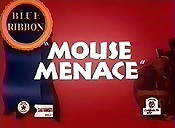
Mouse Menace
- Studio
- Warner Bros. Cartoons, Inc.
- Distributor
- Warner Bros.
Synopsis
Porky is having trouble getting rid of a wise-guy mouse. He first tries with a cat, which is immediately rocketed from the house, then sets loose a mountain lion, which is quickly stuffed and mounted. Finally, he hires a mobster cat (equipped with brass knuckles, TNT, axes, etc.), who is simply conked out with a bowling ball to the head. As a last resort, Porky builds a mechanical cat. In short order, the rodent gives the robot an electric shock, replaces its head with a toaster, and, as a coup de grace, blows up the mechanical cat- along with Porky's house.
Characters
Porky Pig, Mouse, Cat
Credits
Directing
- Director
- Art Davis (as Arthur Davis)
Producing
- Producer
- Edward Selzer
Writing
- Writer
- George Hill
Animation
- Animator
- Manny Gould, Don Williams, Cal Dalton
- Effects Animation
- A.C. Gamer
Voices
- Voice
- Mel Blanc (Porky Pig, Mouse)
Music
- Music
- Carl W. Stalling
Crew
- Layout
- Don Smith
- Backgrounds
- Richard H. Thomas
Production notes
Art Davis' first cartoon at Warner Bros. as a director. He takes over Robert Clampett's unit.
In September of 1943, beginning with A Feud There Was, Warner Bros. began re-releasing select color cartoons in their Blue Ribbon program. Typically the Blue Ribbon reissues received new opening sequences with Blue Ribbon title cards and standardized music. Cartoon production credits were also removed. Between ten and fifteen cartoons were released in any given year, with cartoons coming from as far back as 1935. The reissues continued until the close of the studio in the 1960's.
All Blue Ribbon cartoons were released as "Merrie Melodie" cartoons regardless of the original series. The first "Looney Tunes" short to be included in the Blue Ribbon series was The Hep Cat, which was added in 1949. The only current prints of many of these cartoons are the Blue Ribbon releases, although restoration of these cartoons with original elements and titles is always ongoing.
Pictures


Reviews
Mouse Menace
Art Davis was great right out of the gate. He is looooooong over-do for honours.
World War II was over and everything was settling down. This was good news for Porky, for this would be the beginning of a new prosperity for him. Even though the public still enjoyed Bugs, Daffy, and any other major stars being created at the studio, they didn't necessarily felt an absolute need for aggressive characters as much. Thus, Porky was given a second chance in this period.
Here, he would become the frustrated batchelor that, like his persona in My Favourite Duck, would retaliate after 6 and a half minutes of dealing with an antagonist. In this cartoon, Porky tries everything to get rid of a mouse. In Little Orphan Airedale (by Chuck Jones c. 1947) Porky does battle with a dog named Charlie and at the end throws him out of the car. In The Pest Who Came to Dinner (by Art Davis c. 1948), Porky has trouble with a termite. However, when Mr. Sureshot the exterminator causes more damage than the termite, Porky and the insect team up to ruin him. They then go into a furniture business together.
Porky had indeed coma a long way since his black & white days at this point. He was still being supportive to the stars (Charlie Dog, Daffy Duck, Sylvester, and any other generic mice) but he was much more mature and had more meat to his personality. Under the guidance of Jones, McKimson, and Davis, Porky would become just as complicated and viable a character as any others at that studio.