
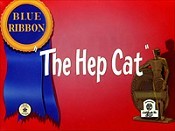
The Hep Cat
- Studio
- Leon Schlesinger Studios
- Distributor
- Warner Bros.
Synopsis
Hep Cat, a rather self-assured feline (with an eye for the ladies), finds himself in the sights of a neighborhood junkyard dog. Rosebud the Dog chases the crazy singing and dancing cat around back alleys of the city.
Characters
Hep Cat, Rosebud the Dog, Bird
Credits
Directing
- Director
- Robert Clampett
Producing
- Producer
- Leon Schlesinger
Writing
- Writer
- Warren Foster
Animation
- Animator
- Robert McKimson
- Additional Animation, uncredited
- Virgil Ross, Rod Scribner
Voices
- Voice
- Mel Blanc (Hep Cat), Bea Benaderet (Bird), Kent Rogers (Rosebud The Dog)
Music
- Music
- Carl W. Stalling
Production notes
The first color Looney Tune (yes, it took until 1942 for Looney Tunes to go to color), and the first one to feature wide concentric rings.
The first Looney Tunes short to be incuded in the Blue Ribbon reissue series.
Jerry Colonna and Robert Taylor are caricatured. There is also a reference to Victor Mature.
Songs include: "Java Jive" (Ben Oakland-Milton Drake), performed by the Hep Cat.
Sexual innuendo is featured through much of the cartoon.
In September of 1943, beginning with A Feud There Was, Warner Bros. began re-releasing select color cartoons in their Blue Ribbon program. Typically the Blue Ribbon reissues received new opening sequences with Blue Ribbon title cards and standardized music. Cartoon production credits were also removed. Between ten and fifteen cartoons were released in any given year, with cartoons coming from as far back as 1935. The reissues continued until the close of the studio in the 1960's.
All Blue Ribbon cartoons were released as "Merrie Melodie" cartoons regardless of the original series. The first "Looney Tunes" short to be included in the Blue Ribbon series was The Hep Cat, which was added in 1949. The only current prints of many of these cartoons are the Blue Ribbon releases, although restoration of these cartoons with original elements and titles is always ongoing.
Pictures
 Looney Tunes Opening Title
 Looney Tunes Title Card
 Color Looney Tunes Title Card</a>. Color Looney Tunes were introduced this season, complete with "ring" opening titles. Looney Tunes titles have thicker rings than their Merrie Melodies counterparts.
 Black and White Opening Title
 Black and White Looney Tunes Title
Reviews
The Hep Cat
I absolutely howl whenever I see this one. How the guys got all the sexual innuendo by the censors is a real mystery. I have had to explain the caricatures of Robert Taylor and Jerry Mahonie to my kids.
The pert little pussycat with the high-heel feet, wiggling her butt to a boogy-woogie piano beat while the Hep Cat pants--this is one of the greatest scenes of all--and when he romances the puppet, mistakenly fondling the dog's nose, eventually becoming ramrod erect and then draining down the steps--wow--very strong imagery that cannot be mistaken for mere slapstick. Compared with the romantic interplay, the dog chases nearly seem superfluous, but the pace of the whole film is so rapid that it works well. Man, i wish I could have spent some time with Bob Clampitt. What a guy.
The Hep Cat
What's with the low score??? This is a Clampett masterpiece. In fact, one of the many masterpieces he churned out from 1941 through to 1946.