
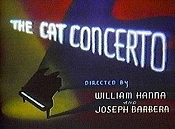
The Cat Concerto
- Studio
- MGM
- Distributor
- Metro-Goldwyn-Mayer
Synopsis
Tom is an acknowledged master pianist primed to give his greatest performance of Liszt's Second Hungarian Rhapsody. As he prepares and finally settles down, ready to play, Jerry is determined to disrupt Tom's concert. Jerry pulls on the strings inside the piano, slams the shutter on Tom's hands, and generally runs amok. Tom fights him with the piano without missing a single note.
Characters
Tom, Jerry
Credits
Directing
- Director
- William Hanna, Joseph Barbera
Producing
- Producer
- Frederick Quimby
Music
- Music
- Scott Bradley
- Non-Original Music
- Frédéric Chopin
- Non-Original Music, Hungarian Rhapsody #2
- Franz Liszt
Animation
- Animator
- Kenneth Muse, Ed Barge, Irv Spence
Art Department
- Backgrounds
- Robert Gentle
Crew
- Pianist
- Shura Cherkassky
Companies and other credits
- Pianist: unconfirmed)
Production notes
Tom's expert piano playing was based on the animators studying the fingers of great cartoon composer Scott Bradley playing Franz Liszt's "Hungarian Rhapsody #2."
Although the pianist who actually recorded the music is uncredited, it has been surmised the piano part was played by Shura Cherkassky. Some also attribute the piano to Jakob Gimpel (who did, in fact, play the same piece in Warner Bros. Rhapsody Rabbit), but his son does not believe it possible to be his father.
There was- and is, to this day- a mysterious and unresolved controversy regarding this cartoon, and Warner Bros' Rhapsody Rabbit. Both shorts were released in 1946, both used the same music, many of the same gags, and both had nearly identical plots. Even the stage in both cartoons looks strikingly similar. And when two studios release nearly identical films within months of each other, both studios instantly and loudly began accusing the other of plagiarism.
One theory for how both studios fell upon the same story was the possibility that Technicolor accidentally (or mischievously!) sent a print of one film to the rival studio, where the plot was copied. It has also been theorized that one of the studios was involved in some serious espionage. Or the simplest of all theories: that both studios just came up with a good idea at the same time. It has happened since; Pixars' A Bugs Life and DreamWorks' Antz from 1998 are a good example of similar themes from competing studios.
Of all the theories, the one that seems to make the most sense is the one put forth by the son of the pianist of the Warner Bros. cartoon. According to Peter Gimpel, his father may have mentioned in passing to rival pianist Shura Cherkassky that he was working on a cartoon at Warner Bros. involving Franz Lizst's 2nd Hungarian Rhapsody. Cherkassky, a consummate practical joker, may have just mentioned using the same song as a possible Tom And Jerry plot to his friends at MGM, and angled himself in to the job as pianist for the cartoon. Certainly, both Cherkassky and Gimpel knew each other well during this period, and they are the only concrete link at the rival studios between people who would have known the details- and could have told each other.
We will never know the true story of how the same story, with the same gags, and the same score was procuced by two rival studios in 1947. Oh, and for what its worth, MGM ended up winning that year... Bugs Bunny would wait another ten years for his gold statue.
Songs: "Credits" (Frédéric Chopin-arr. Scott Bradley), "The Cat's Concerto" (Franz Liszt (arr. Scott Bradley), "On the Atchison, Topeka, and the Santa Fe" (Harry Warren-Johnny Mercer)
Awards
Academy Award Winner, Best Short Subject (Cartoon), 1947.
Nominee, BAFTA Film Award, Special Award, 1949
Nominee, BAFTA Film Award, Special Award, 1949
Pictures



Reviews
The Best
This is easily the most enjoyable T&J short ever made. The fact that every move, every smack, slap, slam-- EVERYTHING goes along with the music (which is very enjoyable by itself) makes it almost mesmerizing. I would recommend this to newcomers and fans alike.
The Cat Concerto
It's cartoons like this one which explain why I like and prefer classical music to any other kind! Favorite scene--when Tom catches his finger in the strategically-placed mousetrap, and then looks on angrily as Jerry dances back and forth on the piano keys in a most smart-alecky way. Perfect 10!
The Cat Concerto
A definite classic, love the random acts of violence in this one, especially the part where Tim strikes Jerry in the head with the little rod inside the piano, and it takes Jerry a little while before it kicks in that the thing that hit him hurt.
The Cat Concerto
It is an historical fact that good ol' H&B saw a print of Bugs Bunny's "Rhapsody Rabbit" and just did a copy of it. THEN, through a ridiculous technicality, they took the Oscar that rightfully belonged to Bugs. One of H&B's lowest moments!
The Cat Concerto
This is definately my favorite Tom and Jerry episode. And I looove the classical piece they used for it.