
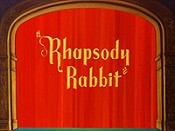
Rhapsody Rabbit
- Studio
- Warner Bros. Cartoons, Inc.
- Distributor
- Warner Bros.
Synopsis
Bugs tries to perform a piano concerto while dealing with the piano's resident mouse.
Characters
Bugs Bunny, Mouse
Credits
Directing
- Director
- Isadore Freleng (as I. Freleng)
Producing
- Producer
- Edward Selzer
Writing
- Writer
- Tedd Pierce, Michael Maltese
Voices
- Voice
- Mel Blanc (Bugs Bunny)
Music
- Music
- Carl Stalling
Animation
- Animator
- Manuel Perez, Ken Champin, Virgil Ross, Gerry Chiniquy
- Layouts
- Hawley Pratt
Art Department
- Backgrounds
- Terry Lind
Music Department
- Piano Soloist
- Jakob Gimpel
Crew
- Piano
- Jakob Gimpel
Production notes
There was- and is, to this day- a mysterious and unresolved controversy regarding this cartoon, and MGM's The Cat Concerto. Both shorts were released in 1946, both used the same music, many of the same gags, and both had nearly identical plots. Even the stage in both cartoons looks strikingly similar. And when two studios release nearly identical films within months of each other, both studios instantly and loudly began accusing the other of plagiarism.
One theory for how both studios fell upon the same story was the possibility that Technicolor accidentally (or mischievously!) sent a print of one film to the rival studio, where the plot was copied. It has also been theorized that one of the studios was involved in some serious espionage. Or the simplest of all theories: that both studios just came up with a good idea at the same time. It has happened since; Pixars' A Bugs Life and DreamWorks' Antz from 1998 are a good example of similar themes from competing studios.
Of all the theories, the one that seems to make the most sense is the one put forth by the son of the pianist of the Warner Bros. cartoon. According to Peter Gimpel, his father may have mentioned in passing to rival pianist Shura Cherkassky that he was working on a cartoon at Warner Bros. involving Franz Lizst's 2nd Hungarian Rhapsody. Cherkassky, a consummate practical joker, may have just mentioned using the same song as a possible Tom And Jerry plot to his friends at MGM, and angled himself in to the job as pianist for the cartoon. Certainly, both Cherkassky and Gimpel knew each other well during this period, and they are the only concrete link at the rival studios between people who would have known the details- and could have told each other.
We will never know the true story of how the same story, with the same gags, and the same score was produced in the same year by two rival studios. Oh, and for what its worth, MGM ended up winning that year... Bugs Bunny would wait another ten years for his gold statue.
This was the very first cartoon broadcast on the Cartoon Network when it first went on the air on October 1, 1992.
Pictures


Reviews
Rhapsody Rabbit
The basic premise of this cartoon is that Bugs is trying to play a Lizst concerto in concert but is hampered by a small mouse inside the piano. This cartoon's significance is two-fold:
a) Since the beginning of the WB animation department, classical music had been looked upon with scorn by much of the staff and was ridiculed in most of the cartoons. The reason for much of this was that Walt Disney absolutely insisted that classical music and nothing else be used. This was one of the many reasons that many animators left Disney for WB and/or elsewhere and was certainly the main reason for Carl Stalling leaving Walt. So, for the longest time, classical music was put through the wringer at Termite Terrace. Even though toons such as Rhapsody in Rivets, Pigs in a Polka, and A Corny Concerto all rely on synchronozation to a classical piece, they do possess a charming hammy quality. But, Rhapsody Rabbit was the WB cartoon that treated classical music with the respect that an avid music buff would appreciate. This would lead to other great WB symphonic toons like Rabbit of Seville, Mouse Mazurka, What's Opera, Doc?, etc.
b) This could have been the year for Bugs, Freleng, and Termite Terrace to finally win an Oscar. But, something happened. The Technicolor company sent a copy to MGM by mistake where the team of Hanna Barbara saw it. Upon witnessing the above-excellent animation they paniced and rushed the production of their cartoon Cat Concerto (having the same premise as Rhapsody Rabbit) so that it could be submitted for Oscar consideration. So, both the Bugs and the Tom & Jerry cartoons were submitted that year. Here's an inside tip, the submitted films for the Acadamy then and now are screened alphabeticly. So, Cat Concerto was viewed BEFORE Rhapsody Rabbit and the acadamy thought that Bugs was copying Tom & Jerry. Cat Concerto got the nomination AND THE WIN!!! This just shows that Bugs would have been a shoe-in had it not been for Hanna and Barbara pulling that. Some say that's the main reason Tweetie Pie won the Oscar the following year, as a way of apologizing for the mistake. I personally think that Tweetie Pie would have won on it's own merits regardless but that's a whole other post. Not to worry, Bugs would receive an Oscar, but not now.
Rhapsody Rabbit
This cartoon was, by and large, the work of three men. There was director Freleng, who also wrote it (according ot Maltin's book, these musicals were written entirely by the director himself). Also, Ross & Chiniquy were the only two animators who worked on this cartoon; when I spoke with Virgil Ross in 1991, he said the other two animators were only listed contractually.
Rhapsody Rabbit
WOW!!! No other reviews of this one YET?!?
A small but vital piece of info: When I spoke with animator Virgil Ross in 1991, he told me that he and Gerry Chiniquy were really the only animators who worked on this one (i.e., that Champin and Perez merely got contractual credit for it). Also, in all probability, Michael Maltese and Tedd Pierce didn't write this cartoon at all: Freleng's musical pantomime films were written by the director himself.