
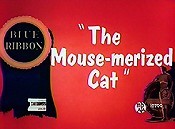
The Mouse-Merized Cat
- Studio
- Warner Bros. Cartoons, Inc.
- Distributor
- Warner Bros.
Synopsis
We start way out in outer space and zoom in to Earth, to the United States, to "Mousachewsetts," to a deli and to a mouse named "Catsello," who informs his partner, "Babbitt," that "the people are here!" Using his new book on hypnosis, Babbitt plans to hypnotize Catsello into going out and facing the cat and bringing back some food. Catsello resists, but he then starts transforming into other personalities, including Bing Crosby, Frank Sinatra, Jimmy Durante and Rochester (from the "Jack Benny Show"). Babbitt convinces Catsello that he's a chicken, then a vicious dog. At first, he scares the cat; then, the cat dehypnotizes him. The cat and Catsello have a battle of wills, hypnotized and dehypnotized, until Catsello hypnotizes Babbitt into thinking that he's a cowboy, and the cat into thinking that he's a horse. They ride off. All alone in the deli of food, Catsello is stuffing himself. He says, "I'm a baaaad boy."
Characters
Babbitt, Catsello, Cat
Credits
Directing
- Director
- Robert McKimson
Producing
- Producer
- Edward Selzer
Writing
- Writer
- Warren Foster
Voices
- Voice
- Mel Blanc (Catsello), Ted Pierce (Babbitt)
Music
- Music
- Carl W. Stalling
Animation
- Animator
- Art Davis, Richard Bickenbach, Cal Dalton, Don Williams
Art Department
- Layouts and Backgrounds
- Richard H. Thomas, Cornett Wood
Visual Effects
- Effects Animation
- A. C. Gamer
Production notes
The final screen appearance for Babbitt and Catsello.
Cartoon Network cuts the moment which Babbit turns Catsello into Rochester and he receives a phone call from Jack Benny.
In September of 1943, beginning with A Feud There Was, Warner Bros. began re-releasing select color cartoons in their Blue Ribbon program. Typically the Blue Ribbon reissues received new opening sequences with Blue Ribbon title cards and standardized music. Cartoon production credits were also removed. Between ten and fifteen cartoons were released in any given year, with cartoons coming from as far back as 1935. The reissues continued until the close of the studio in the 1960's.
All Blue Ribbon cartoons were released as "Merrie Melodie" cartoons regardless of the original series. The first "Looney Tunes" short to be included in the Blue Ribbon series was The Hep Cat, which was added in 1949. The only current prints of many of these cartoons are the Blue Ribbon releases, although restoration of these cartoons with original elements and titles is always ongoing.
Pictures



Elsewhere: Wikipedia