
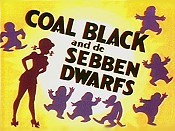
Coal Black And De Sebben Dwarfs
Coal Black And De Sebben Dwarfs is a 1943 Merrie Melodies theatrical cartoon from Leon Schlesinger Studios, directed by Robert Clampett and Arthur Lueker, released on January 16, 1943.
Also known as: So White And De Sebben Dwarfs (Working Title)
- Studio
- Leon Schlesinger Studios
- Distributor
- The Vitaphone Corporation, Warner Bros. Pictures
Synopsis
A blackface parody of Disney's Snow White and the Seven Dwarfs with a strong swing backbeat... and no apologies!
Mammy (who resembles Aunt Jemima) tells her "Honey Child" the story of "So White" and the wicked Queen who "was as rich as she was mean." "She had everything," including sugar, coffee, auto tires, scrap metal, Chattanooga choo-choos, and a family coat of arms consisting of dice and switchblades. So White is a lascivious sexpot forced to wash miles and miles of laundry as she sings "Blues in the Night." "Magic Mirror on the wall, send me a prince about six feet tall," intones the Queen. When zoot-suited, thick-lipped hipster Prince Chawmin' (who has dice for teeth!) finds So White "dynamite," the Queen calls in Murder Inc. to "black out So White." Prince Chawmin' and the dwarfs are all miniature caricatures of Fats Waller, except for one who resembles Stepin Fetchit. The prince kisses and tries to revive the heroine.
Characters
So White, Queenie, Prince Chawmin', Seven Dwarfs, Mammy, Child, Worm, Hitman
Credits
Directing
- Director
- Robert Clampett
- Assistant Director
- Arthur Lueker (uncredited)
Producing
- Producer
- Leon Schlesinger
Writing
- Writer
- Warren Foster
- Based on the Original Fairy Tale By
- Jacob Grimm, Wilhelm Carl Grimm (uncredited)
- Adaptation
- Al Dempster (uncredited), Thomas McKimson (uncredited)
Voices
- Voice
- Vivian Dandridge (So White), Ruby Dandridge (Queenie), Leo 'Zoot' Watson (Prince Chawmin'), Mel Blanc ("Dopey" Dwarf, Worm, Hitman, Dwarfs), Ivy Anderson (Narrator), Lillian Randolph (Mammy)
Music
- Music
- Carl W. Stalling
- Musical Score
- Eddie Beals (uncredited), Milt Franklyn (uncredited)
Animation
- Animator
- Rod Scribner (also character designer and layout artist, uncredited), Manny Gould (uncredited), Robert McKimson (uncredited), Thomas McKimson (uncredited), Art Babbitt (uncredited), Rev Chaney (uncredited)
- Layout Artist
- Michael Sasanoff (uncredited)
- Final Checker
- Gladys Hallberg (uncredited)
- Key Assistant Animator
- Charlotte Huffine (uncredited)
Art Department
- Character Design
- Gene Hazelton (uncredited)
- Painter
- Mabel Andes (uncredited), Ruth Cavert (uncredited), Helen Cope (uncredited), Frances Garcia (uncredited), Sue Gee (uncredited), Betty Monahan (uncredited), Lela Perry (uncredited), Hazel Preston (uncredited), Martha Sigall (uncredited), Dawn Smith (uncredited), Dolores Spencer (uncredited), Auril Thompson (uncredited)
- Assistant Ink & Paint Supervisor
- Betty Brenon (uncredited)
- Inker
- Ivy Carol Christensen (uncredited), Fern Crawford (uncredited), Florence Finkelhor (uncredited), Florence Hammontre (uncredited), Verena Ruegg (uncredited)
- Ink & Paint
- Connie Crawley (uncredited), Lucille Hazell (uncredited), Marjorie Kallman (uncredited), Marion Stevens (uncredited), Marian Stevenson (uncredited), Beverly Wingard (uncredited)
- Ink & Paint Supervisor
- Frank Powers (uncredited)
- Story Sketches
- Rod Scribner (uncredited)
Camera
- Animation Camera
- Ray Bloss (uncredited), John W. Burton (uncredited), Henry 'Smokey' Garner (uncredited), Ken Moore (uncredited)
Editing
- Editor
- Treg Brown (uncredited)
Sound
- Sound Effects Editor
- Treg Brown (uncredited)
- Paint Checker and Mixer
- Ann Almond (uncredited)
Production Management
- Production Manager
- Raymond Katz (uncredited)
Production notes
According to Beck and Friedwald, Coal Black is a Bob Clampett masterpiece, and certainly one of the greatest Warner Bros. cartoons ever made. Sure to offend, but not to be ignored.
In 1968, United Artists (then owners of the A.A.P. library of pre-1948 Looney Tunes and Merrie Melodies cartoons) compiled the cartoons they considered too potentially offensive to be shown on television, and withheld those cartoons from distribution. AT that time, UA felt that these eleven cartoons should be withheld from broadcast because the depictions of black people in the cartoons were deemed too offensive for contemporary audiences.
This cartoon is one of those withheld from distribution, one of the so-called "Censored 11." (The "Eleven" are: Hittin' the Trail for Hallelujah Land (MM,1931), Sunday Go to Meetin' Time (MM, 1936), Clean Pastures (MM, 1937), Uncle Tom's Bungalow (MM, 1937), Jungle Jitters (1938), The Isle of Pingo Pongo (MM, 1938), All This and Rabbit Stew (MM, 1941), Coal Black and de Sebben Dwarfs (MM, 1943), Tin Pan Alley Cats (MM, 1943), Angel Puss (LT, 1944), and Goldilocks and the Jivin' Bears (MM, 1944)). More recently, when Ted Turner became owner of the library, he continued the ban, and refused to allow any of these cartoons to be shown or released on video. To date, these shorts have not been officially broadcast on television since 1968. However, according to a recent e-mail, a woman in Phoenix claims that she has seen this on television there recently.
Along with black stereotypes, this cartoon features savagely anti-Japanese jokes (the film was made a year after Pearl Harbor).
Vivian Dandridge (the voice of So White) and Ruby Dandridge (the voice of Queenie) were the sister and mother, respectively, of actress-singer Dorothy Dandridge.
Jimmy Durante is caricatured.
A unique "That's All, Folks!" card features an animated shot of Mammy and a little girl rocking in an armchair.
Working title: "So White And De Sebben Dwarfs." It was changed at the last minute because someone in film marketing at Warner Bros. pointed out that in those days the theaters sometimes included the name of the cartoon short on the marquee, and was concerned that some people would think that the Disney feature was being shown, and be angry about the "false advertising." So the name was changed and became "Coal Black and de Sebben Dwarfs".
Clampett wanted an all-black band to score the cartoon, much like how the Fleischers had Cab Calloway score the Betty Boop cartoons they were featured in. Producer and noted tight wad Schlesinger refused to fund the endeavor, and the black band Clampett had hired, Eddie Beals and His Orchestra, only recorded the music for the final kiss sequence. The rest of the film was scored, as was standard for Warner cartoons at the time, by Carl W. Stalling.
In the late seventies, Bob Clampett defended this cartoon. He said:
In 1942, during the height of anti-Japanese sentiment during World War II, I was approached in Hollywood by the cast of an all-black musical off-broadway production called Jump For Joy while they were doing some special performances in Los Angeles. They asked me why there weren't any Warner's cartoons with black characters and I didn't have any good answer for that question. So we sat down together and came up with a parody of Disney's "Snow White" and "Coal Black" was the result. They did all the voices for that cartoon, even though Mel Blanc's contract with Warners gave him sole voice credit for all Warners cartoons by then. There was nothing racist or disrespectful toward blacks intended in that film at all, nor in Tin Pan Alley Cats which is just a parody of jazz piano great Fats Waller, who was always hamming into the camera during his musical films. Everybody, including blacks had a good time when these cartoons first came out. All the controversy about these two cartoons has developed in later years merely because of changing attitudes toward black civil rights that have happened since then.
Pictures


Reviews
Things Have Not Changed
I am a (white) producer/director, entertainment attorney, and have had the task for many years of managing and directing African-American actresses. Interesting about Coal Black is that apart from some of the terminology, NOTHING has changed in regard to the attitudes about black women in this country, since the day the cartoon aired. I have read the commentaries about what Coal Black means, and I agree. I DON'T agree however, with the misguided assumption that attitudes have changed. For instance, it is seldom we see a pretty black woman cast beside a pretty white female lead; the black females the media allows to have awards and media careers are overrepresented as obese and funny looking; roles for them are still overwhelmingly the slut and prostitute; black entertainment from people allowed by the mainstream to succeed - such as Tyler Perry - support theses same assumptions. No, as another commentator alluded to, we have NOT come a long way...
My opinion...
I am a huge fan of this cartoon for so many reasons. The music. The animation. The humor and WWII jokes. That cutie So White. The big lips on some of the characters hurt me at first, but then I was very able to get past that and see the positive of this cartoon and similar cartoons which far outweighed the negative. Some cartoons depicting blacks definitely offend me but this particular short has more positive and neutral elements than negative. As far as big lips go, I understand the concept of caricatures. Black people's full lips may be exaggerated to grotesque proportions, but white people's long noses are often exaggerated to grotesque proportions as well. Because they're CARTOONS, get it? Even the worst stereotypes depicted in the old cartoons aren't anywhere near as damaging as contemporary stereotypes depicted on BET and MTV. For me, these are the real minstrel shows. I'd like to copy and paste part of a letter I wrote to the Jim Crow Museum of Racist Memorabilia that sums up my opinion very well (pardon the anger and language but I was having a pretty bad day so I blew my top when I wrote it):
"Wow...I’m in a paroxysm of anger here; I can’t explain this eloquently, but hopefully you’ll understand. I am a teenage black girl who has to deal with embarrassing stereotypes and ignorance everyday. You know, it really infuriates me is the cliche "We’ve come a long way." That's very naïve. The stereotypes of the past such as watermelon, toms, and mammies have been replaced with much worse stereotypes such as bucks, wanton jezebel sluts, "smokin’ crack and rapin’ b*tches," etc. I think the bigger problem here is modern-day minstrelsy, and it’s not being emphasized enough in your museum. And what’s even worse is that these modern stereotypes are self-debasing ones that blacks bring upon themselves, and whites and black youth glorify this sh*t. The moral decay in black America (and all of America) makes me want to vomit. It also imposes an inferiority complex on black youth. I have a great disdain for hip-hop and modern-day minstrel "coons" such as Snoop Dogg and Kings of Comedy, not because I hate my people, but for the complete opposite reason. And all of this so-called political correctness bullsh*t -- they’ll waste all this effort censoring a blackface bunny in a Looney Tunes cartoon, but they'll regard these rap videos and degrading vulgar low comedy as acceptable? "
And if hating rap and our country's moral decay makes me a prude, so be it. My mama and dad raised me to have some integrity. I'm not saying you have to hate rap yourself, but you sure as heck better not approve of rap and then badmouth Coal Black. Then not only would you be a hypocrite but you'd be depriving the world of great cartoons and music. And while fortunately there's some decent educated balanced reviews on Coal Black you wouldn't believe the slander and biased negative slant it has on certain articles- like wikipedia and this other extremist blogger crumb named Yolanda something. Isn't it about time the reign of political correctness as fallen? I look foward to the day where I can watch Coal Black in hi-res on DVD. And let's get CB's killer-diller soundtrack on CD already! Oh yeah, and defense of one of my favorite cartoon characters, So White isn't a ho. She's just sexy and flirty and knows how to flirt her way out of trouble- Black Betty Boop. Notice the double standard- she's no more sexual than Betty Boop but just because she is black she is immediately labeled as some "lascivious jezebel". Chick from Hallelujah was a jezebel. Lil' Kim and the rap video chicks are jezebels. Foxxy Love from Drawn Together was a jezebel. But So White? Just a 40's pinup sweetheart and just as pretty as Ms. Boop and the Disney princesses. Betty Boop's babydoll face, Betty Grable's legs/skirt, and Jane Russell's curves-in pure chocolate-voiced by Dorothy Dandridge's equally cute (IMO) sister. Yowza!
Conclusion: I dig Coal Black and ALL OF YOU HATERS STOP BRINGING IT DOWN AND SLANDERING IT! It’s a free country for the rest of us too you know.
Coal Black And De Sebben Dwarfs
It's been said that you can't know where you're going unless you know where you came from. This 1940s era cartoon, at the time it was released, was considered "OK" ... and kids today need to know that this era was an era of ambivalence toward racial stereotypes. It would help them to understand the civil rights movement a whole lot better.
Having said that ... and for the moment, disregarding the racial stereotypes (not to mention the politically incorrect word for short people in the title), there is one thing that amazes me about this cartoon.
Clampett drew the heroine, So White, as an incredibly well-built young woman. And, he drew her wearing a micro-mini-skirt that would have raised eyebrows even in the 1960s (in a 1940s cartoon). I was born in 1950 so I don't know how this cartoon was received when it was released. But, I'm wondering if there was any flak from parents (or censorship groups) over Clampett's choice of attire for the lead character?
Coal Black And De Sebben Dwarfs
Coal Black is simply stunning for all the right artistic reasons, and--I like this particularly--they really shove it up Disney's [snout]-! My favorite WB classic.
I can't add much to what's already been written by others, but I would remind the PC Police that they have only to watch the "WB" network and observe the capering of the black TV stars to see that Coal Black is not very different. And--when I no longer hear the "N" word blaring from the car speakers of black kids' cars, and they can summon the self-respect to retire that particular ephitet forever, I will begin to listen to all the criticism.
Coal Black And De Sebben Dwarfs
A masterpiece. A celebration of Jazz, Swing, and the American Spirit crammed into one of the most energetic pieces of animation ever made. Bob Clampett's legendary elastic animation style works perfectly. And So White ranks up there with Red Hot Riding Hood, Betty Boop and Jessica Rabbit as one of the sexiest characters in animation history.
While the 1940's caricatures and stereotypes in this picture are understandably offensive to many modern viewers, my advice is to try to see it in its historical context. We were at war, and it was common to make fun of our aggressors (as in fact, it still is today.) Black actors and musicians donated their talents to this cartoon, and saw it as a celebration of their culture rather than a put-down.
If you can see beyond the stereotypes, you will be rewarded with a great experience, an explosion of great music and perfect comedic timing. This is hard to find on video, but not impossible-you owe it to yourself to see this one if you can.
Coal Black And De Sebben Dwarfs
One of Bob Clampett's Best Merry Melodies.
- Great music & colored humor make this spoof of Snow White a wonderful time capsule of WWII humor (1943)
- Coal Black is well worth seeeing!
- Wonderful usage of vivid colors in many scenes seem unique to this production
- Contains reference to "Citizen Kane" (Rosebud)
- We just love that "wheel of shoes" on the prince's car.
- It dose contain some racial humor & has resulted in being banned
- Contains WWII slur "...kills japs for free"
Coal Black And De Sebben Dwarfs
Although this film is a landmark for black culture one also can't help but notice the telling of the times with the notice that the hired killers will kill 'Japs for free'. This may seem racist in todays world but seeing that this came out right after Pearl Harbour, I believe that this just made the short film more a part of history and a valuable educational show for all children when telling them about how the world was in the past.
Coal Black And De Sebben Dwarfs
one of the best warner cartoons i know. i wonder it wasn't done from tex avery. the swing make of it the fastest cartoon i know. sublime music and hommage on black music. i understand it as a nice contribution to black culture and not as a bad joke. what a swing!!!
Coal Black And De Sebben Dwarfs
I personally see nothing offensive about this cartoon. It's more of a celebration of black Americans rather than a parody of them.
Coal Black And De Sebben Dwarfs
A stunner! Clampett condenses Snow White into a hip, black version with gag after gag. Plus, the soundtrack is wonderful, with period jazz stylings premeating throughout.
Rather Politically Incorrect these days it's more than worth seeking out.
Elsewhere: Wikipedia