
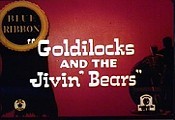
Goldilocks And The Jivin' Bears
Goldilocks And The Jivin' Bears is a 1944 Merrie Melodies theatrical cartoon from Warner Bros. Cartoons, Inc., directed by Isadore Freleng, released on September 2, 1944.
- Studio
- Warner Bros. Cartoons, Inc.
- Distributor
- Warner Bros., Vitaphone
Synopsis
This is the story of Goldilocks and the three black bears, who are jazz musicians, mixed with Little Red Riding Hood and the Big Bad Wolf. Three black bears- the king-size bear, the middle-size bear, and the wee little bear- are a hot swing trio who hold a jam session. When their instruments get too hot (Little Bear on bass, Middle Bear on piano, Big Bear on horn), they decide to take a walk to let them cool. Meanwhile, the Big Bad Wolf comes along. Red is busy working at Lockheed as a riveter, The wolf spots sexy Goldilocks entering the bears' place and starts chasing "Goldie" as the bears return. Thinking that they're jitterbugging, they pick up their instruments and "give out." Goldie gets into the swing, bouncing the Big Bad Wolf all over the dance floor and wearing him out. The wolf tries to escape from the dance-crazed Goldie, but Goldie has boarded up the doors and windows. Later, the wolf rests at Grandma's house just as Red Riding Hood shows up. Red is disappointed that the wolf isn't chasing her, but he shows her his red, burning feet. The bears show up and start "jamming." Grandma, hiding in the closet, forces the wolf to jitterbug with her.
Characters
Goldilocks, Three Bears, Grandma, Big Bad Wolf
Credits
Directing
- Director
- Isadore Freleng (as I. Freleng)
Producing
- Producer
- Edward Selzer
Writing
- Writer
- Tedd Pierce
Voices
- Voice
- Mel Blanc (Big Bad Wolf, Wee Small Bear, Western Union Boy), Ruby Dandridge (Little Red Riding Hood), Vivian Dandridge (Goldilocks), Lillian Randolph (Grandma), Ernest "Bubbles" Whitman (Narrator), Sara Berner
Music
- Music
- Carl W. Stalling
Animation
- Animator
- Ken Champin
- Layouts
- Hawley Pratt
- Animators, uncredited
- Richard Bickenbach, Jack Bradbury, Gerry Chiniquy, Manuel Perez, Virgil Ross
Art Department
- Backgrounds
- Paul Julian
Editing
- Editor
- Treg Brown
Production notes
Amos 'n' Andy and Little Black Sambo are caricatured.
With this cartoon, the Merrie Melodies Series Title Card credit that reads Produced by Leon Schlesinger transitioned to A Warner Bros. Cartoon; this was Edward Selzer's first Merrie Melodies cartoon as a producer.
In 1968, United Artists (then owners of the A.A.P. library of pre-1948 Looney Tunes and Merrie Melodies cartoons) compiled the cartoons they considered too potentially offensive to be shown on television, and withheld those cartoons from distribution. AT that time, UA felt that these eleven cartoons should be withheld from broadcast because the depictions of black people in the cartoons were deemed too offensive for contemporary audiences.
This cartoon is one of those withheld from distribution, one of the so-called "Censored 11." (The "Eleven" are: Hittin' the Trail for Hallelujah Land (MM,1931), Sunday Go to Meetin' Time (MM, 1936), Clean Pastures (MM, 1937), Uncle Tom's Bungalow (MM, 1937), Jungle Jitters (1938), The Isle of Pingo Pongo (MM, 1938), All This and Rabbit Stew (MM, 1941), Coal Black and de Sebben Dwarfs (MM, 1943), Tin Pan Alley Cats (MM, 1943), Angel Puss (LT, 1944), and Goldilocks and the Jivin' Bears (MM, 1944)). More recently, when Ted Turner became owner of the library, he continued the ban, and refused to allow any of these cartoons to be shown or released on video. To date, these shorts have not been officially broadcast on television since 1968.
In September of 1943, beginning with A Feud There Was, Warner Bros. began re-releasing select color cartoons in their Blue Ribbon program. Typically the Blue Ribbon reissues received new opening sequences with Blue Ribbon title cards and standardized music. Cartoon production credits were also removed. Between ten and fifteen cartoons were released in any given year, with cartoons coming from as far back as 1935. The reissues continued until the close of the studio in the 1960's.
All Blue Ribbon cartoons were released as "Merrie Melodie" cartoons regardless of the original series. The first "Looney Tunes" short to be included in the Blue Ribbon series was The Hep Cat, which was added in 1949. The only current prints of many of these cartoons are the Blue Ribbon releases, although restoration of these cartoons with original elements and titles is always ongoing.
Pictures


Reviews
Goldilocks And The Jivin' Bears
Definitely one of my favorite cartoons ever. I love the musical score- especially the boogie-woogie by the narrator and bears' swing at the end. Like Coal Black, Red Hot Riding Hood and Tin Pan Alley Cats I wish I could get the soundtrack to listen to. The dialogue, jokes, and references are very funny. Bugs Bunny funny. And I love Goldilocks- she's uniquely and breathtakingly gorgeous, loveable and such a sweetheart. She's pretty shy and demure- until you get her on the dance floor! This cartoon isn't insulting at all and the only offensive thing in the whole cartoon is the way some of the characters are drawn, I mean shoot, the bears didn't have to have lips! But I can definitely get past that to enjoy the rest of the cartoon, and so should you. This should not be banned. So anyway, here's my detailed comments about the "Censored 11" in general (so I don't have to keep repeating it):
http://forum.bcdb.com/forum/gforum.cgi?post=73409;search_string=;#73409
Goldilocks And The Jivin' Bears
Unlike earlier Freleng black-oriented musicals, the censorship of this one's inexplicable. The bears may talk like blacks--but they're BEARS, for cryin' out loud!
Nifty predecessor to "The Three Little Bops."
Elsewhere: Wikipedia