
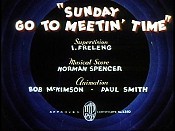
Sunday Go To Meetin' Time
- Studio
- A Vitaphone Production
- Animation studio
- Leon Schlesinger Studios
- Distributor
- Warner Bros., The Vitaphone Corporation
Synopsis
It is Sunday and all the black folks are getting ready for church. All the usual sight gags are here including the devout church lady whose husband Nicodemus wants nothing more than to shoot craps. Nicodemus is knocked unconscious while trying to steal chickens.
While out cold, he imagines himself in hell, where he is put on trial for past indiscretions (such as stealing watermelons). When Nicodemus comes to, he races back to church, having learned his lesson.
While out cold, he imagines himself in hell, where he is put on trial for past indiscretions (such as stealing watermelons). When Nicodemus comes to, he races back to church, having learned his lesson.
Characters
Nicodemus, Mammy, Kids, The Devil
Credits
Directing
- Director
- Isadore Freleng (as I. Freleng)
Producing
- Producer
- Leon Schlesinger
Writing
- Writer
- Allen Rose
Music
- Music
- Norman Spencer
Animation
- Animator
- Robert McKimson (as Bob McKimson), Paul J. Smith
Production notes
In 1968, United Artists (then owners of the A.A.P. library of pre-1948 Looney Tunes and Merrie Melodies cartoons) compiled the cartoons they considered too potentially offensive to be shown on television, and withheld those cartoons from distribution. AT that time, UA felt that these eleven cartoons should be withheld from broadcast because the depictions of black people in the cartoons were deemed too offensive for contemporary audiences.
This cartoon is one of those withheld from distribution, one of the so-called "Censored 11." (The "Eleven" are: Hittin' the Trail for Hallelujah Land (MM,1931), Sunday Go to Meetin' Time (MM, 1936), Clean Pastures (MM, 1937), Uncle Tom's Bungalow (MM, 1937), Jungle Jitters (1938), The Isle of Pingo Pongo (MM, 1938), All This and Rabbit Stew (MM, 1941), Coal Black and de Sebben Dwarfs (MM, 1943), Tin Pan Alley Cats (MM, 1943), Angel Puss (LT, 1944), and Goldilocks and the Jivin' Bears (MM, 1944)). More recently, when Ted Turner became owner of the library, he continued the ban, and refused to allow any of these cartoons to be shown or released on video. To date, these shorts have not been officially broadcast on television since 1968.
In September of 1943, beginning with A Feud There Was, Warner Bros. began re-releasing select color cartoons in their Blue Ribbon program. Typically the Blue Ribbon reissues received new opening sequences with Blue Ribbon title cards and standardized music. Cartoon production credits were also removed. Between ten and fifteen cartoons were released in any given year, with cartoons coming from as far back as 1935. The reissues continued until the close of the studio in the 1960's.
All Blue Ribbon cartoons were released as "Merrie Melodie" cartoons regardless of the original series. The first "Looney Tunes" short to be included in the Blue Ribbon series was The Hep Cat, which was added in 1949. The only current prints of many of these cartoons are the Blue Ribbon releases, although restoration of these cartoons with original elements and titles is always ongoing.
Songs: "You've Got to Give the Devil His Due," "The Swingin'est Man in Town" and "Shout All Over God's Heaven."
Pictures


Reviews
Sunday Go To Meetin' Time
Well, the stereotypes in this film nearly do it in......but it's the musical numbers that save the day. And it's one of the more memorable looks at what'll happen to you in hell.