
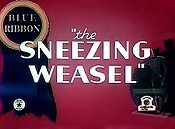
The Sneezing Weasel
The Sneezing Weasel is a 1938 Merrie Melodies theatrical cartoon from A Vitaphone Production, directed by Tex Avery, released on March 12, 1938.
- Studio
- A Vitaphone Production
- Distributor
- Warner Bros.
Synopsis
Willie the Weasel sets his hungry eyes on a group of young chicks while the mother hen is away. When he enters the chicken coop, the chicks fight back with a military-style defense that sets the weasel spinning.
Characters
Willie the Weasel, Chicks
Credits
Directing
- Director
- Tex Avery
Producing
- Producer
- Leon Schlesinger
Writing
- Writer
- Cal Howard
Voices
- Voice
- Fred 'Tex' Avery (Willie), Bernice Hansen
Music
- Music
- Carl W. Stalling
Animation
- Animator
- Sid Sutherland
Production notes
Tex Avery's first appearances as a voice actor.
There's a reference to "Gone With the Wind."
Remade in 1943 as "Flop Goes The Weasel."
In September of 1943, beginning with A Feud There Was, Warner Bros. began re-releasing select color cartoons in their Blue Ribbon program. Typically the Blue Ribbon reissues received new opening sequences with Blue Ribbon title cards and standardized music. Cartoon production credits were also removed. Between ten and fifteen cartoons were released in any given year, with cartoons coming from as far back as 1935. The reissues continued until the close of the studio in the 1960's.
All Blue Ribbon cartoons were released as "Merrie Melodie" cartoons regardless of the original series. The first "Looney Tunes" short to be included in the Blue Ribbon series was The Hep Cat, which was added in 1949. The only current prints of many of these cartoons are the Blue Ribbon releases, although restoration of these cartoons with original elements and titles is always ongoing.
Pictures


Reviews
The Sneezing Weasel
The Sneezing Weasel is an early Tex Avery effort which, while it is timed rather sluggishly like a fair amout of his other efforts at Warners, still affords us a forward glimpse of stylistic elements familiar from his later Warners and MGM cartoons. The character of Willie the Weasel is voiced by Tex himself, with his familar guffaw in tow. When Willie backs the sick chick up into the corner, he says "Now I've got you behind the eight ball", and that literally is what we see, just as we would in Symphony in Slang for MGM. Willie's sneezing sets up a string of cause and effect gags, and later when Willie is lying unconcious in bed the sick chick revives him with smelling salts only to knock him out deeper into his coma.
This is far from being the funniest cartoon Avery made at Warners, and it is clearly no comparison to its remake, Chuck Jones' Flop Goes the Weasel. By the time Jones' remake was made, the Termite Terrace style was in full bloom in terms of comic timing, character modelling, swish animation, sound effects and side-splitting gags. Flop Goes the Weasel is one of funniest cartoons Chuck Jones made in the 1940s, and there's no way such a primitive Avery title could compete with that. But for those who are interested in Tex' work as a whole, The Sneezing Weasel is interesting as an early vehicle where a lot of the basic elements of his style are seen to come together and cooperate in a typical and successful way.