
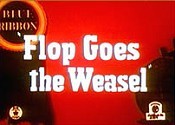
Flop Goes The Weasel
Flop Goes The Weasel is a 1943 Merrie Melodies theatrical cartoon from Leon Schlesinger Studios, directed by Chuck Jones, released on March 20, 1943.
- Studio
- Leon Schlesinger Studios
- Distributor
- Warner Bros.
Synopsis
A weasel tries to convince a baby chick that he is his mother. But the chick figures this out and clobbers him instead.
Characters
Chickens, Chick, Weasel, Mammy
Credits
Directing
- Director
- Chuck Jones (as Charles M. Jones)
Producing
- Producer
- Leon Schlesinger
Writing
- Writer
- Tedd Pierce
Voices
- Voice
- Mel Blanc (Weasel, Chick), Ruby Dandridge (Mammy), Lillian Randolph
Music
- Music
- Carl W. Stalling
Animation
- Animator
- Ken Harris
- Layout, uncredited
- John McGrew
- Animators, uncredited
- Robert Cannon, Ben Washam, Lloyd Vaughan
Art Department
- Backgrounds, uncredited
- Bernyce Polifka
Production notes
A remake of Fred 'Tex' Avery's "The Sneezing Weasel."
In September of 1943, beginning with A Feud There Was, Warner Bros. began re-releasing select color cartoons in their Blue Ribbon program. Typically the Blue Ribbon reissues received new opening sequences with Blue Ribbon title cards and standardized music. Cartoon production credits were also removed. Between ten and fifteen cartoons were released in any given year, with cartoons coming from as far back as 1935. The reissues continued until the close of the studio in the 1960's.
All Blue Ribbon cartoons were released as "Merrie Melodie" cartoons regardless of the original series. The first "Looney Tunes" short to be included in the Blue Ribbon series was The Hep Cat, which was added in 1949. The only current prints of many of these cartoons are the Blue Ribbon releases, although restoration of these cartoons with original elements and titles is always ongoing.
Pictures


Reviews
Flop Goes The Weasel
Fascinating to view....if you can get a hold of it (it's suppressed, due to concerns over racism).
A film that really shows the emerging style of Jones & what made him so unique as a director: his mastery of facial expression (on the weasel, whom I somehow sympathized with--foreshadowing of the Coyote, perhaps?) and also Jones' feel for stylized & abstract compositions really propelling the film along. The little black chick would leave his legacy with the mature version of Tweety; and the mammy hen's vocal number at the start of the flim is a nice touch.
Elsewhere: Wikipedia