
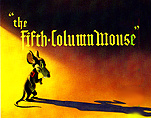
The Fifth-Column Mouse
Also known as: Fifth Column Mouse
- Studio
- Leon Schlesinger Studios
- Distributor
- Warner Bros.
Synopsis
In the kitchen, a trio of mice are singing "Ain't We Got Fun" and floating on a bar of soap in the sink. A "friendly" cat bursts in and starts attacking the mice. He corners one of them and offers him a bribe of cheese to let him join the mouse pack.
The cat tells the mouse that he can have all the cheese he wants if he will convince the other mice to be the cat's slaves. Unfortunately, the mouse accepts and puts his friends in danger. The cat uses trickery to catch and enslave the mice (he convinces them to serve him and he won't eat them).
The cat is waited on hand and foot by the mice. When he announces that he wants a "nice, fat, tender mouse" for dinner, they realize that they've been betrayed. Instead of panicking, the brave mice, to the song "We Did It Before (And We Can Do It Again)," organize an army to fight the cat.
The mouse army prepares for battle and comes up with an attack plan. The mice build a marvelous robot mechanical bulldog with extending chomping teeth. The robotic bulldog chases the cat. The mice then shave him with an electric razor, leaving only a dot-dot-dot-dash pattern, which stands for the letter V (signifying victory) in Morse code. The cat runs away and the mice win!
Characters
Fifth-Column Mouse, Three Mice, Cat
Credits
Directing
- Director
- Isadore Freleng (as I. Freleng)
Producing
- Producer
- Leon Schlesinger
Writing
- Writer
- Michael Maltese
Voices
- Voice
- Mel Blanc, The Sportsmen (Mice)
Music
- Music
- Carl W. Stalling
Animation
- Animator
- Ken Champin, Gerry Chiniquy, Manuel Perez
Production notes
The dot-dot-dot-dash that the mouse shaves into the cat is Morse code for a "V for Victory".
The cat is portrayed with stereotypical derogatory Japanese features in a non-PC scene with a mouse giving the Nazi salute. The cat is also briefly caricatured as Hitler, thanks to the condensation on the window as he looks in at the mice.
Note that the Blue Ribbon reissue drops the word "The" from the title, as well as the hyphen between "Fifth" and "Column," to read "Fifth Column Mouse."
In September of 1943, beginning with A Feud There Was, Warner Bros. began re-releasing select color cartoons in their Blue Ribbon program. Typically the Blue Ribbon reissues received new opening sequences with Blue Ribbon title cards and standardized music. Cartoon production credits were also removed. Between ten and fifteen cartoons were released in any given year, with cartoons coming from as far back as 1935. The reissues continued until the close of the studio in the 1960's.
All Blue Ribbon cartoons were released as "Merrie Melodie" cartoons regardless of the original series. The first "Looney Tunes" short to be included in the Blue Ribbon series was The Hep Cat, which was added in 1949. The only current prints of many of these cartoons are the Blue Ribbon releases, although restoration of these cartoons with original elements and titles is always ongoing.
Songs include: "Ain't We Got Fun?" (Ray Egan), The Mice; "We Did It Before (And We Can Do It Again)" (Charlie Tobias-Cliff Friend), Chorus of House Mice.
Pictures


Reviews
Fifth-column mouse
Probably the best, most entertaining war related, "propaganda" cartoon of all time. First viewed in the late 1950s, when I was a budding film fan; reviewed again last month (on an old VHS tape purchased years back) to find not of the magic had been lost. This should have achieved cult status by now, or at least been restored & reissued on DVD.
The Fifth-Column Mouse
For some reason in Looney Tunes, black cats really DO mean bad luck. For the cats, that is. Whether chasing birds, mice, or even worms, black cats (especially Sylvester) can't seem to catch a break. The cat in this cartoon almost did, however. At one point, he had a whole bunch of mice serving him. But, then it all collasped, thanks to a dog machine. This cartoon was based on WWII. As a kid, I watched this with my grandpa, who fought in WWII. As we watched the cartoon, he told me what everything represented. My favorite part was watching the mice army prepare their dog machine.
Fifth-Column Mouse
Superficially, it's a typical cat and mouse cartoon. Actually, it is an extended metaphor (or analogy) of the events leading up to World War II. A certifiable masterpiece by Freleng.