
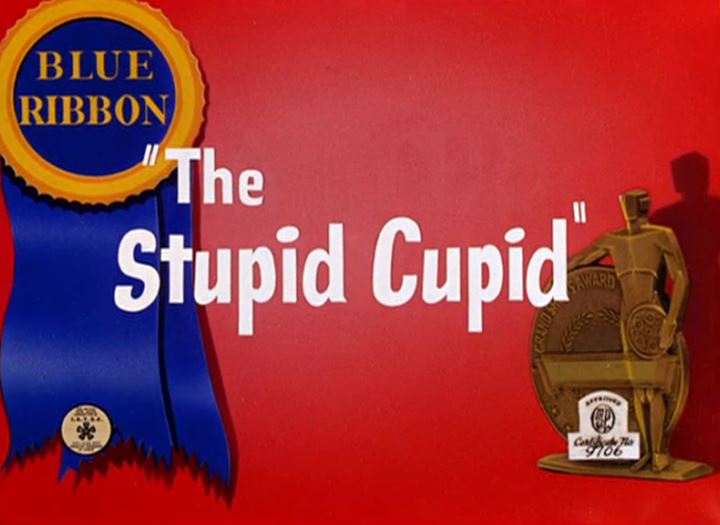
The Stupid Cupid
The Stupid Cupid is a 1944 Looney Tunes theatrical cartoon from Warner Bros. Cartoons, Inc., directed by Frank Tashlin, released on November 25, 1944.
- Studio
- Warner Bros. Cartoons, Inc.
- Distributor
- Warner Bros.
Synopsis
Elmer Fudd as Cupid can't seem to get it right, so he tortures Daffy Duck in return.
Characters
Daffy Duck, Elmer Fudd, Rooster, Dog, Cat, Bluebird, Emily
Credits
Directing
- Director
- Frank Tashlin
Producing
- Producer
- Edward Selzer
Writing
- Writer
- Warren Foster
Voices
- Voice
- Mel Blanc (Daffy Duck, Elmer Fudd, Dog, Cat, Bluebird, Rooster, Emily)
Music
- Music
- Carl W. Stalling
Animation
- Animator
- I. Ellis
- Animators, uncredited
- Cal Dalton, Art Davis
Production notes
Scene deleted from current version: after being shot with Cupid's arrow and falling in love with a dog, the cat shoots itself in the head nine times.
This cartoon is known for having many abrupt jumps and an ending without a real punch line. There are three scenes (two in the Cartoon Network's version) which end with a heart-shaped, pink-colored "iris out." The end, however, has a very abrupt fadeout while Daffy is kissing the hen. According to Greg Ford, the original ending involved Daffy telling the rooster "If you haven't tried it, don't knock it." Theories have been formulated that this cartoon may have had a special closing given the theme of the story, but unless an original print (non-Blue Ribbon) is discovered, we may never know for sure.
In September of 1943, beginning with A Feud There Was, Warner Bros. began re-releasing select color cartoons in their Blue Ribbon program. Typically the Blue Ribbon reissues received new opening sequences with Blue Ribbon title cards and standardized music. Cartoon production credits were also removed. Between ten and fifteen cartoons were released in any given year, with cartoons coming from as far back as 1935. The reissues continued until the close of the studio in the 1960's.
All Blue Ribbon cartoons were released as "Merrie Melodie" cartoons regardless of the original series. The first "Looney Tunes" short to be included in the Blue Ribbon series was The Hep Cat, which was added in 1949. The only current prints of many of these cartoons are the Blue Ribbon releases, although restoration of these cartoons with original elements and titles is always ongoing.
Pictures




Reviews
The Stupid Cupid
This cartoon starts off great. But, there are two places where it looks as though someone spliced out something (badly) so the whole thing seems incomplete.
Elsewhere: Wikipedia