
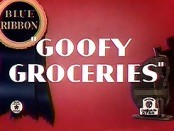
Goofy Groceries
Goofy Groceries is a 1941 Merrie Melodies theatrical cartoon from Leon Schlesinger Studios, directed by Robert Clampett, released on March 29, 1941.
- Studio
- Leon Schlesinger Studios
- Distributor
- Warner Bros.
Synopsis
It's wintertime inside an old-fashioned grocery store. When the lights go out, many well-known (at that time) brand names and products found in a grocery store come to life to put on various song, dance and comedy acts. We get to see a Jack Benny bunny, the Carnation cows, and sardines who perform a takeoff on Busby Berkeley's most famous routine from the movie musical "Footlight Parade"- "By a Waterfall." All is going well until a gorilla breaks out of the animal crackers and wreaks havoc. Is Jack "bunny" enough to save everyone in the store? Don't worry – there's a surprise ending that never happened in "King Kong."
Characters
Grocery Products, Labels, Jack Bunny, Rochester, Gorilla, Crab, Chicken Pie, Dog, Little Black Boy, Superman, Cows, Can-Can Dancers, Gorilla's Mother, Cow
Credits
Directing
- Director
- Robert Clampett
Producing
- Producer
- Leon Schlesinger
Writing
- Writer
- Melvin Millar
Voices
- Voice
- Mel Blanc (Jack Bunny, Rochester, Gorilla, Crab, Chicken Pie, Dog, Little Black Boy, Superman, Voice yelling "Help" in the dark), Bea Benaderet (Cows, Can-Can Dancers, Gorilla's Mother), Elvia Allman (Cow, Can-Can Dancers), Jack Lescoulie (Jack Bunny), Kent Rogers
Music
- Music
- Carl W. Stalling
Animation
- Animator
- Vive Risto
- Animator, uncredited
- Rod Scribner, Izzy Ellis, John Carey
Editing
- Editor
- Treg Brown (uncredited)
Production notes
This was the first color short directed by Robert Clampett, who had supervised a Technicolor sequence opening the 1937 feature film "When's Your Birthday?".
The version currently airing on Cartoon Network is nearly 9 minutes long.
An obvious parody of Superman, Super Guy appears six months before Superman's animated debut in the Fleischer Studios cartoon "Superman."
There are also caricatures of Eddie "Rochester" Anderson, Jack Benny, Ned Sparks and even the Carnation brand.
The final Eddie Anderson gag and a sequence depicting African-American children are frequently cut for television showings.
The gorilla's wife calls him home in a parody of "Henry Aldrich," a then-popular radio show.
In September of 1943, beginning with A Feud There Was, Warner Bros. began re-releasing select color cartoons in their Blue Ribbon program. Typically the Blue Ribbon reissues received new opening sequences with Blue Ribbon title cards and standardized music. Cartoon production credits were also removed. Between ten and fifteen cartoons were released in any given year, with cartoons coming from as far back as 1935. The reissues continued until the close of the studio in the 1960's.
All Blue Ribbon cartoons were released as "Merrie Melodie" cartoons regardless of the original series. The first "Looney Tunes" short to be included in the Blue Ribbon series was The Hep Cat, which was added in 1949. The only current prints of many of these cartoons are the Blue Ribbon releases, although restoration of these cartoons with original elements and titles is always ongoing.
The closing scene in which Jack Bunny is left in blackface after a lit stick of dynamite explodes on him has been edited out when broadcast on Cartoon Network. A local TV station in San Francisco has also edited the scene. However, KOFY reduced the speed of the "That's All Folks" end card so that the viewers can hear Jack Bunny say "My oh my, tattletale grey!"
Pictures


Elsewhere: Wikipedia