

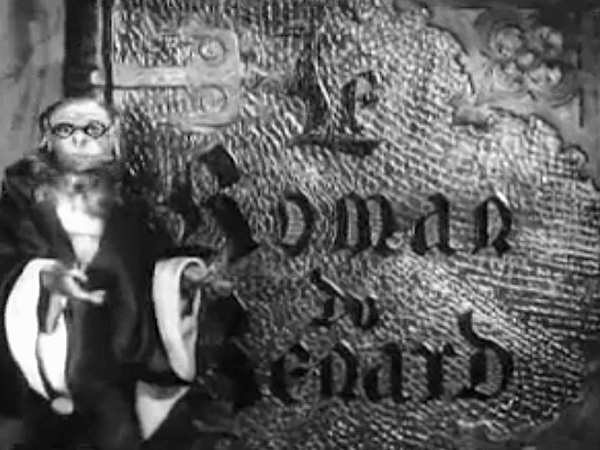
Le Roman De Renard
Le Roman De Renard is a 1937 Ladislaw Starewicz Studio animated feature film from Ladislaw Starewicz Production, directed by Ladislaw Starewicz and Irène Starewicz, released on April 10, 1937.
English title: The Story Of The Fox
Foreign title: Reinicke Fuchs (German)
- Studio
- Ladislaw Starewicz Production
Synopsis
At the court of Noble the Lion, many complaints accumulate against Renard the Fox. There isn't an animal who hasn't suffered from Renard. Noble decrees peace between his subjects, which enables Renard to do his tricks once more.
Renard is imprisoned. After a harsh trial and notwithstanding the pleas of skilled lawyers, he is condemned to hanging.
But Renard asked to be introduced to the Lion, to whom he relates an extraordinary story of treasure and of conspiracy, one worth saving his life.
Naturally, the treasure can't be found, and a furious Noble the Lion orders the siege of Malpertuis, the Fox's castle. All the machines of war are put in action, but Renard frustrates this strategy. Noble, understanding that the rebel is the most astute of his subjects, crowns him and makes him his minister.
Characters
Fox, Monkey, Lion, Wolf, Bear, Cock, Badger, Cat, Donkey, Rabbit, Fox Cub
Credits
Directing
- Director
- Ladislaw Starewicz, Irène Starewicz
Producing
- Producer
- Louis Nalpas, Roger Richebé
Writing
- Writer
- Ladislaw Starewicz, Irène Starewicz, Jean Nohain, Antoinette Nordmann, Roger Richebé
- Based on the Story By
- Johann Wolfgang von Goethe
Voices
- Voice
- Romain Bouquet (Fox), Claude Dauphin (Monkey), Laine (Lion), Sylvain Itkine (Wolf), Léon Larive (Bear), Robert Seller (Cock), Debray (Badger), Nicolas Amato (Cat), Jaime Plama (Cat, singing), Pons (Donkey), Sylvia Bataille (Rabbit), Suzy Dornac (Fox Cub)
Music
- Music
- Vincent Scotto
Animation
- Animator
- Ladislaw Starewicz, Irène Starewicz
Art Department
- Art Direction
- Ladislaw Starewicz
Camera
- Photography
- Ladislaw Starewicz
Editing
- Editor
- Laura Sejourné
Production notes
The first animated feature film made in France, and the third animated feature film with sound worldwide.
Marionette animation.
Production in Paris lasted from 1929 to 1931. The film was not released until 1937 in Berlin in 1937 and in 1941 to France. Because of this delay in release, Quirino Cristiani's Peludópolis (1931) and Novyy Gullivyer (The New Gulliver) (1935) from the Soviet Union released before this one publicly, making it the third sound animated feature.
Ladislaw Starewicz (1892-1965)- (also spelled Ladislas Starevitch, Ladislas Starewitch, or Wladyslaw Starewicz)- was an innovative independent stop-motion puppet animator who worked in Russia and France during a 40-year career which began in 1908 in North-Eastern Poland (modern Lithuania).
Born Władysław Starewicz in Moscow, Russia, he was raised by his grandmother on the Baltic coast. As the director of a natural history museum in Kaunas, Lithuania, he wanted to document the battle of two stag beetles. Inspired by a viewing of Les Allumettes Animées [Animated Matches] (1908) by Emile Cohl, Starewicz developed his own stop-motion animation style with the short film Walka Żuków, and the first animated film in Poland or Russia.
In 1911, Starewicz moved to Moscow and began work with the film company of Aleksandr Khanzhonkov. There he made two dozen films, most of them puppet animations using dead animals as puppets. Strekoza I Muravei [The Grasshopper and the Ant] (1911) got Starewicz decorated by the czar. The best-known film of this period, perhaps of his entire career, was Miest Kinooperatora Operatora (The Cameraman's Revenge) (1912), a dark and cynical look at infidelity and jealousy among the insects.
Like most of the Russian film community at the time, Starewicz sided with the White Army. After the October Revolution of 1917, he was forced to flee from Moscow to Yalta on the Black Sea. After a brief stay, Starewicz and his family fled before the Red Army could capture the Crimea, stopping in Italy for a while before joining the Russian émigrés in Paris. There, Władysław Starewicz officially changed his name to Ladislas Starevich, finding it easier to pronounce in French.
In Paris, the Russian refugees formed a company in the remains of Georges Méliès' old studio. He made one animated film for this studio, l'Épouvantail [The Scarecrow] (1921), before the operation was closed down. Most of the Russians went on to film studios in Berlin or Hollywood. Wishing to remain independent and enjoying his new country, Starevich moved to Fontenay-sous-Bois and started on a series of self-produced puppet films that would keep him busy for the rest of his life. In these films he was assisted first by his wife France Starevich and later by his daughter Irina (who had changed her name to Irène). During the years at Fontenay-sous-Bois, the Stareviches made two dozen films. Among the most notable are La Voix du Rossignol [The Voice of the Nightingale] (1923), a hand-tinted film (some sources say Prizmacolor) and Fétiche Mascotte [The Mascot or The Devil's Ball] (1933), a long and strange story about a loving dog puppet who practically goes through Hell to get an orange to a girl dying of scurvy. He is also noted for making France's first (and the world's third) animated-length feature with sound, Le Roman De Renard [The Story Of The Fox] (1937).
Ladislas Starevich died at his home on February 26 1965. He was in the middle of production on Comme Chien et Chat (Like Dog and Cat), which remains unfinished.
Pictures

Elsewhere: Wikipedia