
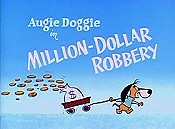
Million-Dollar Robbery
Million-Dollar Robbery is an episode of Augie Doggie and Doggie Daddy (season 1), directed by William Hanna and Joseph Barbera, first aired on Syndication on December 1, 1959.
- Studio
- Hanna-Barbera Studios
- Distributor
- Columbia/Screen Gems
Synopsis
Doggie Daddy is complaining about the bills and he says that he'd have to rob a bank to pay them, and Augie takes him literally.
Characters
Augie Doggie, Doggie Daddy, Bank Guard, Blink Guards, Bank Robber
Credits
Directing
- Director
- William Hanna, Joseph Barbera
Producing
- Producer
- William Hanna, Joseph Barbera
Writing
- Writer
- Michael Maltese
Voices
- Voice
- Daws Butler (Augie Doggie, Bank Guard, Teller), Doug Young (Doggie Daddy, Newscaster, Blink Guards, Bank Robber)
Music
- Music
- John Seely
Animation
- Animator
- Dick Lundy
- Layouts
- Ed Benedict, Story Sketches
Art Department
- Backgrounds
- F. (Fernando) Montealegre
Production Management
- Production Supervision
- Howard Hanson
Crew
- Titles
- Lawrence Goble
Production notes
The Quick Draw McGraw Show was the third cartoon television production created by Hanna-Barbera following their success with The Ruff and Reddy Show and The Huckleberry Hound Show. The show debuted in syndication in the fall of 1959, and was sponsored by Kellogg's Foods. The series was in production for three years, with 45 episodes produced for syndication. The series was re-run on CBS's Saturday morning from 1963-66.
This component of the show featured a pair of father and son dogs who were representative of the motherless family programs that were in abundance on TV. Augie Doggie and his pop, Doggie Daddy, were inseparable. Augie adored his father and hung on his every word, even when it was obvious that his "dear old Dad" was in over his head.
This component of the show featured a pair of father and son dogs who were representative of the motherless family programs that were in abundance on TV. Augie Doggie and his pop, Doggie Daddy, were inseparable. Augie adored his father and hung on his every word, even when it was obvious that his "dear old Dad" was in over his head.
