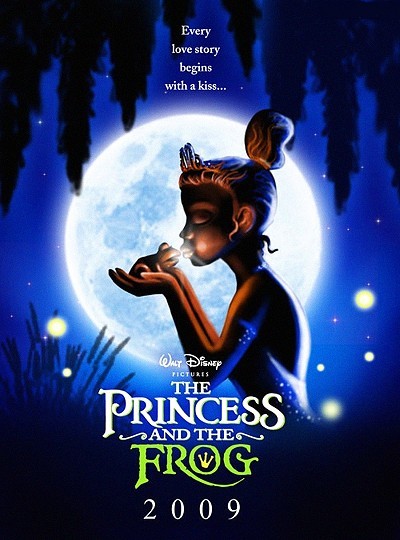
The Princess And The Frog
Also known as: The Frog Princess (Working Title)
Foreign titles: Tiana Y El Sapo (Spanish), A Princesa Y O Sapo (Spanish)
- Studio
- Walt Disney Feature Animation, Walt Disney Pictures
- Animation studio
- Walt Disney Animation Studios
- Distributor
- Walt Disney Studios Motion Pictures
Synopsis
A musical set in the legendary birthplace of jazz- New Orleans- "The Princess and the Frog" introduces the newest Disney princess, Tiana, a young African-American girl living amid the charming elegance and grandeur of the fabled French Quarter. From the heart of Louisiana's mystical bayous and the banks of the mighty Mississippi comes a tale of love, enchantment and discovery with a soulful singing crocodile, voodoo spells and Cajun charm at every turn.
Characters
Princess Tiana, Young Tiana, Charlotte La Bouff, Young Charlotte, Prince Naveen, Dr. Facilier, Eli "Big Daddy" La Bouff, Eudora, Louis, Ray, Lawrence, Mama Odie, James, Reggie, Darnell, Two Fingers, Mr. Henry Fenner, Mr. Harvey Fenner, Buford, Marlon the Gator, Ian the Gator, Cousin Randy, Georgia
Credits
Directing
- Director
- Ron Clements, John Musker
Producing
- Producer
- Peter Del Vecho
- Executive Producer
- John Lasseter
- Associate Producers
- Paul D. Lanum, Craig Sost
Writing
- Writer
- Ron Clements, John Musker, Rob Edwards
- Story
- Paul Briggs, Randy Cartwright, Tom Ellery, Kevin Gollaher, Bruce Morris, Wilbert Plijnaar, Toby Shelton, Josie Trinidad
- Original Story By
- Ron Clements, John Musker, Greg Erb, Jason Oremland
- Based On The Story By
- Jacob Grimm, Wilhelm Grimm (Jacob Grimm, Wilhelm Grimm)
Voices
- Voice
- Anika Noni Rose (Princess Tiana), Elizabeth M. Dampier (Young Tiana), Jennifer Cody (Charlotte La Bouff), Breanna Brooks (Young Charlotte), Bruno Campos (Prince Naveen), Keith David (Dr. Facilier), John Goodman (Eli "Big Daddy" La Bouff), Oprah Winfrey (Eudora), Michael-Leon Wooley (Louis), Jim Cummings (Ray), Peter Bartlett (Lawrence), Jenifer Lewis (Mama Odie), Terrence Howard (James), Ritchie Montgomery (Reggie), Don Hall (Darnell), Paul Briggs (Two Fingers), Jerry Kernion (Mr. Henry Fenner), Corey Burton (Mr. Harvey Fenner), Michael Colyar (Buford), Emeril Lagasse (Marlon the Gator), Kevin Michael Richardson (Ian the Gator), Randy Newman (Cousin Randy), Danielle Moné Truitt (Georgia), Jeff Draheim, Rob Edwards, Kelly Hoover, Jennifer Kilger, Allison Norman, Lynwood Robinson, Lorry Ann Shea, Bruce W. Smith, Marlon West, Joe Whyte, Seth R. Williamson, Shanda M. Williamson, Shane R. Williamson
Music
- Music
- Randy Newman
- Songs
- Randy Newman
Animation
- Supervising Animators
- Mark Henn (Tiana), Randy Haycock (Prince Naveen), Nik Ranieri (Charlotte), Bruce W. Smith (Dr. Facilier), Ruben Aquino (as Ruben A. Aquino) (Eudora And James), Duncan Marjoribanks (Big Daddy La Bouf), Anthony de Rosa (Lawrence), Eric Goldberg (Louis), Michael Surrey (Ray), Andreas Deja (Mama Odie)
- Animator
- Dale Baer, Sandro Cleuzo, Brian Ferguson, Danny Galieote, T. Daniel Hofstedt, James Lopez, Joe Oh, Frans Vischer, Eric Walls, Andreas Wessel-Therhorn, Matt Williames, Bert Klein (Louis), Hyun Min Lee (Louis), Randy Cartwright (Frogs)
- Scene Planners
- Thomas Baker, Mark Henley
- Key Assistant Animator
- James A. Harris
- Layout Supervisor
- Rasoul Azadani
- Layout Artists
- Jon Krummel, Robert J. St. Pierre
- Rough Inbetweeners
- Todd Jacobsen, Joe Pitt
- Clean-Up Animation Supervisor
- Vera Pacheco
- Key Clean-Up Artists
- Trevor Tamboline, Marshall Lee Toomey
- Clean-Up Artists
- Nicola Courtney, Ana Paula Corbellini Indalencio, Sandy Kellerman, Paul Mota, Vittoria Quane
- Clean-Up Inbetween Artists
- Boris Maras, Lon Smart, Amanda Zima
- Technical Director
- Eric Daniels
Art Department
- Production Designer
- James Finch
- Art Director
- Ian Gooding
- Head Of Story
- Don Hall
- Character Designer
- Rick Maki
- Visual Development Artist
- Craig Elliott
- Color Stylist
- Heidi Friese
- Story Artists
- Paul Briggs, Randy Cartwright, Tom Ellery, Kevin Gollaher, Bruce Morris, Wilbert Plijnaar, Toby Shelton, Josie Trinidad
- Background Supervisor
- Sunny Apinchapong
- Ink And Paint Artists
- Ron Cohee, David Karp, Priscila Vertamatti
Editing
- Editor
- Jeff Draheim
Music Department
- Music Contractor
- Peter Rotter
Casting
- Casting Manager
- Curtis A. Koller
Production Management
- Production Manager
- Monica Lago-Kaytis
Crew
- Assistant to Producer
- Shanda M. Williamson
Production notes
Release date reflects film's broad premiere; the film premiered in limited release on December 11, 2009.
Disney's first film with an African-American princess.
This film marks Disney's return to the 2-D, hand-drawn method of animation. Disney's Michael Eisner shut down the hand-drawn unit in 2004 with the production of Home On The Range, believing instead that 3D computer animation was Disney's future. He has since been proved wrong.
Ron Clements and John Musker, directors who kicked off the Disney Renaissance in twenty years previous with The Little Mermaid (1989), return to Disney to direct The Princess and the Frog. Not only does this film kick off a new Disney revival, but it proves the end of the Eisner "All films will be digital 3D computer generated" decree. Many people champion the fact that The Princess and the Frog is notable for featuring the first African-American Disney Princess, Tiana. And that is true enough. But the Disney return to hand animation (in 2 or 3 D!), the return to musicals, and the return to well-known fairy tales are the real story here.
With the ouster of Michael Eisner in 2006, incoming Ed Catmull and John Lasseter, the new president and chief creative officer of Disney Animation Studios, immediately reversed this decision and brought back hand-drawn animation at the studio. Lasseter began the long process of luring back all the talent Eisner had either been laid off or had left the studio when Eisner closed the traditional animation units in 2003. In Lasseter's efforts to rebuild the legacy of hand-drawn animation, he brought back Disney Renaissance directors Ron Clements and John Musker and gave them almost free reign over their next project.
When announced as The Frog Princess in July 2006, it drew criticism from many quarters. African-American critics disapproved of the name for the heroine (Maddy), the setting, her occupation as a chambermaid, and many other factors. French people found the title a slur on their nationality. All of these critiques were addressed by Disney in some manner or fashion.
Clements and Musker kept at work on the project, aiming for a classic Disney look. The pair looked to Lady and the Tramp as the quintessential Disney film. Returning to the Disney roots seemed to be the watchwords on this production, with animator Andreas Deja focusing on what 2D is good at- the quality of a line. Speaking on what Disney perfected in the 1950's, Deja said, "All those things that were non-graphic, which means go easy on the straight lines and have one volume flow into the other – an organic feel to the drawing."
Reportedly, Alan Menken was the automatic choice of writers Ron Clements and John Musker as composer (they had all worked together on "The Little Mermaid"), but Disney chief creative officer John Lasseter insisted on Newman because of the New Orleans setting. Composer Randy Newman was born in Los Angeles and moved with his family to New Orleans, where his mother's family lived. He lived there as a small child and summered there until he was 11. His 1974 song "Louisiana 1927" (and Aaron Neville's cover version) gained much radio airplay in the aftermath of Hurricane Katrina.
Because the CAPS system was now so outdated, Disney brought in a new animation and coloring system called Toon Boom Harmony. To test the new system, the animators knocked out a quick Goofy short called How to Hook Up Your Home Theater. The WACOM digitizers were not easy for the animators to use, so it was decided to return to pencil and paper for animation.
The 2009 film had a final budget of 105 million. The film grossed over 265 million in release, so it was a substantial hit for Disney, and a fine way to kick off the new Disney revival.
The character of Princess Tiana was originally named Maddy, but changed when the name was deemed to reinforce negative stereotypes.
This was the 49th film in the official Disney list of animated films.
Awards
Academy Award Nominee, Best Animated Feature, 2010.
Academy Award Nominee, Best Original Song: "Almost There" (Music and Lyric by Randy Newman), 2010.
Academy Award Nominee, Best Original Song: "Down in New Orleans" (Music and Lyric by Randy Newman), 2010.
Nominee, Annie Award, Best Animated Feature, 2010.
Nominee, Annie Award, Animated Effects, James Mansfield, 2010.
Nominee, Annie Award, Character Animation in a Feature Production, Andreas Deja, 2010.
Nominee, Annie Award, Character Animation in a Feature Production, Eric Goldberg, 2010.
Nominee, Annie Award, Character Animation in a Feature Production, Bruce Smith, 2010.
Nominee, Annie Award, Production Design in a Feature Production, Ian Gooding, 2010.
Nominee, Annie Award, Voice Acting in a Feature Production, Jen Cody, Voice of Charlotte, 2010.
Nominee, Annie Award, Voice Acting in a Feature Production, Jenifer Lewis, Voice of Mama Odie, 2010