
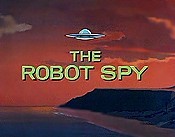
The Robot Spy
The Robot Spy is an episode of Jonny Quest, directed by William Hanna and Joseph Barbera, first aired on ABC on November 6, 1964.
- Studio
- Hanna-Barbera Studios
- Distributor
- Columbia/Screen Gems
Synopsis
At a military base, where Dr. Quest is perfecting his para-power gun, a strange craft lands nearby, carrying an inert black sphere, which they take back to the lab for a further look. Unbeknownst to them, the sphere is a spy sent by Dr. Zin.
Characters
Roger T. "Race" Bannon, Radar Man, Jonny Quest, Dr. Benton C. Quest, Bandit, Pilot Red 1, Jones, Hadji, Dr. Zin, Officer, Gate Guard, Zin's Servant, Soldier Guarding Robot Spy, Sergeant
Credits
Directing
- Director
- William Hanna, Joseph Barbera
Producing
- Producer
- William Hanna, Joseph Barbera
Writing
- Writer
- William D. Hamilton
- Based On An Idea By
- Doug Wildey
- Story Direction
- Dan Gordon
- Story Supervision
- Arthur Pierson
Voices
- Voice
- Mike Road (Roger T. "Race" Bannon, Radar Man), Tim Matheson (as Tim Matthieson) (Jonny Quest), Don Messick (Dr. Benton C. Quest, Bandit, Pilot Red 1, Jones), Danny Bravo (Hadji), Vic Perrin (Dr. Zin), Doug Young (Officer, Gate Guard, Zin's Servant, Soldier Guarding Robot Spy, Sergeant), Tol Avery, Daws Butler, Henry Corden, Sam Edwards, Will Kuluva, Cathy Lewis, Keye Luke, Marvin Miller, Pat O'Malley, Nestor Paiva, Everett Sloane, John Stephenson, Janet Waldo, Jesse White, Sandy Wormser
Music
- Music
- Hoyt Curtin (Music Director)
Animation
- Animator
- Harvey Toombs, Don Patterson, Jack Ozark, Chuck Harriton, Anatole Kirsanoff
- Layouts
- Bill Perez, Tony Sgroi, Z.T. Jablecki, C.L. Hartman, Earl Martin, Jim Tutwiler
- Animation Direction
- Charles Nichols (as Charles A. Nichols)
Art Department
- Character Design
- Alex Toth
- Backgrounds
- F. Montealegre, Harvard Pennington, Robert Gentle, Peter Van Elk, Leo Swenson
- Supervising Art Director
- Doug Wildey
- Ink And Paint Supervisor
- Roberta Greutert
Camera
Editing
- Editor
- Warner Leighton, Donald A. Douglas, Ken Spears, Ed Warschilka, Larry Cowan
- Supervising Film Editor
- Tony Milch
Sound
- Sound Direction
- Buddy Myers
Production Management
- Production Supervision
- Howard Hanson
Crew
- Technical Supervisor
- Frank Paiker
- Continuity
- Marceil Ferguson, Evelyn Sherwood, Annie Lee Holm, Jane Phillippi, Joyce Gard, Woody Chatwood, Jan Gusdavidson, Myke Nelson, Elizabeth MacGowan, Christine Decker, Natalie Yates, Joan Orbison, Ted C. Bemiller
Companies and other credits
- © MCMLXIV Hanna-Barbera Productions
- Inc
- A
- HANNA-BARBERA
- PRODUCTION
- Thanks to the ClassicJQ site for updated (and correct!) credits!
Production notes
Originally sponsored by The Big G Cereals of General Mills.
Repeated on ABC May 6, 1965.
Jonny Quest is one of the longest running Saturday morning cartoon shows of all time, alongside such mainstays as Scooby-Doo and Fat Albert. Unlike Scoob and Al, however, only a mere 26 episodes were produced of the original Jonny Quest.
The show was an adventure series about pre-teen Jonny Quest, who, along with mystical Indian friend Hadji, pet dog Bandit, Jonny's super-scientist father Dr. Benton Quest, and government intelligence agent/bodyguard/pilot Race Bannon, investigated strange goings-on all over the world. Episodes of Jonny Quest blended mystery, adventure, action, intrigue, scientific marvels, and humor as the group traveled everywhere from the Sargasso Sea to equatorial Africa.
Jonny Quest originally ran in primetime on ABC during the 1964-65 season, but much like Hanna-Barbera predecessor The Jetsons, the program didn't find success until it moved to Saturday morning. When it hit, it hit big. Jonny Quest ran on CBS from 1967-1970, then back to ABC through 1972. In 1978, the program became part of The Godzilla Power Hour, and in 1979, Jonny Quest moved to NBC, where it stayed until 1981. All that milage on twenty-six original episodes- pretty impressive.
Hanna-Barbera rebooted the character in 1986 in The New Jonny Quest, a segment on The Funtastic World of Hanna-Barbera. This lasted thirteen episodes.
In 1996, the Turner Company released an updated, all-new series entitled Jonny Quest: The Real Adventures. This new series featured an additional character in Jessie Bannon, the daughter of Race, and made extensive use of computer animation.
Working title: "Dr. Zin's Robot Spy."
Jonny Quest is one of the longest running Saturday morning cartoon shows of all time, alongside such mainstays as Scooby-Doo and Fat Albert. Unlike Scoob and Al, however, only a mere 26 episodes were produced of the original Jonny Quest.
The show was an adventure series about pre-teen Jonny Quest, who, along with mystical Indian friend Hadji, pet dog Bandit, Jonny's super-scientist father Dr. Benton Quest, and government intelligence agent/bodyguard/pilot Race Bannon, investigated strange goings-on all over the world. Episodes of Jonny Quest blended mystery, adventure, action, intrigue, scientific marvels, and humor as the group traveled everywhere from the Sargasso Sea to equatorial Africa.
Jonny Quest originally ran in primetime on ABC during the 1964-65 season, but much like Hanna-Barbera predecessor The Jetsons, the program didn't find success until it moved to Saturday morning. When it hit, it hit big. Jonny Quest ran on CBS from 1967-1970, then back to ABC through 1972. In 1978, the program became part of The Godzilla Power Hour, and in 1979, Jonny Quest moved to NBC, where it stayed until 1981. All that milage on twenty-six original episodes- pretty impressive.
Hanna-Barbera rebooted the character in 1986 in The New Jonny Quest, a segment on The Funtastic World of Hanna-Barbera. This lasted thirteen episodes.
In 1996, the Turner Company released an updated, all-new series entitled Jonny Quest: The Real Adventures. This new series featured an additional character in Jessie Bannon, the daughter of Race, and made extensive use of computer animation.
Reviews
The Robot Spy
This is the quintessential JG episode: minimalistic, stripped-down animation, a giant bug of an espionage ploy, and the best story involving the psychotically envious Dr. Zin, the JQ version of Professor Moriarty. The story is told for the most part with images and music--not much dialogue compared to the other episodes. The atmosphere of creeping dread is perfectly built until the final explosive minutes when the robot spy stilts out of the Quest compound, ignoring flamethrowers, bazooka fire, and a tank blockade.
The Robot Spy
recurring Fu Manchu-like villain Dr. Zin sends the title entity after the JQ gang. really entertaining. (a similar entity was in the otherwise forgettable movie 'The Explorers'. Recommended.
The Robot Spy
The Robot Spy episode has numerous examples of what, IMHO, makes the classic 1964 Jonny Quest series stand head and shoulders above other animation shows. This, for lack of any better term, I call "less is more". The show's writers and artists collaborated in the use of dialogue and scenes to create a world that feels much, much richer than it was drawn. Other shows have attempted to capture this feeling by drawing scenes so full of detail that they appear cluttered and, actually, more unrealistic. Jonny Quest takes the opposite approach, by letting the viewer's imagination fill in the scenes instead. Following are some examples from this episode that show what I mean:
- When Race hauls the robot spy back to the warehouse, we see the backs of Dr. Quest and a soldier watching as Race drives the sand truck into the building. Then Dr. Quest says, "Lower away!" and we imagine Race (now off-camera) complying and gently lowering the robot to the floor.
- When Dr. Quest is preparing the para-power ray gun for use against the escaping robot, he gives urgent commands: "Jonny, hook in the power line", "Race, turn on the generators" and "Hadji, you handle the hydraulic pressure". During all this, we see a brief scene of Jonny nodding his head as he gets his instructions, and then it's back to Dr. Quest at the console. But the feel of the scene is much more dramatic; we can imagine Jonny, Race, and Hadji moving quickly to accomplish their tasks.
- There are numerous scenes when the character speaking is "off camera", and we simply see others listening to the speaker. But the words carry the scene; we don't need to see the speaker to hear those words, and it sets the scene for the next speaker's words, which are often delivered by someone "on camera" listening to the first speaker.
- Also, there are a number of examples when we see the speaker from behind, and see the face of the listener. About the only motion is the speaker's head gently bobbing as he speaks. Much less complicated than drawing mouths that match the words being spoken, yet equally (if not more) effective!
- When Bandit spots a jackrabbit in the desert, we see the rabbit's nose wrinkling as he sniffs the air in Bandit's direction. The only reason this is even noticed at all is because almost everything else in the scene is absolutely still.
- the hair on Bandit's back is raised, making his outline appear slightly ragged.
- When Dr. Quest admonishes the boys to keep the noise down, the camera is focused on Jonny and Hadji. When the view shifts back to Race and Dr. Quest, we see the good doctor turning back toward the robot craft. In our minds, however, we see what happened before, Dr. Quest turning from the craft to speak to the boys. Subtle? Sure, but effective.
- After the para-power ray brings down the robot's escape craft, the camera cuts to a shot of Dr. Quest with his face buried in his hand. No words are spoken by the good doctor, but we certainly feel the intensity of the moment, and the great relief coursing through the scientist at another disaster averted.