
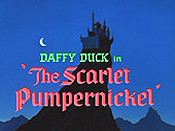
The Scarlet Pumpernickel
- Studio
- Warner Bros. Cartoons, Inc.
- Distributor
- Warner Bros.
Synopsis
Daffy "Dumas" Duck has written his own screenplay which parodies The Scarlet Pimpernel and tries to sell it to "J.L.," the studio head. The cartoon concerns itself less with "The Scarlet Pimpernel," Baroness Emmuska Orczy's tale of an heroic figure who smuggles doomed noblemen out of Paris during the French Revolution, than with mocking swashbucklers in general and Errol Flynn in particular (Errol is mentioned no less than three times).
Daffy plays the title character, a dashing highwayman (as Flynn) with an unspecified mission in life, except to irritate the Lord High Chamberlain (Porky as Claude Rains). The Chamberlain, realizing that his daughter Melissa is the Scarlet Pumpernickel's true love, arranges to marry her to the Grand Duke (Sylvester as Basil Rathbone), hoping that this will flush the Pumpernickel out of hiding. Elmer Fudd has a small part as the proprietor of the King's Nostril Inn.
Daffy plays the title character, a dashing highwayman (as Flynn) with an unspecified mission in life, except to irritate the Lord High Chamberlain (Porky as Claude Rains). The Chamberlain, realizing that his daughter Melissa is the Scarlet Pumpernickel's true love, arranges to marry her to the Grand Duke (Sylvester as Basil Rathbone), hoping that this will flush the Pumpernickel out of hiding. Elmer Fudd has a small part as the proprietor of the King's Nostril Inn.
Characters
Daffy Duck, Sylvester, Porky Pig, Elmer Fudd, Henery Hawk, Mother Bear, Melissa Duck, Highwayman, J.L.
Credits
Directing
- Director
- Chuck Jones (as Charles M. Jones)
Producing
- Producer
- Edward Selzer
Writing
- Writer
- Michael Maltese
Voices
- Voice
- Mel Blanc (Daffy Duck, Sylvester, Porky Pig, Elmer Fudd, Highwayman, J.L.), Bea Benaderet (The Fair Melissa)
Music
- Music
- Carl Stalling
Animation
- Animator
- Phil Monroe, Ben Washam, Lloyd Vaughan, Ken Harris
- Layouts
- Robert Gribbroek
Art Department
- Backgrounds
- Peter Alvarado
Production notes
Modern versions have removed the scene where Daffy shoots himself in the head.
Mother Bear appears in a cameo in which she plays the harp in the background.
The second of only two Sylvester cartoons animated by Phil Monroe.
The Blue Ribbon release featured blue rings. This release also features the original title cards and includes credits.
In September of 1943, beginning with A Feud There Was, Warner Bros. began re-releasing select color cartoons in their Blue Ribbon program. Typically the Blue Ribbon reissues received new opening sequences with Blue Ribbon title cards and standardized music. Cartoon production credits were also removed. Between ten and fifteen cartoons were released in any given year, with cartoons coming from as far back as 1935. The reissues continued until the close of the studio in the 1960's.
All Blue Ribbon cartoons were released as "Merrie Melodie" cartoons regardless of the original series. The first "Looney Tunes" short to be included in the Blue Ribbon series was The Hep Cat, which was added in 1949. The only current prints of many of these cartoons are the Blue Ribbon releases, although restoration of these cartoons with original elements and titles is always ongoing.
Even though Arthur Q. Bryan usually voices Elmer Fudd, Mel Blanc does one speaking line for him in this short.
According to Michael Barrier on a DVD commentary, Daffy and Sylvester's voices are the exact same. They both lisp. Daffy's voice is played back more at a higher pitch.
Pictures


Reviews
The Scarlet Pumpernickel
This was it. This was the major turning point in Daffy's career prophesized by both You Oughta Be in Pictures and The Great Piggy Bank Robbery.
The toon starts off with Daffy in Mr. Warner's office saying that he is sick of doing comedy and would like to try his hand at acting in an action-adventure picture (that he's written of course). This is obsurdity carried out into ridiculousness. I guess the snow-job he tried to pull on Porky years before worked better on himself. His ego is so huge at this point that he actually believes that he can be taken seriously in a straight dramatic role.
As Daffy reads the script to "J.L.", it is acted out by Daffy and an all Looney cast (namely Porky, Sylvester, Henery Hawk, etc.). However, upon watching this narrative played out, we see that Daffy still retains that wacky comedic spirit from his earlier days. This just shows that even though Daffy would be predominantly greedy with delusions of grandeur beyond this point, he would still do his familiar schtick and WOO HOO WOO HOO every once in a while just because..................... he's Daffy.
But, this cartoon would not affect Daffy's career alone. This idea of show biz egos being made fun of would be the bread & butter of such innovative shows as SCTV, Saturday Night Live, and Larry Sanders. (The greatness of these shows could be the subject of a whole other post).
Quite a lot of greatness packed into 7 minutes I'd say!
Elsewhere: Wikipedia