
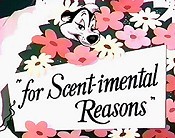
For Scent-Imental Reasons
- Studio
- Warner Bros. Cartoons, Inc.
- Distributor
- Warner Bros.
Synopsis
Pepé Le Pew invades a Parisian perfumery, where he sniffs the various scents. The shopkeeper runs in horror and recruits a female cat to run the skunk out of the shop. She tosses the cat inside, and a bottle of dye falls over, accidentally painting a white stripe down the cat's back. Pepé gives chase...
Characters
Pepé Le Pew, Cat, Perfume Shop Owner
Credits
Directing
- Director
- Chuck Jones (as Charles M. Jones)
Producing
- Producer
- Edward Selzer
Writing
- Writer
- Michael Maltese
Voices
- Voice
- Mel Blanc (Pepé Le Pew, Perfume Shop Owner), Bea Benaderet
Music
- Music
- Carl Stalling
Animation
- Animator
- Ben Washam, Ken Harris, Phil Monroe, Lloyd Vaughan
- Layouts
- Robert Gribbroek
Art Department
- Backgrounds
- Peter Alvarado
Production notes
The Blue Ribbon release featured orange rings. This release also features the original title cards and includes credits.
In September of 1943, beginning with A Feud There Was, Warner Bros. began re-releasing select color cartoons in their Blue Ribbon program. Typically the Blue Ribbon reissues received new opening sequences with Blue Ribbon title cards and standardized music. Cartoon production credits were also removed. Between ten and fifteen cartoons were released in any given year, with cartoons coming from as far back as 1935. The reissues continued until the close of the studio in the 1960's.
All Blue Ribbon cartoons were released as "Merrie Melodie" cartoons regardless of the original series. The first "Looney Tunes" short to be included in the Blue Ribbon series was The Hep Cat, which was added in 1949. The only current prints of many of these cartoons are the Blue Ribbon releases, although restoration of these cartoons with original elements and titles is always ongoing.
Awards
Academy Award Winner, Best Short Subject (Cartoon), 1950
Pictures


Reviews
For Scent-imental Reasons
While Odor-able Kitty barely established anything about the character of Pepe, this one established EVERYTHING. Jones and Maltese had seen all the mistakes made in Odor-able Kitty (1945) and Scent-imental Over You (1947) and fixed them all here.
For one, this cartoon marks the first appearance of the hapless female cat who would be unofficially dubbed Penelope in the future. (But truly, she had many names during Pepe's career). When Pepe is found in a perfume shop, the owner tosses her in so that she can get rid of that skunk de pew. Instead, some white liquid gets accidentally poured down her back and Pepe mistakes her for an attractive female skunk. This is of course the most easily recognisable element of the Pepe Le Pew cartoons and it made it's debut here.
But, other aspects were introduced as well. For one thing, while the cat has locked herself in a glass case, Pepe insists that she exit it at once. She then tells him that she won't on account of him stinking. Once it sinks in Pepe puts a gun to his head, gives her an sad ironic smirk and walks away. Then a gunshot is heard and she's devastated. However, after she emerges from the glass case, it is revealed that the suicide was a hoax and the chase resumes. There are other times in the future when Pepe is made aware of his condition and yet remains ever determined. The cartoons Really Scent and Touche` and Go come to mind.
And then there's the ending. Both Pepe and Penelope fall out of a window, he into a can of blue paint and she into a full rain barrel. The water washes the stripe off of her and makes her look all scraggily. So, Pepe doesn't recognise her as the lovely creature he is persuing. But, at the same time, the blue paint not only covers up Pepe's smell but makes the cat notice Pepe's manly physique as well. This turns the tables, she is now the repellent one in mad persuit of Pepe and he is the nervous prey. This would be repeated in future installments like Little Beau Pepe and Really Scent. But, besides being a brilliant punchline, it also reveals an aspect of Pepe as to why he chases. It's not just out of love. Pepe needs to feel the fear in the female he is persuing. Deep down that's what keeps him going. It's not an issue of malice, it's just his fetish. Once she starts returning the woos, he gets scared and feels the need to retreat. No doubt Jones injected this chauvanistic elements as a way of making fun of Tedd Pierce, a man who thought he was much more of a "lady-killer" than he actually was.
But, the significance and greatness of this cartoon would not end within itself. For this was Chuck Jones' first cartoon to win an Oscar. Thus this cartoon was a major step up for the careers of both Pepe and Jones. Not only that, it put egg on the face of Selzer who thought it would never fly. His wrong assessment of Friz Freleng's Tweetie Pie happened again.
Whew, that's quite alot to pack into 7 brilliant minutes of film.
Elsewhere: Wikipedia