
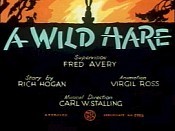
A Wild Hare
Also known as: The Wild Hare (Blue Ribbon Reissue)
- Studio
- Leon Schlesinger Studios
- Distributor
- Warner Bros.
Synopsis
Be vewy, vewy qwiet, as Elmer's hunting rabbits. This short establishes many standards we expect in a Bugs Bunny cartoon, right from the start. Examples: pushing a gun down a rabbit hole, Bugs inquiring, "What's up, Doc?"
Characters
Bugs Bunny, Elmer Fudd, Skunk
Credits
Directing
- Director
- Tex Avery
Producing
- Producer
- Leon Schlesinger
Writing
- Writer
- Rich Hogan
Animation
- Animator
- Virgil Ross, Charles McKimson (uncredited), Robert McKimson (uncredited), Rod Scribner (uncredited)
Voices
- Voice
- Mel Blanc (Bugs Bunny, Skunk), Arthur Q. Bryan (Elmer Fudd)
Music
- Music
- Carl W. Stalling
Production notes
This is the first official Bugs Bunny cartoon, although there are some very Bugs-like characters that precede this cartoon.
In September of 1943, beginning with A Feud There Was, Warner Bros. began re-releasing select color cartoons in their Blue Ribbon program. Typically the Blue Ribbon reissues received new opening sequences with Blue Ribbon title cards and standardized music. Cartoon production credits were also removed. Between ten and fifteen cartoons were released in any given year, with cartoons coming from as far back as 1935. The reissues continued until the close of the studio in the 1960's.
All Blue Ribbon cartoons were released as "Merrie Melodie" cartoons regardless of the original series. The first "Looney Tunes" short to be included in the Blue Ribbon series was The Hep Cat, which was added in 1949. The only current prints of many of these cartoons are the Blue Ribbon releases, although restoration of these cartoons with original elements and titles is always ongoing.
The Blue Ribbon reissue erroneously misspelled the title card as "The Wild Hare", and removes a Carole Lombard joke.
Ms. Lombard had died in a plane crash on January 16, 1942, and it was felt to be in poor taste to make a joke in her name after the accident. Her name was replaced with that of Barbara Stanwyck's.
Awards
Academy Award Nominee, Best Short Subject (Cartoon), 1941
Pictures


Reviews
A Wild Hare
Excellent blue print for "Bugs Bunny"s to follow.
This is where it all truly began. Tex had seen all the Bugs cartoons made before inwhich he seemed to resemble Daffy and would go on to inspire the creation of Woody Woodpecker. He then decided to give this rabbit a go. This is where Bugs personality came into being. It was this cartoon that introduced the catch-phrase "What's up, Doc?", the carrot obsession, the Brooklyn accent, and the unflappable calm demeanor when faced with a fire-arm.
The cartoon itself is about par by Tex's standards but in the theatres it caused a sensation. The audiences loved it and wanted to see more. This cartoon was even nominated for an Oscar. Which proves that even the acadamy couldn't ignore the greatness of such a character.
Although this is predominantly credited as the first Bugs Bunny cartoon, it was a jump start for Elmer Fudd's career as well. For you see, what Chuck Jones established in Elmer's Candid Camera, Tex Avery improved on in this cartoon. Instead of a photographer, Elmer is now a hunter (or as pointed out in Looney Tunes: Back in Action, secretly evil). This was to help Bugs seem more like he's saving his own life rather than merely causing trouble. (Of course, to learn more about Bugs' role in this toon, check out Significant Toons in Bugs Bunny's Career on this same forum.) And yet, despite the addition of fire arms, Elmer is no more menacing than he is with a camera.
Another component Tex improved upon is Elmer's intelligence. In Candid Camera, Elmer was simply overwhelmed by his surroundings. Here, he is actually shown to have very low intelligence. Bugs has to actually show Elmer his ears, tail, and hopping abilities in order for Elmer to even have a clue as to Bugs being a rabbit. That component adds another wrinkle to his angst. It's not that he doesn't know how to handle things it's that he's too stupid to handle things. Even in Bugs' death scene, every one of us could see through this hammy performance. However, Elmer falls for it even so much as to cry against a tree. And, of course, then has a nervous break-down when he realizes that Bugs is indeed alive and with enough energy to kick Elmer in the rear as high as the tree he's leaning on.
Thus, the immense popularity of this cartoon would insure that the careers of both Bugs AND Elmer would be secure for quite a while.
A Wild Hare
This is the first real Bugs Bunny film. The audience loved the cartoon. They called the box office and said "when are we going to see more of that rabbit?" like the box office had something to do with it.