
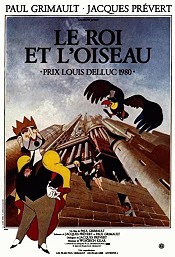
Le Roi Et L'oiseau
Le Roi Et L'oiseau is a 1980 Les Films Paul Grimault animated feature film from Les Films Paul Grimault, Les Films Gibé, Antenne 2, directed by Paul Grimault and Emile Bourget, released on March 19, 1980.
English title: The King And The Mockingbird
- Studio
- Les Films Paul Grimault, Les Films Gibé, Antenne 2
- Distributor
- Les Grands Films Classiques
Synopsis
King Charles V and Three Make Eight and Eight Make Sixteen exercises tyrannical rule over the kingdom of Takicardie.
Only a cheerful, talkative bird with sumptuous plumage, which has constructed its nest on top of the gigantic palace, very close to His Majesty's secret apartments, dares to taunt him.
The King is in love with a charming, modest shepherdess whom he wants to marry. But she loves a little chimneysweep.
The shepherdess and the chimneysweep flee to escape the King, and, taking refuge at the summit of the palace's highest tower, save a small careless bird, taken in one of the tyrant's traps. The father bird, in return, promises to help them.
The police discover the fugitives' trail. A wild pursuit ensues. Flying machines piloted by mustached policemen, mysterious creatures who spy on the city, motorized tritons and the King on his electric floating throne, or on his gigantic robot, chase them and, finally, capture them.
The bird and the chimneysweep, separated from the shepherdess, are put to work in the big royal workshops, then thrown, for lack of discipline, into the lions' pit.
Meanwhile, the King prepares to marry the shepherdess with grand pomp.
Then the bird, again using his witty eloquence and his shrewdness (and aided by a blind musician), succeeds in provoking the lions to revolt against the King.
The big cats escape and liberate the people of the lower town, interrupting the marriage ceremony, and the bird follows the orders of the gigantic robot...
The palace and the upper town are destroyed. The shepherdess and the chimneysweep are able to live happily ever after.
Characters
Bird, King Charles V and Three Make Eight and Eight Make Sixteen, Police Chief, Shepherdess, Chimneysweep, Sentencieux, Blind Man, Porter, Lion Tamer, Town Crier, Palace Mayor
Credits
Directing
- Director
- Paul Grimault
- Assistant Director
- Emile Bourget
Writing
- Writer
- Jacques Prévert, Paul Grimault
- Based on "The Shepherdess and the Chimneysweep, " by
- Hans Christian Andersen
Voices
- Voice
- Jean Martin (Bird), Pascal Mazzotti (King), Raymond Bussières (Police Chief), Agnès Viala (Shepherdess), Renaud Marx (Chimneysweep), Hubert Deschamps (Sentencieux), Roger Blin (Blind Man), Philipe Derrez (Porter, Narrator), Albert Médina (Lion Tamer, Town Crier), Claude Piéplu (Palace Mayor), Lionel Charpy, Jacques Colombat, Robert Lombard, Jean Mermet, Vincent Montrobert, Jean Herbert Popeck, Pierre Risch, Bruno Sermonne, Jean Vimenet, Jeanne Witta
Music
- Music
- Wojciech Kilar
- Songs
- Joseph Kosma
- Lyrics
- Jacques Prévert
Animation
Art Department
- Backgrounds
- Gérard Soirant
Editing
- Editor
- Paul Grimault
Sound
- Sound Effects
- Henri Gruel
- Sound Montage
- Aline Asséo, René Chaussy
- Mixing
- Jean Neny
Casting
- Voice Recording
- Claude Panier, Bob Chaubaroux
Crew
- Decoration
- Paul Grimault (with the artistic collaboration of Lionel Charpy, Roger Duclent)
Production notes
Production lasted from 1977 until 1979.
Director Paul Grimault and writer Jacques Prévert considered this film to be the complete version of their work. They had earlier disavowed themselves of "La Bergère et Le Ramoneur," which they deemed an incomplete version.
Nonetheless, excerpts from "La Bergère et Le Ramoneur" were incorporated into the later work. Animators were Henri Lacam, G. Allignet, J. Aurance, G. Dubrisay, R. Dumotier, L. Dupont, R. Genestre, P. Granger, G. Juillet, P. Landrot, Jacques Leroux, L. Logé, R. Moreau, J. Mutschler, P. Ovtcharoff, J. Rannaud, R. Richez, R. Rosé, A. Ruiz, R. Segui, J. Vausseur, P. Watrin.
Awards
Prix Louis-Delluc, 1979
Elsewhere: Wikipedia