
Counterfeit Goof
- Studio
- Walt Disney Television Animation
- Animation studio
- Kennedy Cartoons, Inc
- Distributor
- Buena Vista Television
Synopsis
Goofy is mistaken for his double, a master counterfeiter, by the 'big boss' of a local mob.
Characters
Goofy, Pete, Max
Credits
Producing
- Producer
- Roy Wilson, Hank Tucker, Ken Kessel
- Supervising Producer
- Robert Taylor
Writing
- Writer
- Stephen Levi, Bruce Talkington
- Created by
- Peter Montgomery
Voices
- Voice
- Bill Farmer (Goofy), Dana Hill (Max), Jim Cummings (Pete), Frank Welker (Waffles), Rob Paulsen, Richard Karron
Music
- Music
- Mark Watters
- Theme Song
- Randy Petersen, Kevin Quinn, Robert Irving
Art Department
- Storyboards
- Holly Forsyth, John Norton
Production notes
Two snippets in this episode are used in the opening.
A classic line of Goofy's is re-used in this episode when he's fighting S. Slick "He won't get away." That line was used from two classic Disney shorts: The Whalers" and "No Sail."
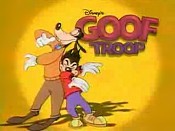
Disney's Goof Troop found the world's silliest talking dog all grown up and rearing a child. Goofy, scatterbrained as always, lived in Spoonerville, where he was raising his 11-year-old son Max. The two lived next door to the narrow-minded Pete, his loving wife Peggy, daughter Pistol, and son P.J., who as good friends with Max.
Episodes usually revolved around the adventures and the mischief Max and P.J. got themselves into, with the hapless Goofy and disgruntled Pete inadvertently getting involved to sort things out. The show balanced these wacky hijinks with social lessons on peer pressure and popularity, and the disagreeable Pete always got his comeuppance one way or another.
Following the pattern set by Darkwing Duck and others, Goof Troop started its run on cable's Disney Channel before moving on to both ABC's Saturday morning lineup and a slot on the two-hour Disney Afternoon block (which also included Darkwing Duck and Tale Spin). Both the network episodes and the syndicated ones were originals, giving kids a healthy helping of goofiness six days a week.
In 1995, Goofy and Max teamed up again for the theatrical film A Goofy Movie, which took the wacky suburbanites on a cross-country road trip. One year later, the series came full circle, as its reruns returned to their original home on the Disney Channel.
Originally aired in April and May of 1992 on the Disney Channel; release date reflects second airing in Syndication as part of the two-hour Disney Afternoon cartoon block (replacing DuckTales.) These repeats in syndication aired concurrently with new episodes aired on ABC on their Saturday morning line-up.