
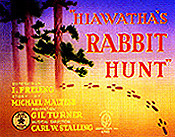
Hiawatha's Rabbit Hunt
Hiawatha's Rabbit Hunt is a 1941 Merrie Melodies theatrical cartoon from Leon Schlesinger Studios, directed by Isadore Freleng, released on June 7, 1941.
- Studio
- Leon Schlesinger Studios
- Distributor
- Warner Bros.
Synopsis
Bugs is reciting passages from "Hiawatha," and he realizes that the famous Longfellow poem is about him. A goofy little Hiawatha goes rabbit hunting. As he puts it, "I'm gonna catch me a rabbit and I'm gonna put 'em right in this pot!" Hiawatha catches Bugs, but, needless to say, he is no match for the rabbit, who takes a bath in the soup cauldron. Bugs ends the film by reciting more passages from "Hiawatha."
Characters
Bugs Bunny, Hiawatha
Credits
Directing
- Director
- Isadore Freleng (as I. Freleng)
Producing
- Producer
- Leon Schlesinger
Writing
- Writer
- Michael Maltese
- Based On The Original Poem, "The Song of Hiawatha" By
- Henry Wadsworth Longfellow
Voices
- Voice
- Mel Blanc (Bugs Bunny)
Music
- Music
- Carl W. Stalling
Animation
- Animator
- Gil Turner
- Animators, uncredited
- Richard Bickenbach, Gerry Chiniquy, Cal Dalton, Manuel Perez, Herman Cohen
Production notes
A parody of Disney's "Little Hiawatha;" in fact, the character design is a parody of Disney animator Ward Kimball. Portion reused in 1944's "What's Cookin' Doc?."
The first Bugs Bunny cartoon directed by Isadore "Friz" Freleng.
Due to pressure from Warner Bros., this cartoon was one of 12 pulled from rotation by the Cartoon Network for its 2001 "June Bugs" marathon, originally planned as the first broadcast of the complete chronology of Bugs Bunny cartoons. The reason given was its purportedly offensive depiction of the Native American character Hiawatha.
In September of 1943, beginning with A Feud There Was, Warner Bros. began re-releasing select color cartoons in their Blue Ribbon program. Typically the Blue Ribbon reissues received new opening sequences with Blue Ribbon title cards and standardized music. Cartoon production credits were also removed. Between ten and fifteen cartoons were released in any given year, with cartoons coming from as far back as 1935. The reissues continued until the close of the studio in the 1960's.
All Blue Ribbon cartoons were released as "Merrie Melodie" cartoons regardless of the original series. The first "Looney Tunes" short to be included in the Blue Ribbon series was The Hep Cat, which was added in 1949. The only current prints of many of these cartoons are the Blue Ribbon releases, although restoration of these cartoons with original elements and titles is always ongoing.
Awards
Academy Award Nominee, Best Short Subject (Cartoon), 1942
Pictures


Elsewhere: Wikipedia