

Tweetie Pie
- Studio
- Warner Bros. Cartoons, Inc.
- Distributor
- Warner Bros.
Synopsis
Thomas the cat (to be known in later cartoons as Sylvester) finds Tweety in the snow warming himself by a cigar butt. Thomas's mistress rescues the little yellow bird before her cat can devour him, but Thomas doesn't give up. He uses stacks of chairs and a Rube Goldberg setup to get at Tweety while trying not to get caught by the lady.
Characters
Thomas (Sylvester), Tweety, Woman
Credits
Directing
- Director
- Isadore Freleng (as I. Freleng)
Producing
- Producer
- Edward Selzer
Writing
- Writer
- Tedd Pierce, Michael Maltese
Animation
- Animator
- Virgil Ross, Gerry Chiniquy, Ken Champin, Manuel Perez
Voices
- Voice
- Mel Blanc (Thomas (Sylvester), Tweety), Bea Benaderet (Woman, [uncredited])
Music
- Music
- Carl Stalling
Crew
- Layouts
- Hawley Pratt
- Backgrounds
- Hawley Pratt
Production notes
The first Warner Bros. short to win an Academy Award. This is also the first Sylvester and Tweety cartoon, although Sylvester is referred to as Thomas in the short.
The first cartoon in which Tweety is canary yellow. Earlier, Tweety's color was pink. Director Bob Clampett recalled that movie censors complained that Tweety looked naked. Instead of giving his character short pants, Clampett drew him with yellow feathers.
While Tweetie Pie was being made, producer Edward Selzer ordered director Friz Freleng not to use a canary, but instead, to use a woodpecker from an earlier production. Freleng immediately quit; however, that evening, an apologetic Selzer called Freleng at home and hired him back. Selzer accepted the Academy Award for the short the following year.
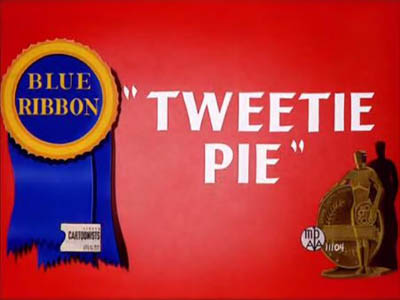
In September of 1943, beginning with A Feud There Was, Warner Bros. began re-releasing select color cartoons in their Blue Ribbon program. Typically the Blue Ribbon reissues received new opening sequences with Blue Ribbon title cards and standardized music. Cartoon production credits were also removed. Between ten and fifteen cartoons were released in any given year, with cartoons coming from as far back as 1935. The reissues continued until the close of the studio in the 1960's.
All Blue Ribbon cartoons were released as "Merrie Melodie" cartoons regardless of the original series. The first "Looney Tunes" short to be included in the Blue Ribbon series was The Hep Cat, which was added in 1949. The only current prints of many of these cartoons are the Blue Ribbon releases, although restoration of these cartoons with original elements and titles is always ongoing.
Awards
Academy Award Winner, Best Short Subject (Cartoon), 1948
Pictures

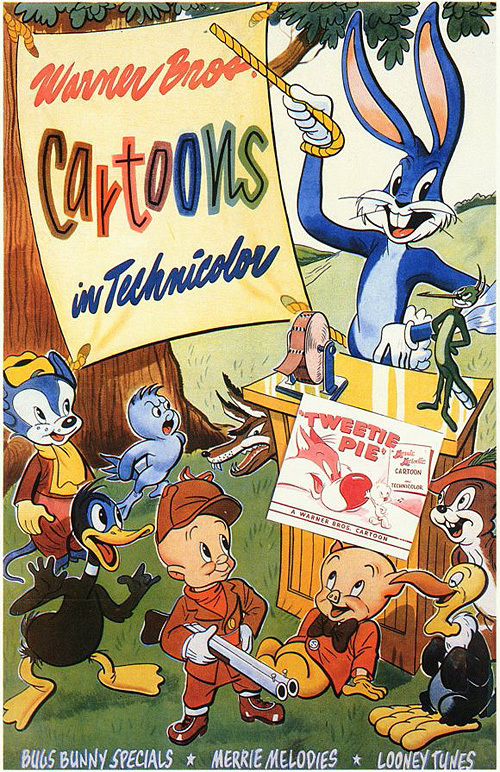




Reviews
Tweetie Pie
A definite highlight in Sylvester's career. For this is the toon that won Sylvester, Tweety, Friz, and Warner Bros. it FIRST OSCAR!!! However, there are some that think that this cartoon only won because Rhapsody Rabbit had been accidentally snubbed last year and so this Oscar was ONLY awarded to Tweetie Pie for that reason.
But, this cartoon has it's own merits as well. For one thing, Sylvester and Tweety were created seperately by two different directors (Tweety - Clampett; Sylvester - Freleng). Miraculously, when the two were put together, it was instant chemistry. This cat & bird team played off each other nicely. (Incidentally, this is almost indentical to how Laurel & Hardy got started 20 years prior). The scene at the very end inwhich Tweety constantly hits Sylvester with a shovel expresses their synergy perfectly.
The puzzling part is, their producer at the time Eddie Selzer didn't think this would be a good pairing. But, Friz fought him all the way and was eventually given permission for Ed to make this cartoon. The results certainly proved Eddie wrong beyond all doubt. This incident would inspire Chuck Jones to fight for the life of Pepe Le Pew and Jack Warner to reinstate the Tazmanian Devil. Cartainly, any cartoon that can prove big business wrong is okay by me.
One thing that is easy to spot in this cartoon is that Tweety went through a physical change. He went from pink to yellow. The reason for that is because the censorboard of the time felt that the pink Tweety looked naked and that he might encourage promiscuity that way. (Of course that's just my speculation. I'm sure the real reason is much more non-sensical.)
Well, at any rate, Tweety had a new look and a new aversary, namely Sylvester. This is the putty tat that Tweety would think he saw for the rest of his career. From that point on, Tweety only worked with Sylvester. The Oscar this cartoon won made sure of that.
This also marks the first time that Tweety would use a human as protection against a cat. Whenever Sylvester made a noise trying to catch Tweety, the lady of the house would run downstairs and hit the putty tat with a broom. After this happened enough times, Sylvester was thrown outside.
But this is where the true magic of this cartoon begins. Even while outside in the snow, Sylveser still does not give up his persuit of Tweety. When Sly climbs down the chimney, Tweety's ready with a stack of logs and some kerosene. When he finally burns the broom used by the lady to whack him, Tweety fills in for her using a shovel instead. The synergy between these two was incredible. Even though Sylvester would go on to work with others like Hippety Hopper, Speedy Gonzales, Porky Pig, etc. he always came back to Tweety. I guess there was something about getting abused by that bird that he couldn't resist. They would repeat this chemistry in great cartoons like I Taw a Putty Tat, Bad Ol' Putty Tat, Bird in a Guilty Cage, Tweet Tweet Tweety, etc. They wouldn't all be greats though.