
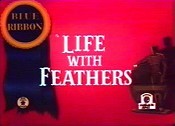
Life With Feathers
- Studio
- Warner Bros. Cartoons, Inc.
- Distributor
- Warner Bros.
Synopsis
A lovebird has fight with his wife and wants to die. He tries to entice Sylvester to eat him. This being too easy, Sylvester figures something is fishy and won't go for it.
Characters
Sylvester, Lovebird, Sweetie Puss
Credits
Directing
- Director
- Isadore Freleng (as I. Freleng)
Producing
- Producer
- Edward Selzer
Writing
- Writer
- Tedd Pierce
Voices
- Voice
- Mel Blanc (Sylvester), Bea Benaderet
Music
- Music
- Carl W. Stalling
Animation
- Animator
- Virgil Ross
- Animators, uncredited
- Jack Bradbury
Production notes
This story was reused in 1951's Cheese Chasers.
The first appearance of Sylvester. Also, the first Sylvester cartoon animated by Virgil Ross, and the first for which Tedd Pierce was a writer.
Sylvester's very first words: "Sufferin' succotash!" (Mel Blanc is said to have borrowed the line from one of his other characters, traveling salesman Roscoe E. Wortle in radio's The Judy Canova Show.)
Cartoon Network cuts the scene which the little blue lovebird is walking and thinking of ways to kill himself.
In September of 1943, beginning with A Feud There Was, Warner Bros. began re-releasing select color cartoons in their Blue Ribbon program. Typically the Blue Ribbon reissues received new opening sequences with Blue Ribbon title cards and standardized music. Cartoon production credits were also removed. Between ten and fifteen cartoons were released in any given year, with cartoons coming from as far back as 1935. The reissues continued until the close of the studio in the 1960's.
All Blue Ribbon cartoons were released as "Merrie Melodie" cartoons regardless of the original series. The first "Looney Tunes" short to be included in the Blue Ribbon series was The Hep Cat, which was added in 1949. The only current prints of many of these cartoons are the Blue Ribbon releases, although restoration of these cartoons with original elements and titles is always ongoing.
Awards
Academy Award Nominee, Best Short Subject (Cartoon), 1946
Pictures


Reviews
Life With Feathers
Sylvester is one of the greatest under-rated characters of all time. The fact that this cartoon, his debut performance, was nominated for an Oscar proves that indefinitely.
It should go without saying that the a characters first appearance is always a big step in his career. Much like a human being's life wouldn't amount to much if he stayed in the womb. But, none-the-less, Sylvester's beginning was quite monumantal for him. Virtually every aspect of Sylvester's persona was here: his low but calculating intelligence, his dexterity at entertaining us while being the butt of a smaller animal's joke, not to mention his trademark lisp and catch-phrase "Thufferin' Thuccatash!"
But, what also helped this cartoon along is it's ingenious story. Friz expertly pulled off a role reversal inwhich the bird WANTS to be eaten but Sylvester does NOT want to eat him. Then, at the end, the roles are switched back again. And, it all happens in a way that makes sense. Not once do you scratch your head and ask "why did they do that?" The story flows beautifully. That is the reason why this particular cartoon was nominated for an Oscar and Sylvester was on his way.
Life With Feathers
All the really salient traits of Sylvester's character originated here--he's not the two-dimensional bad-guy many stereotype him as being.
Perhaps not the SUPREME Sylvester film, but an invaluable point of referece for anyone.