
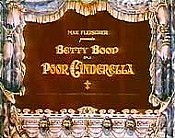
Poor Cinderella
- Studio
- Fleischer Studios
- Distributor
- Paramount Studios
Synopsis
Betty Boop plays Cinderella in this retelling of the classic tale. Cinderella lives with her mean stepsisters, who treat her miserably. They refuse to allow her to attend the prince's ball. Cinderella cries until her fairy Godmother tells the girl to get a pumpkin, some mice and two lizards together. With a wave of her wand, these items turn into a coach, a footman, doorman and horses. Cinderella's rags turn into a resplendent white evening gown complete with glass slippers. The fairy Godmother warns Cinderella to be home by midnight or the magic will end and she will be in rags once more.
At the ball, Cinderella's appearance enchants everyone, especially the prince. He is smitten with this lovely young woman. They both dance until the clock strikes 12, when Cinderella runs from the Palace. In her haste, she leaves one of her glass slippers behind. The Prince searches his kingdom for the woman the slipper fits. All the girls in the realm try on the glass slipper, to no avail. Cinderella is given a chance, and it fits. She becomes the Prince's bride, much to the displeasure of the two stepsisters. The two continue to argue at the gates of the Prince's Palace as the final credits roll.
At the ball, Cinderella's appearance enchants everyone, especially the prince. He is smitten with this lovely young woman. They both dance until the clock strikes 12, when Cinderella runs from the Palace. In her haste, she leaves one of her glass slippers behind. The Prince searches his kingdom for the woman the slipper fits. All the girls in the realm try on the glass slipper, to no avail. Cinderella is given a chance, and it fits. She becomes the Prince's bride, much to the displeasure of the two stepsisters. The two continue to argue at the gates of the Prince's Palace as the final credits roll.
Characters
Betty Boop/Cinderella, Stepsisters, The Prince, Fairy Godmother
Credits
Directing
- Director
- Dave Fleischer
Producing
- Producer
- Max Fleischer
- Presented By
- Adolph Zukor
Writing
- Writer
- Dan Gordon
Animation
- Animator
- Seymour Kneitel, William Henning, Roland Crandall
Voices
- Voice
- Mae Questel, Ann Rothschild, Kate Wright, Margie Hines as Margie Heinz (Betty Boop)
Music
- Music
- Charles Tobias, Murray Mencher, Jack Scholl
Crew
- Recording
- Phil Spitalny
Production notes
The first Color Classic, and Fleischer Studios' first color cartoon. Betty's only classic appearance in color. In this cartoon, Betty has reddish-orange hair, not the usual jet-black!
Rudy Vallee is caricatured singing "I'm Just A Poor Cinderella" during the ball sequence.
Dance numbers may have been rotoscoped.
Lyrics to "I'm Just A Poor Cinderella":
Rudy Vallee is caricatured singing "I'm Just A Poor Cinderella" during the ball sequence.
Dance numbers may have been rotoscoped.
Lyrics to "I'm Just A Poor Cinderella":
Pictures


Reviews
Poor Cinderella
The first Color Classic might well be the best in the series. The sterioptical sequences are marvelous and the masterful animation of the fairy godmother stand out. While this cartoon falls back on some of the typical Fleischer "clowniness"; the obvious importance Max and Dave placed on this production are evident in nearly every scene. Little Ann Little one of the early voices of Betty Boop in real life had red hair, and she told me that is why they colored her hair red. If this is the case, or the fact that Cinecolor was used to me is a moot point. Phil Spitalny's score is lovely to listen to, and Leo. Fiest and Co. Released the sheet music to the title song with Fliescher artwork on the cover. All in all this is another superior piece of animated film-making from not just an animators standpoint, but an inventors standpoint as well.
Poor Cinderella
Poor Cinderella was the first entry in this color series produced from 1934 to 1940. It stars BETTY BOOP in her only color appearance in what has the tone of a small feature. This cartoon runs a full 10 minutes where the average cartoon short was generally only 7 minutes. It has the feel of a cartoon musical version of an Ernst Lubitsch costume feature, and gives indications of Fleischer's interest in producing animated features. Eventhough it is essentially a straight forward telling of the familiar story, it uses beautiful songs and music and manages to include many of the comical cartoon elements that are true to Fleischer animation, such as a pumkin singing about his joy not to be cut up for pumkin pie. And let us not forget, the obvious opportunity to have the top of Betty's gown slip down when the coach hit a bump. It is interesting to see how a limited color pallet was used, having only the hues of red and blue and their combinations to work with. In addition, the use of the three dimensional background system, known as The Stereoptical Process is used to great effect. There is also a beautiful waltz scene using Fleischer's rotoscope process. In all, it's a wonderful cartoon that doesn't take itself too seriously, but is certainly enjoyable to see, and a nice alternative to the Disney type of fairy tale.