
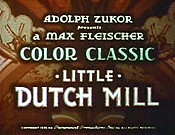
Little Dutch Mill
Little Dutch Mill is a 1934 Color Classics theatrical cartoon from Fleischer Studios, directed by Dave Fleischer, released on October 26, 1934.
- Studio
- Fleischer Studios
- Distributor
- Paramount Studios
Synopsis
The scene painted on a Dutch plate sitting in a china cabinet comes to life. It's a simple tale of a Dutch Hans(el) and Gretel and their pet duck, who play around a mill inhabited by the town miser. The miser catches the children spying on him as he counts his gold and ties them up, threatening to burn their tongues out.
The duck alerts the townspeople, and they clean up the old mill and the miser. In the process, the miser realizes that all his gold did not bring him happiness.
Characters
Hans, Gretel, Duck, Miser, Townspeople
Credits
Directing
- Director
- Dave Fleischer
Producing
- Producer
- Max Fleischer
- Presented By
- Adolph Zukor
Animation
- Animator
- Willard Bowsky, Dave Tendlar
Production notes
This cartoon echoes a theme close to Max Fleischer's heart: reform is better than execution.
Pictures


Reviews
Little Dutch Mill
The third entry in Fleischer's color series is about a Dutch Hans(el) and Gretel who play around an old windmill with their pet duck. The windmill is inhabited by the local miser who hasn't baithed, cut his hair beard finger and toe nails for years. As he tramps around barefoot, he declairs, "I hate things neat and clean. I'm dirty and I'm mean." To that, he stomps on a row of red tulips.
Hans and Gretel see the miser approach and hide behind a log as he enters the mill.
Curious, the children quietly open the shutter on a window in the mill, and watch the miser opening a sack of gold coins he has hidden in the wall. Counting his mounds of gold,he chants to himself, "Gold's like blood, it's life itself."
The children giggle, and seeing them in the window, the Miser chases after after Hans and Gretel in a three-dimensional background scene that follows around them around the mill.
The Miser catches the children, and ties them to a strut inside. He heats a poker on a blacksmith's stove, threatening to burn their tongues out.
The duck runs back to town to bring the townspeople to the mill just in time. From there,
the people set about rehabilitating the Miser. The man take him and bathe him, cut his hair and nails.
The women clean up the living quarters, transforming it into a cheerful environment.
After seeing the change, the Miser is changed also, and throws his money at the people, realizing, "All my gold has brought me naught, happyness cannot be bought."
The theme of this cartoon is a reflection of Max Fleischer's philosophy of rehabilitation.