
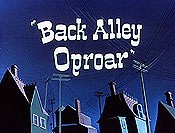
Back Alley Oproar
- Studio
- Warner Bros. Cartoons, Inc.
- Distributor
- Warner Bros.
Synopsis
Elmer is trying to sleep, but Sylvester comes along and sets up his music stand on the back fence outside Elmer's window for an all-night serenade. Sylvester starts singing "Figaro," and when Elmer throws an old pair of shoes at him, Sylvester uses the shoes to stomp out the Second Hungarian Rhapsody on the porch steps. Sylvester sings "Some Sunday Morning," and when Elmer throws a book, "The Thin Man," at him, Sylvester throws it back and it says "The Return of the Thin Man." Elmer starts after the cat, but Sylvester has coated the porch with grease and thumbtacks. Ooh, ouch! Sylvester sings and Fudd chases until Sylvester, cornered, sings Elmer to sleep. Tucking Elmer in, Sylvester wakes him back up again by becoming a one-man band. Elmer gives Sylvester alum-laced milk, which shrinks his voice and head. Finally, Elmer lights a case of dynamite and blows them both up, sending Elmer to restful heaven, where he is soon joined by Sylvester's singing nine lives.
Characters
Elmer Fudd, Sylvester, Orange Cat
Credits
Directing
- Director
- Isadore Freleng (as I. Freleng)
Producing
- Producer
- Edward Selzer
Writing
- Writer
- Michael Maltese, Tedd Pierce
Animation
- Animator
- Gerry Chiniquy, Manuel Perez, Ken Champin, Virgil Ross
Voices
- Voice
- Mel Blanc (Sylvester), Arthur Q. Bryan (Elmer Fudd), Gloria Curran (Orange Cat)
Music
- Music
- Carl Stalling
Crew
- Layouts
- Hawley Pratt
- Backgrounds
- Paul Julian
Production notes
A color remake of 1941's "Notes To You."
Gloria Curran sings the operatic "Carissima" when Sylvester is joined by a vocal chorus toward the end of the cartoon.
This background image for this short's title card is re-used in November for "Kit For Cat."
Sylvester dies at the end of this cartoon. Other cartoons where he dies are: "Satan's Waitin'," "Mouse Mazurka," "Tweet and Lovely." and "Peck Up Your Troubles."
Songs performed by Sylvester: "Figaro," "Second Hungarian Rhapsody" (stomped out with a pair of old shoes thrown by Elmer), "Some Sunday Morning," "You Never Know Where You're Going Till You Get There," and "Go to Sleep."
Elmer throws a copy of the book "The Thin Man" at Sylvester, who throws it back with the new title "Return of the Thin Man."
In September of 1943, beginning with A Feud There Was, Warner Bros. began re-releasing select color cartoons in their Blue Ribbon program. Typically the Blue Ribbon reissues received new opening sequences with Blue Ribbon title cards and standardized music. Cartoon production credits were also removed. Between ten and fifteen cartoons were released in any given year, with cartoons coming from as far back as 1935. The reissues continued until the close of the studio in the 1960's.
All Blue Ribbon cartoons were released as "Merrie Melodie" cartoons regardless of the original series. The first "Looney Tunes" short to be included in the Blue Ribbon series was The Hep Cat, which was added in 1949. The only current prints of many of these cartoons are the Blue Ribbon releases, although restoration of these cartoons with original elements and titles is always ongoing.
Songs:
- "Merrily We Roll Along" (Charlie Tobias-Murray Mencher-Eddie Cantor),
- "Barber of Seville" (Rossini-arr. Carl Stalling),
- "Sweet Dreams Sweetheart" (M.K. Jerome-Ted Koehler),
- "Barber of Seville" (Rossini-arr. Carl Stalling),
- "Back Alley Oproar" (Carl Stalling),
- "Hungarian Rhapsody No. 2" (Liszt-arr. Carl Stalling),
- "Some Sunday Morning" (M.K. Jerome-Ted Koehler-Ray Heindorf),
- "No Sleep" (Carl Stalling),
- "You Never Know Where You're Goin' Till You Get There" (Jule Styne-Sammy Cahn),
- "Stand In" (Carl Stalling),
- "Carissima" (Arthur Penn),
- "Music Appreciation" (Carl Stalling),
- "Cradle Song" (Brahms-arr. Carl Stalling),
- "Frat" (J.F. Barth),
- "Surprise" (Carl Stalling),
- "Moonlight Bay" (Percy Wenrich-Edward Madden),
- "Saucer of Milk" (Carl Stalling),
- "Sailor's Hornpipe" (Unknown-arr. Carl Stalling),
- "Moonlight Bay" (Percy Wenrich-Edward Madden),
- "Elmer" (Carl Stalling),
- "Angel in Disguise" (Stephen Weiss-Paul Mann-Kim Gannon),
- "Dynamite" (Carl Stalling),
- "Sextette From Lucia" (Donizetti-arr. Carl Stalling),
- "Merrily We Roll Along" (Charlie Tobias-Murray Mencher-Eddie Cantor).
Pictures


Reviews
Back Alley Oproar
A much much better cartoon than Notes to You. Elmer is much better suited the role of the fall guy, & Sylvester, for once, gets to dish it out rather than take it, like in the Tweety series. The only downside is in the final scene where Elmer dies a second time by falling from a cloud. That's bad theology in my humble opinion