
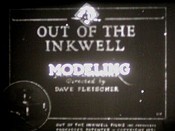
Modeling
- Studio
- Inkwell Studios
- Distributor
- Out of the Inkwell Films
Synopsis
Max draws some ink drops, which coalesce partially, then fully, into The Clown. The Clown seems listless and complains that Max needs to use fresh ink. Max draws the scene on an ice-coated pond and puts The Clown on ice skates to "energize" him. The Clown shows off his ice-skating technique by doing a number of stunts all over the pond. In the meantime, a rather ugly man with a big nose comes into the studio, and "Doc" Crandal sculpts a bust of his head. The man rejects it, saying, "It's no good... it looks too much like me!" While Max tries to intervene, The Clown, taking in the scene, after peering closely at the man, draws a picture of him with his skates on the ice. Unsatisfied with this, he rolls up a big ball of snow and sculpts the man's head out of the ball of snow. The sculpted clay head takes on a life of its own, with the features distorting in all kinds of positions. The Clown climbs out of the frame and climbs up the pedestal and onto the sculpted head, causing all kinds of consternation among Max, "Doc" Crandal and the man, causing the client to leave in a huff. The Clown finally dives back into the inkwell, closing the film.
Characters
The Clown.
Live-Action Characters: Max Fleischer, Roland "Doc" Crandal
Credits
Directing
- Director
- Dave Fleischer
Producing
- Producer
- Max Fleischer
- Executive Producer
- Alfred Weiss
Writing
- Writer
- Max Fleischer
Animation
- Animator
- Max Fleischer, Roland Crandall
Crew
- Created By
- Dave Fleischer
Production notes
Silent cartoon.
A series combining live action and animation created by Max Fleischer, this was one of the most popular short subjects of the 1920s. The films started with the artist, Max Fleischer drawing "The Clown," who would eventually be known as Koko. The "Clown" would challenge his creator, exhibiting a will of his own, and eventually break away from his existence on paper, crossing "the fourth wall" into reality, seeking some sort of pay back for being controlled by his creator, only to be returned to the inkwell before things got too far "out of hand."
A series combining live action and animation created by Max Fleischer, this was one of the most popular short subjects of the 1920s. The films started with the artist, Max Fleischer drawing "The Clown," who would eventually be known as Koko. The "Clown" would challenge his creator, exhibiting a will of his own, and eventually break away from his existence on paper, crossing "the fourth wall" into reality, seeking some sort of pay back for being controlled by his creator, only to be returned to the inkwell before things got too far "out of hand."
Pictures

Reviews
Modelling
After five years at the Bray Studios, and three years of producing OUT OF THE INWELL there, Max and Dave Fleischer left to start their own studio, Out of the Inkwell Films, Inc. in 1921. This was their first release, and is a curious reworking of a theme used in the "Chinaman." In this case, Roland Crandal is a sculptor, and has an ugly man with a big crooked nose for a client. The client is disappointed because the bust looks just like him. Crandal calls on Max for assist-ance. While Max leaves the drawing board, the clown, who was complaining about not having any pep has been put on ice skates. The clown sees the men discussing the problem with the bust, and mocks the client by etching an exact image of the ugly man in the ice. The clown then grabs a mound of snow, and forms his own sculpture in an exact image of the man. Max and Crandal turn and see this, and Max throws a wad of clay at the clown, pinning him to the paper. The client resumes his sitting, and the clown manages to get loose and climbs into the mouth of the sculpture, causing it to wiggle with parts of the nose to breaking off and slinking along like a big worm. This startles the client, causing him to fall backward on the stool. Max and Crandal grab the wod of clay and the clown being made of ink, dissolves out from the clay, and skates his way back to the drawing board. The clown throws the wad of clay used on him and it hits the client. Indignant, the client leaves, hurling a wad of clay meant for Crandal, but hitting Max. Enjoying all this, the clown skates off the paper and hops into the ink bottle. This first effort as independent producers has much more plot, and uses cleaver devices including a combination of cartoon animation with stop motion with the clay bust as used to show the mouth opening with the clown slipping inside. This is also one of the earliest known suriving films that used claymation techniques. Highly entertaining.