
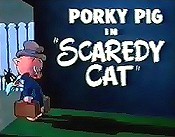
Scaredy Cat
- Studio
- Warner Bros. Cartoons, Inc.
- Distributor
- Warner Bros.
Synopsis
Porky and Sylvester spend the night in Porky's new Gothic mansion. Lo and behold, ghost mice bent on killing Porky haunt the house. Sylvester (whom Porky calls "a yellow dog of a cowardly cat") gets blamed for their attempts on Porky's life, but saves his companion time and again.
Characters
Porky Pig, Sylvester, Ghost Mice, Sylvester's Conscience
Credits
Directing
- Director
- Chuck Jones (as Charles M. Jones)
Producing
- Producer
- Edward Selzer
Writing
- Writer
- Michael Maltese
Animation
- Animator
- Lloyd Vaughan, Ken Harris, Phil Monroe, Ben Washam
Voices
- Voice
- Mel Blanc (Porky, Mouse)
Music
- Music
- Carl Stalling
Crew
- Layouts
- Robert Gribbroek
- Backgrounds
- Peter Alvarado
Production notes
Two scenes have been cut from TV prints. Sylvester pointing a gun to his head in Porky's bedroom and another in which a mouse hiding in a vase points a gun at Porky.
The first cartoon in which Sylvester is named, as well as the first appearance of Sylvester in a cartoon directed by Chuck Jones. One of only two cartoons- the other is "Claws For Alarm- in which Sylvester does not speak.
The first Sylvester cartoon animated by Ken Harris, Lloyd Vaughan or Ben Washam, and the first of only two animated by Phil Monroe.
The Blue Ribbon release featured green rings.
In September of 1943, beginning with A Feud There Was, Warner Bros. began re-releasing select color cartoons in their Blue Ribbon program. Typically the Blue Ribbon reissues received new opening sequences with Blue Ribbon title cards and standardized music. Cartoon production credits were also removed. Between ten and fifteen cartoons were released in any given year, with cartoons coming from as far back as 1935. The reissues continued until the close of the studio in the 1960's.
All Blue Ribbon cartoons were released as "Merrie Melodie" cartoons regardless of the original series. The first "Looney Tunes" short to be included in the Blue Ribbon series was The Hep Cat, which was added in 1949. The only current prints of many of these cartoons are the Blue Ribbon releases, although restoration of these cartoons with original elements and titles is always ongoing.
Pictures


Reviews
Porky and Sylvester at their best!
This is the original that Claws for Alarm was based on. This version has funnier lines and Porky is more sympathetic to Sylvester's plight in this one. This one seems to come up more often than Claws for Alarm, but they are both great!
Scaredy Cat
This is certainly not the first pairing of Porky and Sylvester. That distinction goes to Kitty Kornered. What does make this cartoon great is that Sylvester gets to stretch his pantomime skills. Under Jones competant guidance, we get to see Sylvester try to warn Porky of their impending doom through a series of "histrionic" jestures and complex facial expressions and tell the story way better than anyone else could with dialogue (one of Jones' specialties). Another great aspect of this cartoon is that the constuction is that of the best suspenseful drama or horror movies. The cinematography and the pace create an incrediblly cerebral atmosphere that could rival Hitchcock's best work really. All this and Sylvester's ability come together at the end to make an absolutely brilliant climax. Sylvester's expressions, the sun rise used for emphasis, and the music make for an ending that can blow anything away. Thankfully, this cartoon is available on the first wave of Looney Tunes dvds. I urge all to either buy a copy or, if you've already done so, rewatch this particular cartoon to see what I mean.
Scaredy Cat
Jones understood as much about Sylvester as he later would the Tom & Jerry characters: in either case, no grasp at all of their salient traits. Jones' most unforgivable sin here is robbing SYlvester of the gift of speech--this was an already-well-established character trait of the cat's...part of what makes him so funny. Why doesn't the cat just SAY TO the pig there's something behind him?!?
Worst of all is the plot resolution, where Jones (of all people) drags out two of the tiredest cliches in all cartoondom: he has Sylvester's "angel conscience" appear and tell him (with SIGNS, for God's sake) to save his master (I NEVER could connect with the notion of a humanized-animal having an animal-animal for a pet). FInally, Sylvester never having uttered a word, a mouse comes out of a cuckoo clock and utters the trite line, "Pussycats is the craziest peoples!"
Scaredy Cat
Jones knew about as much of what made Sylvester tick as he did later about H-B's Tom & Jerry. This isn't Sylvester--this is an impostor. And he robs the poor feline of the gift of speech!
THe worst is at the conclusion: Sylvester being rendered mute, he's visited by his "Angel" conscience, holding up signs prompting Sylvester to save his master Porky......one of the tiredest cliches in cartoondom. (That's another thing in cartoons I never could relate to--a two-legged, humanized animal having a four-legged pet animal. It's kinda redundant, isn't it?)