
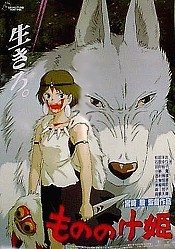
Mononoke Hime
Mononoke Hime is a 1997 Studio Ghibli animated feature film from Studio Ghibli, Tokuma Shoten, Dentsu, Nippon Television Network, directed by Hayao Miyazaki and Hiroyuki Ito, released on July 12, 1997.
Also known as: もののけ姫
English titles: Princess Mononoke, Princess Ghost, Phantom Princess
- Studio
- Studio Ghibli, Tokuma Shoten, Dentsu, Nippon Television Network
- Distributor
- Toho, Miramax Films
Synopsis
A prince is infected with an incurable disease by a possessed boar/god. He is to die unless he can find a cure to rid the curse from his body. It seems that his only hope is to travel to the far east. When he arrives to get help from the deer god, he finds himself in the middle of a battle between the animal inhabitants of the forest and an iron mining town that is exploiting and killing the forest. Leading the forest animals in the battle is a human raised by wolves, Princess Mononoke.
Characters
Prince Ashitaka, San The Princess Mononoke, Lady Eboshi, Jiko Bô, Moro, Kôuroku, Gonza, Toki, Oracle, Okkoto
Credits
Directing
- Director
- Hayao Miyazaki
- Assistant Director
- Hiroyuki Ito, Koji Aritomi, Masakatsu Ishizone
Producing
- Producer
- Toshio Suzuki
- Executive Producers
- Yasuyoshi Tokuma
- Associate Producer
- Seiji Okuda, Diana Tauder
Writing
- Writer
- Hayao Miyazaki
- Original Story
- Hayao Miyazaki
- English Translation
- Neil Gaiman
- ADR Script Consultant
- Jack Fletcher
Voices
- Voice
- Yôji Matsuda (Prince Ashitaka), Yuriko Ishida (Princess Mononoke), Yûko Tanaka (Lady Eboshi), Kaoru Kobayashi (Jiko Bô), Akihiro Miwa (Moro), Masahiko Nishimura (Kôuroku), Tsunehiko Kamijoe (Gonza), Sumi Shimamoto (Toki), Mitsuko Mori (Oracle), Hisaya Morishige (Okkoto)
- English Version
- Billy Crudup (Prince Ashitaka), Claire Danes (Princess Mononoke), Minnie Driver (Lady Eboshi), Billy Bob Thornton (Jigo Bou), Gillian Anderson (Moro), Keith David (Okkoto)
Music
- Music
- Jô Hisaishi
- Theme Song Composition
- Joe Hisaishi
Animation
- Animation Supervisor
- Kitaro Kousaka, Masashi Ando, Yoshifumi Kondô
- Animator
- Masashi Ando, Kitaro Kosaka, Yoshifumi Kondo
- Key Animation
- Atsuko Otani, Atsuko Tanaka, Eiji Yamamori, Hideaki Yoshio, HIroko Minowa, Hiroshi Shimizu, Ikuo Kuwana, Katsuya Kondo, Kenichi Konishi, Kenichi Yamada, Kenichi Yoshida, Makiko Futaki, Mariko Matsuo, Masaaki Endou, Masako Shinohara, Masaru Matsuse, Megumi Kagawa, Michio Mihara, Noriko Moritomo, Sachiko Sugino, Shinji Otsuka, Shinsaku Sasaki, Takehiro Noda, Takeshi Inamura, Toshio Kawaguchi, Tsutomu Awada, Yoshinori Kanada
- Inbetween / Clean-up Animation
- Komasa, Akihiko Adachi, Akihiko Uda, Akiko Teshima, Alexandra Weihrauch, Atsuko Matsushita, Atsushi Tamura, Chiharu Haraguchi, Daisuke Nakayama, David Encinas, Emiko Iwayanagi, Eriko Shibata, Hana Kikuchi, Hiroko Tetsuka, Hiroko Yasutome, Hiromasa Yonebayashi, Hiromi Furuya, Hiromi Nishikawa, Hisako Yaji, Kaori Fujii, Kazuko Hirai, Kazuko Shibata, Keiko Nakaji, Keiko Tomizawa, Keiko Watanabe, Keiko Yozawa, Kiyoko Makita, Koujirou Tsuruoka, Kumiko Ohta, Kumiko Tanihira, Kuri Sawa, Makiko Suzuki, Manabu Kawada, Mariko Suziki, Masae Tanabe, Masae Tomino, Masako Sakano, Masayo Fujikura, Maya Fujimori, Mayu Yazawa, Mayumi Ohmura, Mayumi Yamamoto, Mineko Ueda, Minori Noguchi, Misuzu Kurata, Miyoko Shikibu, Morihiko Yano, Natsuko Iimori, Natsuko Watanabe, Noriko Odaka, Reiko Mano, Rie Kondo, Rie Niidome, Rie Shimizu, Ritsuko Shiina, Sachiko Kobayashi, Seiko Azuma, Shin Itagaki, Shinobu Mori, Shinobu Tsuneki, Sumie Nishido, Tamami Yamada, Yayoi Toki, Yoko Nagashima, Yoko Toju, Yoshie Hayashi, Yukari Yamaura, Yukie Sako, Yumiko Kitajima
- Animation Check
- Hitomi Tateno, Katsutoshi Nakamura, Kazuyoshi Onoda, Masaya Saito, Rie Nakagome
- Film Development, Timing
- Hiroaki Hirabayashi
- Supporting Animation
- Anime Torotoro
Art Department
- Art Directors
- Kazuo Oga, Naoya Tanaka, Nizo Yamamoto, Satoshi Kuroda, Youji Takeshige
- Color Design
- Michiyo Yasuda
- Color Key
- Kanako Moriya, Masayo Iseki, Naomi Mori
- Background Art
- Hiroaki Sasaki, Hisae Saito, Junichi Taniguchi, Kiyomi Oota, Kyoko Naganawa, Masako Osada, Naomi Kasugai, Noboru Yoshida, Ryoko Ina, Sadayuki Arai, Sayaka Hirahara, Seiki Tamura
- Ink & Paint
- Akiko Aihara, Akiko Ono, Atsushi Kodama, Chie Harai, Chiemi Miyamoto, Chiyomi Morisawa, Eiichi Suzuki, Emiko Motohashi, Eriko Ishikawa, Fumiko Oda, Fumiko Taira, Hiroko Otsuk, Hiromi Tsuchiya, Hisashi Nabetani, Junko Kanauchi, Junko Miyakawa, Junko Nagaoka, Kaori Anmi, Kaori Ishikawa, Kaori Yajima, Kaoru Morita, Kaoru Nakagama, Kazue Urayama, Kazuhiro Hirabayashi, Kazuko Kurosawa, Kazuko Tsunoda, Kazuko Yamada, Kazumi Ouchi, Kazuo Kobayashi, Keiko Goto, Keiko Sasaki, Keiko Sato, Kimiko Hatano, Kimiyo Okunichi, Kinuyo Maehara, Kiyomi Fujihashi, Makiko Ota, Mari Hitokurai, Mariko Shimizu, Masako Osumi, Megumi Matsuo, Michiyo Iseda, Mihoko Irie, Mito Ozaki, Miyoko Yoshida, Naomi Anzai, Naomi Atsuta, Naomi Takahashi, Nobuko Watanabe, Reiko Daigo, Sachiko Funasaki, Sayuri Nagashima, Sayuri Takagi, Shizuka Ishiguro, Sigeko Akanuma, Sonoe Sakano, Sumiko Furuya, Tae Tochihara, Tatsumi Yukiwaki, Tomoko Totsuka, Tomoko Yamamoto, Tomomi Tenma, Toshiko Iwakiri, Toyomi Nishimura, Trace-machine, Wakako Sugiyama, Yoriko Asai, Yoshiko Igarashi, Yoshimi Nishiwaki, Yukie Nomura, Yumiko Kimura, Yuriko Katayama, Yuriko Kudo, Anime House, Hadashi Pro, Monsieur Onion, Peacock
- Digital Ink & Paint
- Akira Sugino, Hiroaki Ishii, Kanako Takahashi, Keiichiro Hattori, Makiko Sato, Megumi Ishido, Yuki Murata, Yukiko Kakita, Yumiko Shimoe
- Digital Ink and Paint
- Naigai Carbon Ink, Stac
Visual Effects
- Special Effects
- Kaoru Tanifuji, Kumiko Taniguchi, Masahiro Murakami, Tomoji Hashizume, Toyohiko Sakakibara
- Special Art Effects
- Yoshikazu Fukutome
Camera
- Camera
- Junji Yabuta, Tamaki Kojo, Wataru Takahashi
- Camera Supervisor
- Atsushi Okui
Editing
- Editor
- Hayao Miyazaki, Takeshi Seyama
- Assistant Editors
- Kyoko Mizuta, Mako Tamura, Megumi Uchida
- English Apprentice Editor
- Benu Bhargara
Sound
- Recording & Sound Mixing
- Shuji Inoue
- Recording Assistant
- Masahiro Fukuhara
- Music Mixing
- Makoto Morimoto, Masayoshi Okawa
- Soundtrack CD Production
- Tomoko Okada
- Sound Effects
- Muchihiro Ito
- Sound Effects Assistant
- Takahisa Ishino
- Sound Effects Production Support
- Kazuhiko Ikai, Motoi Watanabe, Shigeru Tokida
- Sound Effects Compilation Support
- Takao Kato, Tsunahiro Yamamura, Aichi-ken Horai-cho, Masamune Kogei, Tokyo Kita-ku Archery League
- Sound Mix Assistant
- Makoto Uchida, Tsukuru Takagi, Tsutomu Asakura
- Audio Director
- Kazuhiro Wakabayashi
- Assistant Audio Director
- Kei Mayama
- Recording & Mixing
- Tokyo T.V. Center
- Audio Recording
- Omnibus Promotion
- Sound Mixing
- Omnibus Promotion, Tokyo T.V. Center
- Effects & Foley Editor
- Dan Edelstein, Gerald Donlan, Warren Shaw
- Assistant Sound Editor
- Charlotte Stebbs, Steve Swartz
- Re-Recording Mixing
- Dominick Tavella
- ADR Engineers
- Ernie Sheesley, James Twomey
- ADR Editor
- Ernie Sheesley
Music Department
- Orchestra Conductor
- Hiroshi Kumagai
- Music Recording
- Hiroya Ishihara, Kenji Furukawa, Wonder Station
- Music Production
- Kazumi Inaki, Toru Takigawa, Yukio Yamashita, Wonder City
Casting
- English Voice Direction
- Jack Fletcher
Production Management
- Production Manager
- Toshiyuki Kawabata
- Production Administration
- Shinsuke Nonaka, Yuichiro Mochizuki
- Production Assistant
- Kenichiro Suzuki, Kenji Imura, Koji Otsuka, Takahiro Yonezawa, David Beron, Eric Lewis, Laurie Bean, Lisa Carlon
- Internet Coordinator
- Noriko Ishimitsu
- Production
- Tokuma Shoten
Crew
- Advertising Producers
- Chihiro Tsukue, Fumiyo Sasada, Mariko Kato, Masaru Tsuchiya, Masaru Yabe, Michiyo Koyanagi, Mieko Hara, Mika Watanabe, Morikazu Wakizaka, Naoto Okamura, Nozomi Fukuda, Shigeto Arai, Yusuke Tomoda
- CG
- Masafumi Inoue, Mitsunori Kataama, Yoshinori Sugano, Yoshiyuki Momose
- Digital Optical Recording
- Noboru Nishio
- Optical Recording
- Futoshi Ueda
- Dialogue Recording
- Mitsuharu Kanei, Nobutaka Hirooka, Rie Nishijima, Tatsuya Ikeba, Yuki Yasoshima
- Theme Song Arrangement
- Joe Hisaishi
- Theme Song Lyrics
- Hayao Miyazaki
- Theme Song Performance
- Yoshikazu Mera
- Chief Executive Producer
- Yasuyoshi Tokuma
- Production Committee
- Akio Ichimura, Daisuke Kadoya, Eiko Fujitsu, Hidehiko Takei, Junko Ito, Kako Nomoto, Kazuaki Ito, Minoru Muroi, Mitsuyoshi Katsurada, Noboru Tsukahara, Nobuhisa Sakata, Noritoshi Aoyagi, Ryoichi Fukuyama, Seiji Urushido, Shigeru Kobayashi, Shogo Komagata, Shokichi Arai, Shozo Katsuta, Sue Fujimoto, Takaya Noda, Tomoki Horaguchi, Tomoko Kamiya, Tsutomu Otsuka, Yoshiko Nagasaki, Yushin Soga, Tokuma Shoten
- Production Desk
- Kazuyoshi Tanaka, Tomoaki Nishigiri
- Film Development, Digital Film I/O
- Hideo Tsuji
- Film Development, Optical
- Masaharu Sekiguchi
- Film Development, Technical Cooperation
- Mikio Mori
- Film Preview Production
- Hiroko Hanamoto, Keiichi Itagaki, Gal Enterprise
- Titles
- Kaoru Mano, Yukari Yoshida
- Special Media Advisor
- Masaya Tokuyama
- Special Media Support
- The Yomiuri Shimbun, The Yomiuri Shimbun
- Publishing Development
- Yukari Tai
- Technical Cooperation
- Mamoru Murao, Roy Evans, Shigeharu Kitamura, Yoshiro Saito
- Public Relations
- Minako Nagasawa, Tamami Yamamoto
- Overseas Promotion
- Haruyo Moriyoshi, Keiji Hamada, Stephen Alpert
- Merchandising Development
- Koichi Asano, Tomomi Imai
- English Adaptation
- Neil Gaiman
- English Translation
- Haruyo Moriyoshi, Ian MacDougall, Steve Alpert
- English Executive Producer
- Bob Weinstein, Harvey Weinstein, Scott Martin, Yasuyoshi Tokuma
- English Theme Song Adaptation
- Neil Gaiman
- English Theme Song Performance
- Sasha Lazard
- English Theme Song Translation
- Steve Alpert
Companies and other credits
- Production: Dentsu Inc
- Production: NTV
- Production: Studio Ghibli
- Production Committee: Dentsu Inc
- Production Committee: NTV
- Production Committee: Studio Ghibli
- Production Studio: Studio Ghibli
- Main Animation Studio: Studio Ghibli
- Key Animation: Telecom Animation Film
- Supporting Animation: Group Donguri
- Supporting Animation: Oh production
- Supporting Animation: Studio Cockpit
- Supporting Animation: Studio Takuranke
- Inbetween / Clean-up Animation: Telecom Animation Film
- Ink & Paint: IM Studio
- Ink & Paint: Studio Ad
- Ink & Paint: Studio Killy
- Ink & Paint: Studio OM Aomori Works
- Ink & Paint: Studio OZ
- Ink & Paint: Toei Animation
- Ink & Paint: Trace Studio M
- Digital Ink and Paint: Chromacolour International Ltd
- Music Production: Studio Ghibli
- Music Recording: AVACO Creative Studios
- Music Performance: Tokyo City Philharmonic Orchestra
- Dialogue Recording: AVACO Creative Studios
- Dialogue Recording: MIT Studio
- Sound Effects Production Support: VOX
- Soundtrack CD Production: Tokuma Japan Communications
- Advertising: TOHO
Production notes
This was the first of Hayao Miyazaki's films to be released in the United States under a marketing agreement between Disney and Tokuma. It thus became the first of his films to gain attention in the West.
At the time of its release, it was the highest-grossing Japanese film of any kind.
The movie took 20 years to conceive and three more to produce.
Reportedly, preview audiences laughed nervously at a sequence in which a man's arm was shot off, as they didn't expect such violence in a movie distributed by Disney.
English translator Neil Gaiman also rewrote the script.
This was the first theatrical anime since 1994's "Armitage III" to use "name" actors in the English-language version.
Reviews
Princess Mononoke
Previous reviews have addressed the incredible beauty of the artwork and the soundtrack, so I won't belabor those points except to say it is as beautifully drawn as any animation I've ever seen.
My reason for putting in my two cents worth is this: the movie deals with man's conflict/rapport with nature in a very mature and exciting way. There are no pure "bad guys" or "good guys". The nobility and crass greediness that reside in us all are fairly represented. This attitude creates a complex and thought provoking film that gives young people credit for their ability to grasp issues that are not simply black vs white, but have all the moral shadings of our actual world.
I was deeply moved by this sad yet uplifting tale, and I enthusiastically recommend all of Miyazaki's films as fine cinema that is suitable for all people who are old enough to deal with the occasionally frightening situations. I'm thinking maybe five yrs old and up.
Mononoke Hime
One word: Awesome. Miyazaki Hayo is a genius, and Studio Ghilbi has done masterful work with this particular film.
Set in feudal Japan, it follows the journey of Ashitaka, the outcast prince of the Amishi people. While defending his village from a boar god driven insane with rage, he is stricken with a curse that only the great Forest Spirit can remedy. With that, he sets out to find the Forest Spirit. When he reaches his destination, he finds that the people living here in Iron Town are at odds with the animals of the forest, and an all out war has broken out. To make matters worse, not only are the Iron Town folk at odds with the denizens of the forest, but also with a rival human lord and his army as well. And, in the middle of it all, is San, a young girl abandoned by her parents and raised by Moro, the wolf god. Due to her aliance with the wolves, she is called Mononoke Hime, or Princess of the Wolves. Ashitaka must find a middle ground between all of those involved, and at the same time try and save his own life from the curse inflicted upon him.
This is the beginning of what is nothing short of a masterwork. The colors, animation, story, voice acting, and music all come together marvelously. If you've got a beef with the Anime genre, then I reccomend you watch this film at least twice. I'm willing to bet your opinion that "Anime is just another cartoon" will change, drastically.
This film stood as the number one movie in Japan until it was unseated by the Teeny-Bopper-fueled "Titanic," which (thankfully) was replaced itself by another of Miazaki's masterpieces, "Sen to Chichiro no Kamikakushi" (The Spiriting Away of Sen and Chichiro, or simply Spirited Away). There's a reason for that, folks, and that is that this is one of the greatest animated films of all time.
Elsewhere: Wikipedia