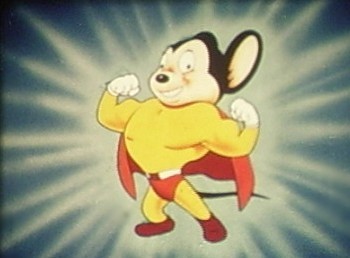
Cat Alarm
- Studio
- TerryToon Cartoons
- Distributor
- 20th Century Fox
Synopsis
The mice of Cheeseville are able to protect themselves from the cats with an alarm that warns them of the approach of feline foes. Mighty Mouse is so grateful for the invention of the alarm that he takes a much-needed vacation to Florida. But the cats plot to capture the mice by faking a news broadcast to Mighty Mouse that the Mouseville dam has burst and a gigantic flood is headed for the town. Flying back to Mouseville at top speed, Mighty Mouse warns the populace of the approaching doom and sends the mice to a cave where the cats trap them. When he becomes aware of the deception, Mighty Mouse flies to the cats' mountain hideout, where he not only saves the citizens of Mouseville, he clobbers the cats and traps them inside their own mountaintop hideout.
Characters
Mighty Mouse, Citizens of Cheeseville, Cats
Credits
Directing
- Director
- Connie Rasinski
Producing
- Producer
- Bill Weiss (Executive Producer)
Writing
- Writer
- Larz Bourne
- Story Supervisor
- Tom Morrison
Voices
- Voice
- Tom Morrison (Mighty Mouse)
Music
- Music
- Philip A. Scheib
Animation
- Animator
- Armand Guidi, Juan Guidi, Larry Silverman, Cosmo Anzilotti
Art Department
- Backgrounds
- Bill Focht
- Design
- John Zago, Martin Strudler
Production Management
- Production Manager
- Frank Schudde
Production notes
The last theatrical Mighty Mouse cartoon. Reportedly, another one had gotten to the storyboard stage for 1966 release, but it evidently never went to cels or film.
One of three shorts produced for inclusion in CBS-TV's Mighty Mouse Playhouse.
Normally, this town would be referred to as "Mouseville," but all the signs in the cartoon say "Cheeseville."
Mighty Mouse talks a lot (more than usual) in this cartoon.
The first shot of Mighty Mouse, in which he relaxes at a resort, shows him without his cape - a rarity for Mighty Mouse cartoons.
Created by I. (Izzy) Klein in the spring of 1940, this character was originally designed as a fly. Paul Terry liked the concept, and green-lighted the project after changing the fly to a mouse called "Supermouse."
After two years on the screen, the Supermouse name was changed to Mighty Mouse. Some reports are that the threat of a lawsuit from DC Comics was behind this name change. Others insist that Terry did not want to compete against a character of the same name that an ex-TerryToons employee drew for Coo Coo Comics.
In any case, in 1944, the character's name was changed, and the Supermouse cartoons were retitled to the new name.