
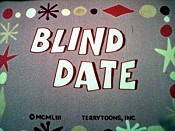
Blind Date
- Studio
- TerryToon Cartoons
- Distributor
- 20th Century Fox
Synopsis
A millionaire dog is looking for his missing childhood sweetheart, "Dimples." He offers a reward in the newspaper. The boys see the offer, and Heckle dresses Jeckle up as a woman in hopes of claiming the fortune. The only thing is that Jeckle looks just too good, and every man in town is after him... including the millionaire. To top it off, the fake Dimples is not really into cross- dressing!
Characters
Heckle, Jeckle, Millionaire Dog
Credits
Directing
- Director
- Eddie Donnelly
Producing
- Producer
- Paul Terry
Writing
- Writer
- Tom Morrison
Voices
- Voice
- Dayton Allen (Heckle, Jeckle), Roy Halee (Heckle, Jeckle)
Music
- Music
- Philip A. Scheib
Production notes
Heckle and Jeckle were two inseparable black magpies, identical in appearance but distinguishably different in personality. Though both were remarkably witty, Heckle spoke with a New York accent, while Jeckle's tone was much more refined. Together, they sought to con free meals and shelter out of the upper class, who in all honesty, presented little difficulty for the clever and mischievous birds.
The first TV appearance of Heckle and Jeckle was on CBS Cartoon Theatre and then thier very own The Heckle And Jeckle Cartoon Show, the very first prime time network animated cartoon series (appearing in 1956, years before The Flintstones). Dick Van Dyke was the host of the show, and he introduced the Heckle and Jeckle segments, along with those of Gandy Goose, by pretending to converse with the animated birds.
In 1979, the magpies appeared in their second show, The New Adventures of Mighty Mouse and Heckle and Jeckle. Once again, the two birds were on the lookout for a free ride, using their immense vocabularies and sharpened street smarts to get the best of people.
The high point of any Heckle and Jeckle cartoon was always the witty banter between the feathered friends. Instead of resorting to violence, the birds bested their foes by outwitting them, and while doing so, indulged in wry commentary that made their adversaries appear even more foolish.
Pictures

Reviews
Blind Date
"Blind Date" is a Heckle & Jeckle cartoon that adults and teenagers will enjoy, but I consider it unappropriate for younger children, due to its bizarre theme of forced cross-dressing. The cartoon character most notorious for this activity is Bugs Bunny, but the wabbit's frequent forays into women's clothing were always voluntary, and Bugs clearly enjoyed pretending to be a girl. "Blind Date" is disturbing because one male cartoon character forcibly disguises another male as a "girl" against his will, and then he initiates a "romance" between this "girl" and a third male.
At the start of "Blind Date", Heckle (the magpie from Brooklyn) reads a newspaper article about Horace, a millionaire who is offering a large reward for the safe return of his long-lost girlfriend Dimple. This inspires Heckle to capture Jeckle (the magpie from England) and drag him back to their bachelor quarters. After consulting a photo of Dimple, Heckle forcibly dresses Jeckle in a corset, dress, high-heeled shoes, blond wig and lipstick. (Heckle just happens to have this female costume handy ... hmm.) Jeckle clearly has no desire to be a "girl", but now Heckle takes the disguised Jeckle to Horace's mansion so that Heckle can claim the reward for returning "Dimple".
Horace is a millionaire dog, who looks and sounds like Dimwit (the dumb hound in several other Heckle & Jeckle cartoons) except that Horace is dressed like a cartoon milionaire (spats, tailcoat, etc.). Of course, Horace is too dumb to notice that his "girlfriend" is really a male magpie in disguise.
Horace keeps trying to smooch with his "girlfriend" Jeckle, who desperately tries to escape but doesn't seem to be able to remove his unwanted female disguise. I find this type of humor somewhat disturbing: parents ought to be aware of it, if only to protect younger children who may be confused or upset by it.
"Blind Date" is also disturbing because it contradicts the usual relationship between Heckle & Jeckle. Normally, the two magpies team up hilariously against all opposition. In "Blind Date", Heckle forces Jeckle into a cruel situation for Heckle's advantage. (Heckle apparently plans to keep the whole reward for himself, without giving Jeckle a share.)
"Blind Date" ends with a very funny gag that reminds me of Buster Keaton's "Seven Chances", even though it's an original gag that doesn't steal from Keaton.
I recommend "Blind Date" for adults and teenagers who enjoy Heckle and Jeckle, but you should screen it carefully before letting young children watch. Your kids might ask some awkward questions about why one "boy" bird wants to turn another boy bird into a girl ... and why a boy dog keeps trying to kiss a boy bird who's wearing girls' clothes.
One of the reviews on the Big Cartoon DataBase website states that Jeckle actually WAS female in the cartoon "The Talking Magpies". That's not correct: "The Talking Magpies" (1946) was made by Paul Terry before he started the official Heckle & Jeckle series. "The Talking Magpies" featured two nameless magpies (one male, one female) who are clearly meant to be a married couple, and who don't look alike. The two magpies in that cartoon are definitely NOT the pair of male lookalikes who starred in the Heckle & Jeckle series.
On a scale of 1 to 10, I give "Blind Date" an 8 for humor, but an asterisk for its content.