
The Little Mermaid
- Studio
- Walt Disney Studios
- Animation studio
- Walt Disney Feature Animation (Burbank)
- Distributor
- Buena Vista Pictures Distribution
Synopsis
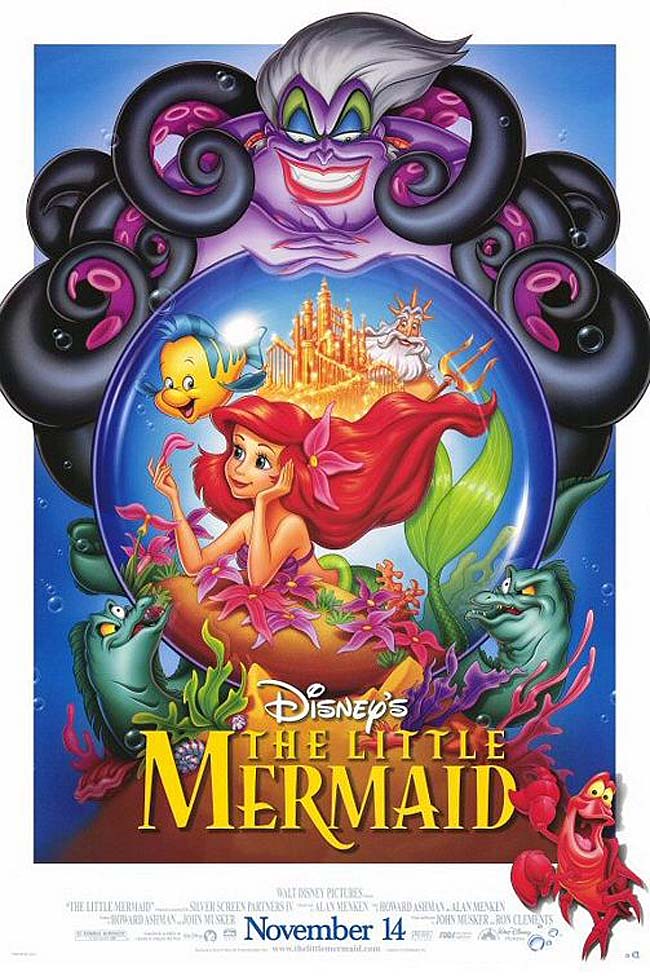
A beautiful mermaid, Ariel, is fascinated by the human world-much to the dismay of her father King Triton, ruler of the Mer-people. Ariel spies handsome Prince Eric and falls hopelessly in love. Sebastian, the crab, is sent by Triton to keep an eye on Ariel, but he cannot stop her from saving Eric's life during a storm at sea.
Ursula, the sea witch, plots to grant Ariel's wish to be human and marry her prince, but only as part of a larger scheme to gain control of Triton's undersea kingdom. In the end, Eric and Ariel join forces to destroy Ursula, and Ariel, transformed into a human, is given Triton's blessing to marry Prince Eric.
Ursula, the sea witch, plots to grant Ariel's wish to be human and marry her prince, but only as part of a larger scheme to gain control of Triton's undersea kingdom. In the end, Eric and Ariel join forces to destroy Ursula, and Ariel, transformed into a human, is given Triton's blessing to marry Prince Eric.
Characters
Ariel, Eric, Sebastian, Flounder, Triton, Ursula/Vanessa, Flotsam, Jetsam, Scuttle, Louis, Grimsby, Carlotta
Credits
Directing
- Director
- John Musker, Ron Clements
- Assistant Director
- Michael Serrian
Producing
- Producer
- Howard Ashman, John Musker
- Associate Producer
- Maureen Donley
Writing
- Writer
- Ron Clements, John Musker
- Story
- Roger Allers
- Original Fairy Tale
- Hans Christian Andersen
Animation
- Animator
- David Stephan, Phil Young, Anthony de Rosa, Doug Krohn, David A. Pacheco, Tony Anselmo, Chris Bailey, James Baxter, Michael Cedeno, David Cutler, Russ Edmonds, Rick Farmiloe (Scuttle), Tony Fucile, Chuck Harvey, Ron Husband, Jay Jackson, Dan Jeup, Leon Joosen, Shawn Keller, Jorgen Klubien, Rob Minkoff, David Pruiksma, Nik Ranieri, Tom Sito, Dave Spafford, Barry Temple, Chris Wahl, Ellen Woodbury
- Assistant Animators
- Michael A. Genz, Sue Adnopoz, Debra Armstrong, Kathleen M. Bailey, Judith Barnes, Arland Barron, Carl Bell, Gee Boedoc, Christopher Cho, Kent Culotta, Margie Daniels, Umberto De La Fuente, Marcia Kimura Dougherty, Lee Dunkman, Teresa Eidenbock, Ray Harris, Carole Holliday, Broose Johnson, Nancy Kniep, Terrey Hamada Legrady, Steve Lubin, Kaaren Lundeen, Brian McKim, Mike McKinney, Terry Naughton, David Nethery, Brett Newton, Dana M. Reemes, Maria Rosetti, Natasha Selfridge, Mike Show, Alan Smart, Dan Tanaka, Peggy Tonkonogy, Alex Topete, Janet Tucker
- Supervising Animators
- Matthew O'Callaghan, Janet Bruce, Mark Henn (Ariel), Glen Keane (Ariel), Duncan Marjoribanks (Sebastian), Andreas Deja (King Triton), Ruben Aquino (Ursula)
- Character Animators
- Philo Barnbart, Chris Buck, Dan Haskett, Kathy Zielinski, Ed Gombert, Andreas Deja, Glen Keane (Ariel)
- Effects Animators
- Dave Bossert, Glenn Chaika, Barry Cook, Randy Fullmer, Christine Harding, Jeff Howard, Christopher Jenkins, Ted Kierscey, Dorse A. Lanpher, Mark Myer, Don C. Paul, Eusebio Torres, Kelvin Yasuda
- Assistant Effects Animators
- Mark Barrows, Allen Blyth, Dan Chaika, Margaret Craig-Chang, Mabel Gesner, Tom Hush, Craig Littell-Herrick, Mike Nguyen, Steve Starr, Allen Stovall, John Tucker
Voices
- Voice
- Jodi Benson (Ariel), Christopher Daniel Barnes (Prince Eric), Pat Carroll (Ursula), Jason Marin (Flounder), Samuel E. Wright (Sebastian), Kenneth Mars (Triton), Buddy Hackett (Scuttle), Rene Auberjonois (Louis), Ben Wright (Grimsby), Paddi Edwards (Flotsam, Jetsam), Edie McClurg (Carlotta), Will Ryan (Seahorse), Charles Adler, Jack Angel, Hamilton Camp, Nancy Cartwright, Jim Cummings, Tim Curry, J.D. Daniels, Jennifer Darling, Ed Gilbert, Gerrit Graham, Mark Hamill, Anne Lockhart, Rod McKuen, Malachi Pearson, Lee Tockar, Robert Weil, Frank Welker
Music
- Music
- Alan Menken
- Songs
- Robby Merkin
- Lyrics
- Howard Ashman
Editing
- Editor
- Mark Hester, John Carnochan
- Assistant Editor
- Scot Scalise
- First Assistant Editor
- Barbara Gerety
- First Assistant Film Editor
- Bill Wilner
- Second Assistant Film Editor
- H. Lee Peterson
Crew
- Casting
- Mary V. Buck, Susan Edelman
- Production Design
- Maureen Donley, Donald Towns
- Art Directors
- Michael Peraza Jr, David Towns
- Production Manager
- Maureen Donley
- Assistant Production Managers
- Sutherland C. Ellwood, Stephen Hickner
- Production Managers, Animation
- Dorothty Aronica McKim, Richard Sullivan
- Character Designer
- Kevin Lima
- Concept Designer
- David A. Dunnet
- Live-Action Model: Ariel
- Sherri Stoner
- Studio Supervisors
- John White, Joe Holmes, Joe Parra
- Story Supervisors
- Brenda Chapman, Thom Enriquez, Ed Gombert, Joel Rault, Gary Trousdale, Matthew O'Callaghan
- Script Supervisor
- Nancy Parent
- Animation Camera
- Rob Maine, Steve P. Damani, Dan Larsen, Harry Moreau, Lin-Z Rogers
- Camera Operator
- Dave Link, John Aardal, Errol Aubry, Ed Austin, Chris Beck, Veronica Hantke, Brandy Hill, Ron Jackson, Chuck Warren
- First Camera Operator
- Joe Jiuliano
- Lamp Operators
- David Thomson, Ann Tucker
- Projectionist
- Don Henry
- Color Timer
- Tom Shaffer
- Key Layout Artist
- Dan St. Pierre
- Layout Designers
- Kelly Asbury, Gary Eggleston, Andy Gaskill, Doug Lefler, Bruce Morris, Kendall O'Connor, Chris Van Allsburg, Rowland B. Wilson
- Layout Artists
- Fred Cline, Lorenzo Martinez, Rasoul Azadani, Fred Cline, Bill Perkins, James Biehold
- Background Supervisor
- Donald A. Towns
- Key Background Artists
- Jo Ann Brewer, Robyn Roberts, Dean Stanley, Bert Wilson
- Background Painter
- Cristy Maltese
- Background Artists
- Tia Kratter, Andrew Richard Phillipson, Kathy Altieri, Doug Ball, Jim Coleman, Greg Drolette, Dennis Durrell, Dean Gordon, Lisa Keene, Philip Phillipson, Craig Robertson, Brian Sebern, Robert Edward Stanton
- Assistant Background Artists
- Jennifer Cha, Jennifer Chiao, Marc S. Christenson, Fred Craig, Rene Garcia, Mac George, Mark Kalesniko, Dan McHugh, Roxy Steven, Lin Yuan
- Background Plate Photography
- Bernie Gagliano
- Color Styling Supervisor
- Elrene Cowan
- Key Color Stylists
- Barbara McCormack, Jill Stirdivant
- Color Stylists
- Betsy Ergenbright, Cindy Finn, Carolyn Guske, Linda McCall, Christina Stocks, Brigitte Strother, Linda Webber
- Modeler
- Rub? Procopio
- Ink And Paint Supervisors
- Gretchen Maschmeyer Albrecht, Carmen Sanderson, Hortensia Casagran
- Ink And Paint Artists
- Jason Buske, Irma Cataya, Greg Chin, Janet English, Robert Kerr, Al Kirsten, Fran Kirsten, Michael D. Lusby, Pam Manes, M?ica M?dez, Lisa Reinert, Laurie Sacks, Elsa Sesto, Andrew Simmons, Joann Tzuanos, Pam Vastbinder, Sharon Vincent, Loretta Weeks, Victoria Winner
- Ink And Paint Assistants
- Chris Hecox, Cherie McGowan
- Paint Supervisors
- Jan Browning, Susan Burke, Penny Coulter, Chuck Gefre, Maria Gonzalez, Barbara Hamane, Ginni Mack, Bethann McCoy, Tanya Moreau, Saskia Raevourl, Heidi Shellhorn, Debra Y. Siegel, Ann Sorensen, Annette Vandenberg
- Paint Artists
- Helga Van Den Berge, Renee Ilsa Alcazar, Joyce Alexander, Lada Babicka, Phyllis Bird, Russell Blandino, Tania Burton, Mimi Frances Clayton, Chris Conklin, Patti Cowling, Elena Marie Cox, Sybil Cuzzort, Sharon M. Dabek, Jean A. Dubois, Phyllis Fields, Joyce Frey, Etsuko Fujioka, Paulino Garc, Kate Hepburn, Eddie Hofmann, Gina Howard, Melody Hughes, David Karp, Kathlyn Kephart, Annette Leavitt, Denise A. Link, Ashley Lupin, Teri McDonald, Celeste McDonald-Perry, Debbie Mihara, Stephanie Myers, Chris Naylor, Leslie Nober, Belle Norman, Barbara Palmer, Melanie Pava, Patricia Pettinelli, Bruce Phillipson, Marilyn Pierson, Ronna Pincus, Gale A. Raleigh, Bonnie Ramsey, Linda Redondo, Sharon Rehme, Colene Riffo, Nellie B. Rodriguez, Ania Rubisz, Gary G. Shafer, Sheryl Ann Smith, Fumiko R. Sommer, Rose Ann Stire, Roxanne M. Taylor, Pattie A. Torocsik, Cookie Tricarico, Britt Van Der Nagel, Irma Velez, Helen Vives, Kathy Walters, Kathy Day Wilbur, Susan Wileman, Denise Wogatzke, Lee Wood, Micki Zurcher, David J. Zywicki
- Paint Assistants
- Gary Eggleston, Janette Hulet, James 'J.R.' Russell
- Painters
- Jason Buske, Irma Cataya, Greg Chin, Janet English, Robert Kerr, Al Kirsten, Fran Kirsten, Michael D. Lusby, Pam Manes, Cherie McGowan, M?ica M?dez, Lisa Reinert, Laurie Sacks, Elsa Sesto, Andrew Simmons, Joann Tzuanos, Pam Vastbinder, Sharon Vincent, Loretta Weeks, Victoria Winner
- Paint Checkers
- Jan Browning, Susan Burke, Chuck Gefre, Maria Gonzalez, Tanya Moreau, Saskia Raevourl, Heidi Shellhorn, Ann Sorensen, Annette Vandenberg, Rhonda L. Hicks
- Airbrush Artists
- William Arance, John Emerson
- Animation Coordinators
- Karen S. Paat, Lisa Poitevint, Bob Revell, Mavis E. Shafer, Barbara Wiles
- Animation Crew
- Francesca Allen, Scott E. Anderson, Dorris Bergstrom, Jerry Lee Brice, Sheila Brown, Merry Kanawyer Clingen, Lee Crowe, Jim A. Davis, Eileen Dunn, Tom Ellery Jr, Mark Fisher, James Fujii, Daniel A. Gracey, Peter Gullerud, Karen Hardenbergh, Tim Ingersolf, Patrick Joens, Jason Lethcoe, Teresa Martin, Tom Mazzocco, Cynthia Overman, Don Parmele, Ginny Parmele, Eric Pigors, Brian Pimental, Michael Polvani, William Recinos, Stan Somers, Bruce Strock, Juliet Stroud, Mike Swofford, Mary Ann Tucker, Tuck Tucker, Jim Van Der Keyl, Dave Woodman, Susan M. Zytka
- Mark-Up
- Rhonda L. Hicks
- Clean-Up Artists
- Bette Isis Baker, Dorothea Baker, Philo Barnbart, Bill Berg, Wesley Chun, Brian Clift, Jes? Cort, Lou Dellarosa, Tom Ferriter, Margaret Flores Nichols, Gail Frank, June K. Fujimoto, Renee Holt, Richard Hoppe, Emily Jiuliano, Marty Korth, Vera Lanpher, Dori Littell Herrick, Lori M. Noda, Gilda Palinginis, Dave Suding, Lureline Weatherly, Cyndee Whitney, Chuck Williams, Stephan Zupkas
- Animation Checker, Ink Supervisors
- Kris Brown, Laura Craig, Eleanor Dahlen, Peggy Gregory, Anne Hazard, Darlene Kanagy, Robin D. Kane, Charlene Miller, Kitty Schoentag, Karan Lee Storr, Tatsuo Watanabe
- Checking Supervisors
- Monica Albracht, Bonnie Blough, Deborah Mooneyham, Madlyn O'Neill, Ann Oliphant, Howard Schartz, Pat Sito
- Animator Trainees
- Ashley Brannon, Bob Bryan, Natalie Franscioni, Dan Boulos, Debbie Du Bois, Brad Kuha, Serge Michaels, Pres Romanillos, Ed Gutierrez
- Cel Cleaners
- Sutherland C. Ellwood, Stephen Hickner
- Cel Service
- Florida M. D'Ambrosio, Rose Dibacci, Shannon Fallis Kane, Frances Moralde, Jessie A. Palubeski, Teresita M. Proctor, Jim Stocks, S. Ann Sullivan
- Xerography Supervisor
- Bill Brazner
- Xerography
- Tina Baldwin, Marlene Burkhart, Douglas E. Casper, Karen Chiu, Warren Coffman, Bob Cohen, Lynnette Cullen, Diana Dixon, Gareth Fishbaugh, Cindy Garcia, Kathryn Gilmore, Suzanne Inglis, Cynthia Neill Knizek, Catherine F. Parotino, Janet Rea, Sherri Vandoli
- Visual Effects Supervisor
- John Cunningham, Mark Dindal, Marti Julian, Joseph Thomas, John T. Vanvliet
- Visual Effects Projectionist
- Don Henry
- Motion Control
- Rob Maine
- Visual Development
- Kay Nielsen
- Special Effects Coordinator
- Jonathan Levis
- Computer Graphics Animators, ILM
- Tina Price, Andrew Schmidt
- Music Producers
- Howard Ashman, Robert Kraft, Alan Menken
- Musical Director
- Robby Merkin
- Orchestrator
- Thomas Pasatieri
- Conductor
- J.A.C. Redford
- Singer, "Kiss The Girl", "Under The Sea"
- Samuel E. Wright
- Singer, "Part Of Your World", "Poor Unfortunate Souls"
- Jodi Benson
- Singer, "Poor Unfortunate Souls"
- Pat Carroll
- Singer, "Les Poissons"
- Rene Auberjonois
- Post-Production Supervisor
- Dennis Edwards
- Executives In Charge Of Sound Post-Production
- Ahmed Agrama, Kent Harrison Hayes
- Post-Production Sound Coordinator
- Fabiola Stevenson
- Sound Editor Supervisors
- Richard C. Franklin Jr, Louis L. Edemann
- Supervising Sound Editor
- Charles L. Campbell
- Sound Editors
- P. Bruce Richardson, Leonard T. Geschke, Chris Jargo, Nils C. Jensen, Chuck Neely
- Assistant Sound Editor
- Pamela G. Kimber
- Sound Editor Trainee
- Jack Nietzsche Jr
- Dialogue Editors
- Theressa Gilroy, Armetta Jackson-Hdamlett, Jim Melton
- Dialogue Loop Editors
- Dennis Moshers Larry Singer
- Foley Artists
- Joe Sabella, Ellen Heuer, John Roesch
- Foley Recordists
- Gregg Orloff, Carolyn Tapp
- Supervising Music Editor
- Kathleen Bennett
- Music Mixer
- John Richards
- Sound Effects Editors
- Alan Howarth, Mel Neiman
- Sound Re-Recording Mixers
- David J. Hudson, Mel Metcalfe, Terry Porter
- Sound Re-Recording Mixer: Foreign Language Versions
- Derek Marcil
- Technology Production Supporter
- Mary Jane 'M.J.' Turner
- Video Engineer
- Bryan J. Rusenko
- Administrator
- Jim Ballantine
- Auditor
- Dennis Park
- Production Coordinator
- Brett Hayden
- Production Secretarys
- Charlene Rogers, Sandee Terzis
- Copying & Shipping
- Wilma I. Guenot, Ann Neale
- Liner Notes
- Gerrit Graham, Samuel Graham, Chris Hubbell
- Production Assistants
- Ron Allen, Bonnie Buckner, Donovan Cook, Stacy R. Meyer
- Special Thanks
- Arlene Schwartz, Albert Tavares, Lulu Washington
Companies and other credits
- Executives In Charge Of Sound Post-Production: car I. D?z
- Video Technicians: Jorge Alia Gregory Hinde Brian Jolley David Jones Hugo Olguin Al Vasquez
Production notes
Initial anticipation was that the film would not even do as well as the previous Oliver & Company, mainly because Mermaid was a "girls film"- Jeffrey Katzenberg's words, not ours. But as the release date neared, all involved knew they had lightning in a bottle, and it would be a big hit. Katzenberg even went back on his initial assessment and proclaimed that The Little Mermaid would be a blockbuster, and be the first animated film to top 100 million in box office. It only reached 85 million.
The idea of doing Hans Christian Andersen's The Little Mermaid had been around the studio for a long time. It was first thought of as a segment in one of the anthology films from the 1940's. Ron Clements proposed it as a full-length feature while still involved in directing The Great Mouse Detective. In 1985, with Tom Hanks and Daryl Hannah's Splash still fresh in his mind, Katzenberg felt the project too similar and vetoed the idea. But even then there was something to the proposal, and he soon relented.
In 1987, off-Broadway songwriter Howard Ashman was brought in to start working on songs for the film. he was familiar to the Disney team having contributed a song to Oliver & Company. In an off-handed remark, Ashman mentioned an idea to update a minor character named Clarence to a Jamaican Rastafarian crab. This small change ended up snowballing through the whole production, changing the focus and energy of the whole film. Music suddenly became one of the main characters of the film, and the story was modified to become a Broadway-style story structure.
Hopes for the film rose ate the studio, and more money was allocated to the budget. The film ended up costing more than 40 million dollars, and amount almost unheard of for an animated film. To create the undersea world, and animate floating characters required a whole new style of animating, and more special effects for any film since Fantasia. Effects animation supervisor Mark Dindal estimated that over a million bubbles were drawn for this film, in addition to the use of other special processes such as airbrushing, back lighting, superimposition, and limited computer animation added to the costs of the movie. There was even an attempt to bring Disney's venerable multi-plane camera into use for the first time in decades. But the machine was in such dilapidated condition there was no way they could use it and the multi-plane shots ended up being photographed at an outside animation camera facility.
While they did not realize it during production, The Little Mermaid would be the last Disney feature to use the traditional hand-painted cel method of animation. Beginning with their next film, final color animation would be accomplished using a digital method of importing the animators drawings, then coloring and combining scanned drawings. This process was called CAPS (Computer Animation Production System), and was developed for Disney by a northern California computer company called Pixar. The CAPS system would save substantial amounts of time and money by eliminating the whole step for inking and painting cels; in fact, cels became a relic of the past. By working in the digital realm, the multi-plane camera and other optical effects used in The Little Mermaid could be previewed in real time rather than after days or weeks of work.
Originally released with the Wallace and Gromit short A Grand Day Out.
So what caused this resurgence in interest in Disney Animated Films? First, the studio was firing on all cylinders, with great animation (Glen Keane and Mark Henn sharing duties on Ariel, Andreas Deja supervising King Triton and Ruben Aquino positively owning Ursula), great music (Broadway-style songs from Alan Menken and incredible lyrics by Howard Ashman) and a great story written by directors Ron Clements and John Musker.
But most of all, it was a return to the Disney roots of animated film making. The Little Mermaid was the first fairy tale the studios had animated since 1959's Sleeping Beauty (a thirty year lapse, for those who are counting). And like the other great Disney classic animated films, The Little Mermaid featured a strong, scary villain, not the milquetoast or comic villains so common through the dark ages of Disney.
The critics saw something they liked, too... The Little Mermaid was nominated for three Oscars (the first Disney film to be so honored since 1977's The Rescuers). It won two, for Best Song ("Under the Sea") and Best Score. The Disney Studios had not been an Academy Award Winner for an animated feature film since 1941 for Dumbo... or 1947 for Song of the South if you want to count that film.
This was the 28th film in the official Disney list of animated films.
Voice actor Samuel E. Wright is also known as actor on "The Dukes of Hazzard" spinoff "Enos" as Officer Turk Adams.
Awards
Academy Award Winner, Best Music, Original Score, 1990.
Academy Award Winner, Best Music, Song ("Under The Sea"), 1990.
Academy Award Nominee, Best Music, Song ("Kiss The Girl"), 1990.
Golden Globe Award Winner, Best Original Score (Motion Picture), 1990.
Golden Globe Award Winner, Best Original Song (Motion Picture), "Under the Sea", 1990.
Golden Globe Award Nominee, Best Picture (Musical or Comedy), 1990.
Golden Globe Award Nominee, Best Original Song (Motion Picture), "Kiss the Girl", 1990
Pictures



Reviews
The Little Mermaid
This is definitly one of my favorite disney movies because of the music and it was just wonderful to look at,sharp eyes look fast for a cameo by Mickey,Donald and Goofy.
The Little Mermaid
Sure, I do agree that The Little Mermaid is a good film and certainly deserves all it's acclaim. However, it's just too much of a chick-flick for me. That's why I'm giving it a less-than-ideal rating.
The Little Mermaid
"The Little Mermaid" represents a return to what made Disney animated films so great in the past, at the same time forging a new idea for movies. Admittedly, LM is based on one of the saddest stories in children's literature, but Disney turned it into a rollicking adventure, full of song and color.
The plot is simple enough: girl sacrifices her voice to get the man of her dreams, but in the able hands of Musker and Clements, it turns into an intergenerational conflict and the need for parents to let their children grow up.
Too much for you? Then sit back and enjoy the lush pallette as the ocean explodes with color and light. Abandoning the wavy effect to indicate being under the sea, the ocean teems with interest, lead by the red-haired Ariel. Her hair flows and bobs on the ocean currents. Her dulcet tones gives meaning to the siren's song.
The music is catchy and memorable, especially the show-stopping "Under the Sea". And evil characters? Ursula is deliciously evil in her double plotting against Ariel and her father, King Triton. Ably abetted by her eels Flotsom and Jetsom, she keeps everyone off-balance.
The excitment builds with false leads and misdirections until the final battle against good and evil.
For some children, the violence may be a bit graphic, as Ursula does not fall to her demise, but something a touch more gruesome, and others will rail against the story-book happy ending, but, it works all for the best.
There is enough in this film to interest children, and parents won't feel embarrassed to see it with them. There's humor, music, excitement and happiness. What more could you want?