
Animation History Timeline 4
Animation Timeline 4 - Golden Age Of Animated Shorts
The next step in Animation History is really the Golden Age Of Animated Shorts. By the 1930's, the cartoon film industry had really matured. The shorts had taken on their modern form, and animated feature films hit the mainstream. By 1932, animated shorts had their own category in the fledgling Academy Awards.
Animation Timeline 4

Ub Iwerks Studio

After Walt Disney and longtime collaborator Ub Iwerks had a falling out in 1930, Pat Powers backed Iwerks in creating his own studio, Celebrity Productions. Some say that Powers instigated falling out, trying to use iWerks as a bargaining chip against Walt Disney in a distribution deal. In either case, Powers was the money behind Iwerks new studio.
It was while running his own studio that Iwerks famously developed his multiplane camera. While his was not the first used in animation, it was the most usable, and the first in Hollywood. It is said that the Iwerks camera rig was build from parts of an old Chevrolet automobile. The Disney Studios was working on one concurrently, but it would not be used until The Old Mill (1937).
Iwerks made his way to Leon Schlesinger Productions at Warner Bros. Studios, where he directed two Looney Tunes shorts. He then jumped over to the A Color Rhapsody at Columbia Pictures, where he directed sixteen shorts between 1937 and 1940. By 1940, he returned to The Walt Disney Studios, where he spent the rest of his career.
See More About Ub Iwerks Studio
1930 – 1936

Merrie Melodies

This series was Warner Bros. second theatrical animated series (preceded by the Looney Tunes cartoon series by about a year), and ran in many movie theaters from 1931 to 1969. Originally conceived as a new cartoon series that would feature music from the soundtracks of current Warner Bros. films, producer Leon Schlesinger funded the series by convinced the studio heads that Merrie Melodies would be the perfect promotional tool for Warner Bros. theatrical musical films. The series had no recurring characters (unlike the Looney Tunes), but was extremely popular with audiences, and even earned an Academy Award nomination it's second year (for It's Got Me Again!).
Hugh Harman and Rudolf Ising left the studio in 1933, taking their characters with them to MGM. Leon Schlesinger took over producing the cartoons from 1933 to 1944. Schlesinger took the series over to color (Cinecolor) in 1934; Looney Tunes would take a further 8 years to move over to color. By this time, the Merrie Melodies were much less music oriented, and the two sister theatrical series became almost indistinguishable.
In September of 1943, beginning with A Feud There Was, Warner Bros. began re-releasing select color cartoons in their Blue Ribbon program. Typically the Blue Ribbon reissues received new opening sequences with Blue Ribbon title cards and standardized music. Cartoon production credits were also removed. Between ten and fifteen cartoons were released in any given year, with cartoons coming from as far back as 1935. The reissues continued until the close of the studio in the 1960's.
See More About Merrie Melodies Cartoons
1931 –

Fiddlesticks
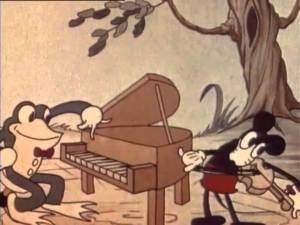
Iwerks first character- Flip the Frog- debuted in the short Fiddlesticks. That debut short was the first animated film released in the Technicolor two-strip process, also becoming thew first animated short to combine color and synchronized sound. So Disney was, in fact, beaten to the punch by his own ex-employee for this first.
August 16, 1930
Peludópolis (Peludó City)

Peludópolis (Peludó City), by Quirino Cristiani, is generally credited as the first animated feature film with sound. The film used the Vitaphone sound-on-disc synchronization system.
September 16, 1931

Flowers And Trees

Flowers and Trees was the first animated film released in the three-strip Technicolor process, and thus the first color Silly Symphony. In fact, Disney films were the only animated films released in the three-strip Technicolor process for the first three years of its availability.
This was also the first film to win an Academy Award for Best Animated Short.
Watch Flowers And Trees On Video
July 30, 1932
Columbia Pictures

Columbia Pictures got off the ground when brothers Jack and Harry Cohn, and Joe Brandt founded Cohn-Brandt-Cohn Film Sales in 1919; it was 1924 before the company took on the Columbia name. Animation first came to the studio when Columbia began distributing Mickey Mouse and other shorts from The Walt Disney Studios.
Animation finally came to Columbia in 1934 when the studio formed up its own animation studio, though the studio had been making Krazy Kat shorts prior to the formation of the animation department. Many popular series came out of the studio, including the long-running A Color Rhapsody series. As the thirties ended, so did the multi-studio series Krazy Kat. New stars like The Fox and Crow and a short stab at comics characters like Lil' Abner ran through the forties, but Columbia never had the hit cartoons like Disney, Warner or even MGM.
The late forties saw Columbia take up distribution of animation upstart United Productions of America, or UPA. By the fifties, Columbia closed its animation studios and contracted UPA to produce animated shorts for the studio. In 1957, after its parent company Columbia dropped UPA, their television arm Screen Gems entered a distribution deal with Hanna-Barbera Productions, the studio which was pioneering and defining animation for the small screen. Screen Gems would distribute Hanna-Barbera cartoons until 1967, when Hanna-Barbera was sold to Taft Broadcasting.
See More About Columbia Pictures
1934 – 1957
The Old Mill

The Old Mill was the first production use of the Disney multiplane camera. Disney also won an Academy Award (Scientific or Technical, Class II) for the invention and use of the Multiplane Camera which allowed a greater depth of field than the regular two dimensional animation of the time.
This short went on to win an Academy Award for Best Animated Short.
November 05, 1937
Snow White And The Seven Dwarfs

Disney's first full-length animated film, Snow White And The Seven Dwarfs went from being Disney's folly to profitable and respected art form.
Snow White was the first animated feature film to be nominated for an Academy Award. While it lost in that category, it was awared a Honorary Oscar in 1939, recognizing the film as a significant screen innovation which has charmed millions and pioneered a great new entertainment field (one statuette - seven miniature statuettes).
In 1989, Snow White and the Seven Dwarfs was the first cartoon to be added by the Library of Congress' National Film Preservation Board to the National Film Registry (it was the registry's inaugural year).
Read More About Snow White And The Seven Dwarfs
December 21, 1937

The Milky Way

It took nine years, but finally a studio other than Disney wins an Oscar for best animated film. MGM took the top honor with the Rudolf Ising directed The Milky Way. MGM would go on to dominate the Academy Awards in the 1940's to the same extent that Disney did in the previous decade.
June 22, 1940
A Wild Hare

Bugs Bunny first appeared in "A Wild Hare" directed by Tex Avery. Though he was nominated with this, his premiere performance, Bugs would not win his first Oscar until 1959 with "Knighty Knight Bugs."
July 27, 1940