
49: The Princess And The Frog
Disney Revival
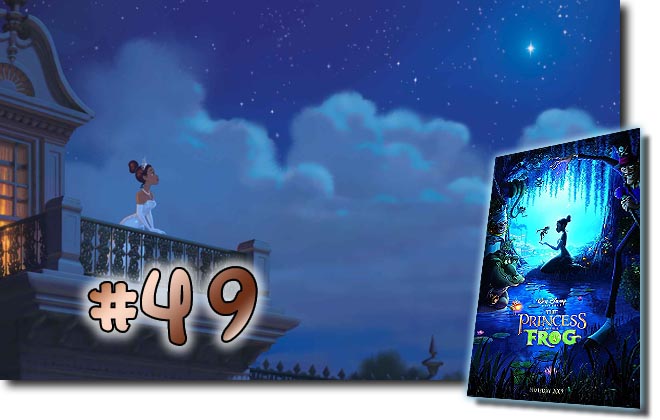
Ron Clements and John Musker, directors who kicked off the Disney Renaissance in twenty years previous with The Little Mermaid (1989), return to Disney to direct The Princess and the Frog. Not only does this film kick off a new Disney revival, but it proves the end of the Eisner "All films will be digital 3D computer generated" decree. Many people champion the fact that The Princess and the Frog is notable for featuring the first African-American Disney Princess, Tiana. And that is true enough. But the Disney return to hand animation (in 2 or 3 D!), the return to musicals, and the return to well-known fairy tales are the real story here.
Production
With the ouster of Michael Eisner in 2006, incoming Ed Catmull and John Lasseter, the new president and chief creative officer of Disney Animation Studios, immediately reversed this decision and brought back hand-drawn animation at the studio. Lasseter began the long process of luring back all the talent Eisner had either been laid off or had left the studio when Eisner closed the traditional animation units in 2003. In Lasseter's efforts to rebuild the legacy of hand-drawn animation, he brought back Disney Renaissance directors Ron Clements and John Musker and gave them almost free reign over The Princess And The Frog.
When announced as The Frog Princess in July 2006, it drew criticism from many quarters. African-American critics disapproved of the name for the heroine (Maddy), the setting, her occupation as a chambermaid, and many other factors. French people found the title a slur on their nationality. All of these critiques were addressed by Disney in some manner or fashion.
Clements and Musker kept at work on the project, aiming for a classic Disney look. The pair looked to Lady and the Tramp as the quintessential Disney film. Returning to the Disney roots seemed to be the watchwords on this production, with animator Andreas Deja focusing on what 2D is good at- the quality of a line. Speaking on what Disney perfected in the 1950's, Deja said, "All those things that were non-graphic, which means go easy on the straight lines and have one volume flow into the other – an organic feel to the drawing."
Reportedly, Alan Menken was the automatic choice of writers Ron Clements and John Musker as composer (they had all worked together on "The Little Mermaid"), but Disney chief creative officer John Lasseter insisted on Newman because of the New Orleans setting. Composer Randy Newman was born in Los Angeles and moved with his family to New Orleans, where his mother's family lived. He lived there as a small child and summered there until he was 11. His 1974 song "Louisiana 1927" (and Aaron Neville's cover version) gained much radio airplay in the aftermath of Hurricane Katrina. His music brought a special feel to The Princess And The Frog that Menken probably could not have achieved.
Because the CAPS system was now so outdated, Disney brought in a new animation and coloring system called Toon Boom Harmony. To test the new system, the animators knocked out a quick Goofy short called How to Hook Up Your Home Theater. The WACOM digitizers were not easy for the animators to use, so it was decided to return to pencil and paper for animation.
The fun and mysterious "A-113" Easter Egg makes an appearance on the street car in The Princess And The Frog…

Princess And The Frog Release
The 2009 film had a final budget of 105 million. The film grossed over 265 million in release, so it was a substantial hit for Disney, and a fine way to kick off the new Disney revival.