
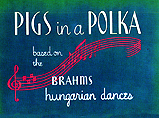
Pigs In A Polka
Pigs In A Polka is a 1943 Merrie Melodies theatrical cartoon from Leon Schlesinger Studios, directed by Isadore Freleng, released on February 2, 1943.
- Studio
- Leon Schlesinger Studios
- Distributor
- Warner Bros.
Synopsis
A spoof of the Three Little Pigs set to Brahms' "Hungarian Dances." The Big Bad Wolf is able to fool only two out of the three pigs.
Characters
Three Little Pigs, Big Bad Wolf
Credits
Directing
- Director
- Isadore Freleng (as I. Freleng)
Producing
- Producer
- Leon Schlesinger
Writing
- Writer
- Warren Foster
Voices
- Voice
- Mel Blanc (Big Bad Wolf, Third Pig), Sara Berner (First Pig), Bea Benaderet (Second Pig)
Music
- Music
- Carl W. Stalling
Animation
- Animator
- Ken Champin
- Layout Artist, uncredited
- Owen Fitzgerald
- Animators, uncredited
- Richard Bickenbach, Jack Bradbury, Gerry Chiniquy, Manuel Perez, Gil Turner
Production notes
The actual release date of this cartoon is in question. Some sources (Leonard Maltin, Of Mice And Magic; Graham Webb, The Animated Film Encyclopedia [Second Edition, 2011]) report the release date as being January 9th, 1943. Other sources (Jerry Beck & Will Friedwald, Looney Tunes and Merrie Melodies [1989]; Douglas L. McCall, Film Cartoons: A Guide to 20th Century American Animated Features And Shorts [1998]) February 2 as the release date. And one source (imdb.com [http://www.imdb.com/title/tt0036264/]) lists February 6 as the release date. Maltin and Webb's date may be the production date or the copyright rather than the release date. Also, Beck & Friedwald's earlier edition (The Warner Brothers Cartoons. Scarecrow Press. 1981.) lists the January 9 date, so it looks like the February 2 date in their later edition might be a correction. Thanks to bryanhbell for the research.
The wolf introduces the Three Little Pigs story very much like Deems Taylor in "Fantasia."
In September of 1943, beginning with A Feud There Was, Warner Bros. began re-releasing select color cartoons in their Blue Ribbon program. Typically the Blue Ribbon reissues received new opening sequences with Blue Ribbon title cards and standardized music. Cartoon production credits were also removed. Between ten and fifteen cartoons were released in any given year, with cartoons coming from as far back as 1935. The reissues continued until the close of the studio in the 1960's.
All Blue Ribbon cartoons were released as "Merrie Melodie" cartoons regardless of the original series. The first "Looney Tunes" short to be included in the Blue Ribbon series was The Hep Cat, which was added in 1949. The only current prints of many of these cartoons are the Blue Ribbon releases, although restoration of these cartoons with original elements and titles is always ongoing.
Awards
Academy Award Nominee, Best Short Subject (Cartoon), 1943
Pictures


Reviews
Pigs In A Polka
The body of this cartoon has no dialog. But the music is captivating. All the action is choreographed to Brahm's pieces, and very well done. This cartoon motivated me to research the Hungarian Dances. Turns out my parents had some old 10" 78rpm recordings of them.
Pigs In A Polka
One of Friz's best musicals. It's an outrage that it lost the Oscar to Disney's "The Fuhrer's Face".
Elsewhere: Wikipedia