

The Organ Grinder
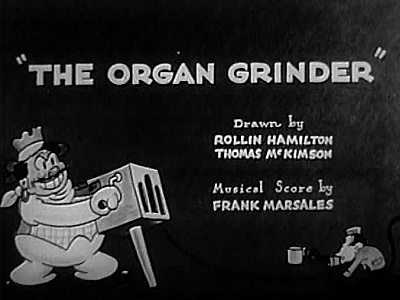
The Organ Grinder is a 1933 Merrie Melodies theatrical cartoon from A Hugh Harman-Rudolf Ising Production, Vitaphone Pictures, directed by Rudolf Ising, released on April 8, 1933.
- Studio
- A Hugh Harman-Rudolf Ising Production, Vitaphone Pictures
- Distributor
- Warner Bros.
Synopsis
The lost art of the organ grinder and his monkey is celebrated in this grand Depression-era cartoon! A beloved Italian organ grinder plays his music and sings his song through a immigrant- filled ghetto neighborhood, where hard-scrabble kids and well-proportioned matrons get hep to the beat that flows from the organ grinder's calliope. Lots of spoofs of life on the Lower East Side and lots of monkeyshines as the organ grinder's pet performs "42nd Street" and imitates some Hollywood greats. The monkey takes wing and gets behind the wheel of a car, driving all over the area and wrecking everything.
Characters
Organ Grinder, Monkey
Credits
Directing
- Director
- Rudolf Ising
Producing
- Producer
- Hugh Harman, Rudolf Ising
Music
- Music
- Frank Marsales
Animation
- Animator
- Rollin Hamilton, Thomas McKimson
Production notes
The monkey does impressions of Laurel & Hardy as well as Harpo Marx in this cartoon.
This cartoon is included as an extra on the home DVD release of "The Mayor of Hell" (1933).
This cartoon is included as an extra on the home DVD release of "The Mayor of Hell" (1933).
Pictures


Reviews
The Organ Grinder
A fantastically drawn black and white cartoon which, at 7:30 minutes, feels like a featurette. The humor is mostly situational, with topical jokes popping in only when the amazing morphing monkey recreates himself in the forms of Harpo Marx, Stan Laurel and Oliver Hardy. This helps keep the film entertaining even for today's context-deprived youngsters (unlike so many of the 1930s cartoons filled with dozens of now-forgotten celebrities and newsmakers).
Despite his vigorous and sometimes destructive exploits (culminating in a car crash into a music store), the other characters in the cartoon are quite charmed by the cartoon's ingenue, an organ-grinder's monkey on the lam.
The cartoon is valuable for snippets of early 1930s New York culture. The organ grinder is the stereotypical Italian, chubby, mustachioed and becapped. He bears more than a passing resemblence to a slightly more life-like "Mario", and he is portrayed as considerably less intelligent and creative than his pet. The soundtrack is appropriate and entertaining. The film's final three minutes run to a setting of "42nd Street", and snippets of music from early Depression-era pop charts (like Cab Calloway's "Hi di ho") are scattered throughout.
Seventy years after being made, "The Organ Grinder" is a visual and aural time capsule of a lost world as experienced through the warped senses of studio animators. The streets are filled with Kosher butchers, pawn shops (replete with the classic three-ball sign), street vendors whose carts are stacked high with produce, open-top large-fendered automobiles, lines of wash stretched between tenement windows, old-fashioned women's support garments and much, much more.
On top of all this, the comedic timiming and general pacing of the piece are perfect. No scene lingers longer than it should, and the viewer's attention is never lost, yet the pace never results in "hanging" jokes or thematically inconsistent illogic. Ultimately more entertaining than the vast majority of longer cartoons from the 1930s, with almost none of the annoying illogic that flaws many of the Merrie Melodies series.