
The Perfect Lesson
- Studio
- The Orphanage Inc.
- Distributor
- Canadian Broadcasting Corporation
Synopsis
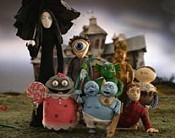
A wondrous and fiendishly humorous series about a Newfoundland orphanage full of freakish children who are desperately trying to get adopted.
Characters
Princess Lucy, Aldous, Armie, Brian Brain, Beasley & Byron, Charlie, Sammy Fishboy, Seymour Talkless, Nanny Goodapple
Credits
Directing
- Director
- Bradley (Brad) Peyton, Marc Lougee
- First Assistant Director
- Jason M. Washington
Producing
- Producer
- Susan Ma (Co-Producer)
- Executive Producers
- Bradley (Brad) Peyton, Fred Fuchs
- Supervising Producer
- Edward Kay
- Creative Producer
- Marc Lougee
- Assistant Editor
- Kemal Ally
Writing
- Writer
- Bradley (Brad) Peyton, Dwayne Hill, Edward Kay
- Creator
- Bradley (Brad) Peyton
- Punch-Up Writer
- Kyle Muir
- Additional Dialogue
- Dwayne Hill
- Script Supervisor
- Joanna Corbett
Voices
- Voice
- Adam Reid (Armie), Stacey Depass, Dwayne Hill (Princess Lucy), Julie Lemieux (Sammy Fishboy), Peter Cugno (Charlie), Andrew Sabiston (Brian Brain)
Music
- Music
- Steve London
Animation
- Animation Directors
- Neil Burns, Marc Lougee
- Animator
- Nathan Carey, Bob Crossman, Payton Curtis, Ryan Fairley, Aaron Fenwick, Lola Leo, Luck Mistruzzi, Peggy Serena, Joel Tellier, Mike Weiss
- Puppet Master
- Tony Chappell
- Animation Editor
- Jay Houpt
- Assistant Puppet Master
- Tina Jones
- Animation Consultant
- Marc Lougee
Art Department
- Production Design
- Jim Goodall
- Art Direction
- Matt Middleton, Laura Small
- Storyboard Artists
- Jim Craig, Mike MacDougall
- Costume Design
- Heather Goodchild
- Assistant Costume Designer
- Rosary Kwak
- Painter
- Kevin Hutchinson
- Scenic Painter
- Bradley McInnis
Visual Effects
- Lead Compositor
- Rainy Venne
- Digital Compositors
- Jason Kozsurek, Bryan Smeall
- Visual Effects Artist
- Keren Kurtz
Camera
- Gaffer
- Ben Essery
Editing
- Editor
- Paul Hunter, Kathy Weinkauf
Sound
- Sound Designer
- Alison Clark
- Foley Artists
- Stefan Fraticelli, Sid ieberman
- Foley Recordist
- Randy Wilson
- Sound Re-Recording Mixer
- Brad Zoern
Music Department
- Music Editor
- Lesley Mackay Hunter
Casting
- Casting
- Dee Shipley
- Voice Director
- Jed McKay
Production Management
- Production Manager
- Jeff Wilson
- Production Coordinator
- Eric Beldowski
- Construction Coordinator
- Adam Weir
- Business and Legal Affairs
- Eric Birnberg, Julie Chang, Thomas Mark Walden
- Production Accountant
- Rose Chalker
- Set Production Assistant
- Kendall Coontz
- Production Assistant
- Ron White
Crew
- Property Master
- Andrew Heffron
- Assistant Property Master
- Ansonn Bryant
- Props
- Tiffany Barnwell, Kim Billing, Jonathan Graham, Allison Hrabluik, Dan Oke, Nikki Woolsey
- Digital Artists
- Gabriel Teran, Greg Zajac
- Fabricators
- Brendan Fahy, Jason Knight, Naomi Yasui
- Character Sculptor
- Christy Langer
- Head Carpenter
- Mark Mantzel
- Carpenters
- Mike Law, Rob White
- Unit Publicist
- Robert Brodey
Production notes
Stop-motion animation.
"It's visually arresting and has an incredibly dry sense of humor," Canadian Broadcasting Corporation executive Sally Catto said of the prime-time series. But at the same time, Brad's animation work isn't emotionally detached, like a South Park. There are moments of great heart in it, too."
To pitch the show to top CBC executives, creator Brad Peyton animated a melancholy Goth named Aldous to talk about the series in her doomed, depressive monotone. In the animation, as she finished her unenthusiastic spiel, her head was chopped off. As the gore oozed out, it formed itself into a blood-soaked CBC logo.
Tabletop sets for the series were built from scratch within a warehouse in the east end of Toronto.
"Princess Lucy is a horrible mutant who thinks she's gorgeous. These characters suffer only briefly- they don't want to wallow in it, they want to have fun. And if I can drop a giant pair of scissors through an orphan's head and cause people to laugh, then I've done my small part for public broadcasting," Peyton said.
The series is remarkably low-budget, said Peyton: "Tim Burton does six warm-up takes- we have to get it on the first shot. Other stop-motion shows look like they ran out of money, but ours looks like we have way more money than we have."
Each of the series' eight central characters were adjusted for each of the 30-frame-a-second shots. Separate lips were needed for different vowels and consonants. Three hours of work resulted in no more than 10 seconds of film.
This TV series ran for only 13 episodes - from June 26 to September 18, 2006. The series received especially poor ratings when it finally aired after being postponed for a year. It has been described as one of the Canadian Broadcasting Corporation's "prime-time dogs" with an audience of only 78,000 people. The series finale had only 163,000 viewers.