
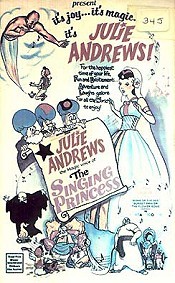
La Rosa Di Bagdad
La Rosa Di Bagdad is a 1949 Ima Film animated feature film from Ima Film, Trans-National, directed by Anton Gino Domenighini, released on December 22, 1949.
English titles: The Rose Of Baghdad, The Singing Princess
- Studio
- Ima Film, Trans-National
- Distributor
- Artisti Associati, Grand National Pictures Ltd. (United Kingdom), Larry Joachim (U.S.A.)
Synopsis
A snake charmer's genie helps rescue his master's sweetheart, a beautiful princess, from a wicked caliph.
Characters
Narrator, Princess Zeila, Sheikh Jafar, Burk, Calif Oman, Zizibé, Fatima, Amin, Amin's Mother, The Grand Kadi, Black Woman at the Fountain, Calina, Choir of the Three Ministers.
English Version: Narrator, Princess Zeila, Amin, Sheikh Jafar, Calif Oman, Tonko, Zirko
Credits
Directing
- Director
- Anton Gino Domenighini
Producing
- Producer
- Anton Gino Domenighini
Writing
- Writer
- Nina Maguire, Tony Maguire
- Co-Writer
- Lucio De Caro
Voices
- Voice
- Germana Calderini (Princess Zeila), Beatrice Preziosa (Princess Zeila [Singing Voice]), Giulio Panicali (Sheikh Jafar), Carlo Romano (Burk, the Magician) [Singing Voice]), Olinto Cristina (Calif Oman), Mario Besesti (Zizibé, Minister of Health), Giovanna Scotto (Fatima), Renata Marini (Amin's Mother), Lauro Gazzolo (The Grand Kadi), Maria Saccenti (Black Woman at the Fountain), Sakella Rio (Black Woman at the Fountain [Singing Voice]), Luisa Malagrida (Calina, Amin's Magpie [Singing Voice]), F. Delle Fornaci (Choir of the Three Ministers [Singing Voice]), Giulio Fioravanti (Choir of the Three Ministers [Singing Voice]), Piero Passarotti (Choir of the Three Ministers [Singing Voice]), Julie Andrews (Princess Zeila), Patricia Hayes (Amin), Stephen Jack (Sheikh Jafar), Arthur Young (Calif Oman), Humphrey Kent (Tonko, Minister of Information), Paul Hansard (Zirko, Minister of Beautiful Things), Stefano Sibaldi (Narrator)
Music
- Music
- Riccardo Pick Mangiagalli
- Lyricists
- Nina Maguire, Tony Maguire
Camera
- Cinematography
- Cesare Pelizzari
Production notes
The first Italian animated feature film.
Julie Andrews' voice role as Princess Zeila in the English-language dub marked her first work in film. She was only 16 or 17 when she was heard in the English-language version.
Awards
First Prize, Children's Film, Venice Film Festival, 1949
Reviews
the Singing Princess - masterpiece
"The Singing Princess" is a wonderful cartoon animated in the house styles of both Disney and the Fleischer Brothers(more the latter than the former, in my opinion). The animation is beautiful and funny - a delight both to children and to adult animation mavens. The movie's view of the Middle East is very dated - still, better the amiable misconceptions of this movie than the so-called War of Civilizations(no doubt the ghost of Edward Said will arise and bonk me in the head for this). The tale is classic fairy tale matter - a beautiful princess falls in love with a mere commoner but an old/ugly rich man is determined to marry her instead, resorting to amoral and supernatural means. Good and Love triumph in the end, as they almost never do in Real Life. The three elderly comic figures do seem straight out of Disney. But the backdrops, the landscapes, etc. seem decidedly Fleischer Brothers in style. For me, it is at times a wonder to watch. Funny things are interspersed throughout the romantic melodrama, equal to any humour put out by Warner Brothers. Any animation fanatic who does not appreciate the work here simply has nationalistic blinkers on. And, God, did Julie Andrews have a pitch-perfect voice at this stage of her life! This is worthwhile just to hear her sing. I suppose the dated ethnic and racial depictions might not rest well with many today(they never quite cross the line into ugly prejudice) - still, one must regard things in their cultural and historical context. I strongly recommend this film to cartoon fans, child and adult alike. It deserved any award it got thrown at it. Greg Cameron, Surrey, B.C., Canada
Elsewhere: Wikipedia