

Bosko The TalkInk Kid
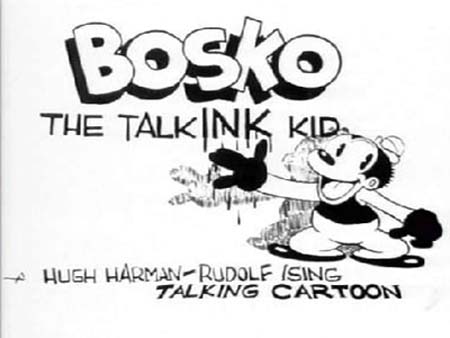
Bosko The TalkInk Kid is a 1929 cartoon from Hugh Harman-Rudolf Ising Productions., directed by Hugh Harman and Rudolf Ising.
- Studio
- Hugh Harman-Rudolf Ising Productions.
Synopsis
This inventive mixture of live-action and animation served to introduce the character of Bosko, a lovable and ever-jovial character. Animator Rudolf Ising sits at his drawing board and before our eyes creates Bosko, who comes to life and shows us "what he can do" in a series of snappy musical and comedy routines.
Characters
Bosko
Credits
Directing
- Director
- Hugh Harman, Rudolf Ising
Producing
- Producer
- Hugh Harman, Rudolf Ising
Voices
- Voice
- Carman Maxwell (Bosko), Rudolf Ising (Animator)
Animation
- Animator
- Paul J. Smith, Roland Hamilton, Isadore Freleng (as Friz Freleng), Hugh Harman, Rudolf Ising
Production notes
Original short that introduced Bosko, never released. Producer-directors Hugh Harman and Rudolf Ising showed it to various studio executives as a pilot for the Bosko character.
Possibly the first "talking" cartoon (as opposed to a cartoon with a soundtrack, as was the case with "Steamboat Willie)."
Possibly the first "talking" cartoon (as opposed to a cartoon with a soundtrack, as was the case with "Steamboat Willie)."
Pictures
Reviews
Sometimes Cinema Is Essential...
A character like Bosko couldn't exist today, what with the blatant use of black-faced caricaturing going on. But it is also part of our history of cinema, coming from the world of vaudeville. Although Rudolf Ising (who, along with Hugh Harman, created the character) would claim Bosko was a "Jewish" stereotype, the evidence is clear for all to see. A bit of a rip-off of Walt Disney's Mickey Mouse, this unreleased "pilot" short single handedly birthed Looney Tunes. Without this synchonized sound (one of, if not THE, first in history), live-action/animation spectacle (also a unique experiment of early cinema, preceeding "Who Framed Roger Rabbit" (Robert Zemeckis, 1988) by decades) we simply wouldn't have the landscape we have today. Watch this immediately if only to see what two young men dared to start!
Note: There is a blatantly racist sub-text to the material but it was often common to caricaturize all individuals, regardless of ethnicity but it is a valid argument to say that African Americans got it more than most.
Elsewhere: Wikipedia