
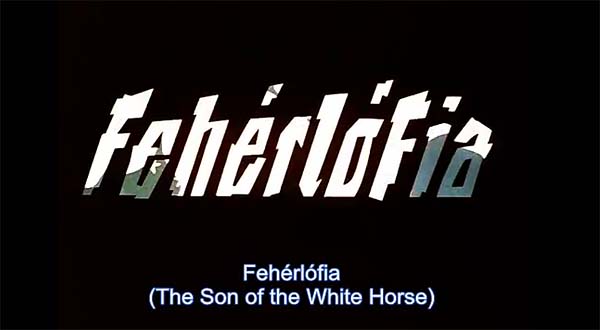
Fehérlófia
Fehérlófia is a 1981 Pannónia Filmstúdió animated feature film from Pannónia Filmmstúdió, directed by Marcell Jankovics, released on October 21, 1981.
English title: Son Of The White Mare
- Studio
- Pannónia Filmmstúdió
Credits
Directing
- Director
- Marcell Jankovics
Producing
- Producer
- Román Kunz
Writing
- Writer
- Marcell Jankovics, László György
- Based On The Story By
- László Arany
Voices
Music
- Music
- István Vajda, István Vajda
Animation
- Animator
- Edit Baksa, Marcell Jankovics, Edit Szalay, Csaba Szórády, Edit Baksa, János Uzsák, László Ujváry, Marcell Jankovics, Edit Szalay, Csaba Szórády, János Uzsák, László Ujváry
- Xerography
- Erzsébet Pintér
Art Department
- Backgrounds
- László Hegedűs
- Graphic Design
- Marcell Jankovics, Zsolt Richly, László Hegedűs
Camera
- Camera
- Zoltán Bacsó
Editing
- Editor
- Magda Hap
Sound
- Sound Engineers
- Mátyás Szakály, Béla Zsebény
Production notes
Production began in 1979 and lasted until 1981.
Second feature-length film of Marcell Jankovics. Prior to the beginning of production, the director had spent years studying Eurasian mythology, folk symbolism and astronomy. His original intent was to combine numerous folk tales into one narrative and focus on the circularity of space and time, the cycle of days, seasons and history's repetition. The working title was "A tetejetlen fa" ("The Tree Without a Top"), another name for the World Tree of Eurasian folklore. Pannonia Film Studio rejected his idea because it went against the teachings of Marxism, which claims that history is linear. As a compromise, Jankovics submitted three folk tales to adapt. Fehérlófia ('Son of the White Mare") was the only one the studio bosses accepted.
There are at least fifty different versions of this story; Jankovics picked and chose different aspects from these, often rewriting the meaning of scenes to preserve his original idea. He combined the fable with ancient Eurasian creation myths and elaborated on the backstory of the titular White Mare and the dragons. Having trouble animating characters that lacked black outlines, the low-ranking animators staged a protest early on, forcing the studio to raise their salary. Jankovics and other high-ranking cartoon creators helped out with the animation. Animation materials were of extremely low quality, which at times necessitated the complete redoing of scenes. The animation team began manufacturing their own in-house brand of paint after what their official supplier had sent them proved unusable. 600 different colors were used in total.
The director also wanted to express an anti-modernity theme, hence the portrayal of the film's dragons as different stages of technological advancement: a stone caveman, a metal war machine and a living city of concrete. This criticism of modern urban life was also rejected by Hungary's communist censorship, thus the final dragon was redesigned to resemble a computerized digital entity. The film also warns against pollution and the fake promise of urban society. This is subtly expressed in the final continuous shot of the main character walking over a polluted cityscape before the credits roll.
Critical reception was largely positive, but some argued the movie was too experimental in its presentation to appeal to the mainstream, too blatant with its sexual imagery for children and too simplistic in its narrative to satisfy adults. Certain art historians thought the unusual art style insisted on by the director and the mixing together of related folk tales undermined the source material's inherent symbolism.
Despite his early frustration, Jankovics now considers this his most accomplished feature-length movie, claiming it's a wonder it got made at all and being thankful for his small but supportive audience. Though it failed as a mainstream feature, the film was overall successful with enthusiasts of avant-garde cinema.
Jankovics claimed the constant fights with censorship and the hurdles of the animation process completely drained his energies, and for a long time he continued to express dissatisfaction with the film, its themes and animation quality. The film sold 490,914 tickets as opposed to the expected one million. A 4K remaster, co-produced by the Hungarian Film Archive, Hungarian Filmlab and the American company Arbelos Films is expected to be released in May of 2019.
Production Notes courtesy Viktor Lőrincz- Thanks Viktor!
Awards
Among the 50 Best Animated Films Ever, Los Angeles, 1984
Pictures
Elsewhere: Wikipedia