
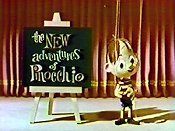
Ring A Ding Ding
- Studio
- Rankin Bass Productions, Videocrafts Incorporated, Crawley Films, Storer Stations
- Distributor
- Star Classics Video
Characters
Pinocchio, Foxy Q. Fibble, Geppetto, Cool S. Cat, Pedro Pistol, Cricket, Simoro, Loch Ness Monster, Rasputin Pasgoodnak
Credits
Directing
- Director
- Arthur Rankin Jr
Producing
- Producer
- Arthur Rankin Jr
Voices
- Voice
- Larry Mann (Foxy Q. Fibble), Paul Kligman, Stan Francis (Geppetto), Claude Ray, Joan Fowler, Jack Mather
Music
- Music
- Jules Bass (Music and Lyrics)
Production notes
Syndicated from 1960-61; 130 five-minute "chapters" were produced. These segments made up a series of five-chapter, 25-minute episodes.
Based on the story and characters of Carlo Collodi's "The Adventures of Pinocchio."
Addition of new material and adaptation by Arthur Rankin, Jr.
This, the first-ever Rankin/Bass production, used the Animagic stop-motion animation process. Animation was produced in Japan. Voice work was recorded in Canada. Hasty production of the episodes led to frequent jerky or stagnant animation.
"I always wanted to do animation work, and having been an animator at ABC on a limited basis, I wanted to expand that. In order to do so, one had to find a property and television stations to play it," recalled producer-director Arthur Rankin, Jr.
In Chicago, the series aired on "Garfield Goose and Friends" and later on "The Ray Rayner Show," both on WGN-TV.
The character Cool S. Cat may have been inspired by Maynard G. Krebs of the "Dobie Gillis" series. Pedro Pistol is a parody of Peter Gunn. Cricket was not named Jiminy, probably to avoid a legal clash with the Disney studios. Pinocchio himself differs considerably from the Disney version; he wears a red-striped T-shirt and blue shorts, and has a pre-school child's voice.
In the last five episodes, starting with #126, Geppetto tells Pinocchio and Cricket stories of Willy Nilly, his pet Roscoe and his landlady. Willy Nilly, although intended to be a spinoff series for syndication, eventually became the 1965 Rankin/Bass film "Willy McBean And His Magic Machine."