
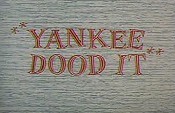
Yankee Dood It
- Studio
- Warner Bros. Cartoons, Inc., Sloan Foundation
- Distributor
- Warner Bros., Sloan Foundation
Synopsis
Elmer Fudd is the king of industrial elves. He visits an outmoded shoemaker's shop to extol the virtues of mass-production capitalism to the shoemaker, whose pet cat (Sylvester) uses a magic word, "Jehosaphat," to turn Fudd's elf helper into a mouse.
Characters
Sylvester, Elmer Fudd, Shoemaker, Elf
Credits
Directing
- Director
- Isadore Freleng (as Friz Freleng)
Producing
- Producer
- Edward Selzer
Writing
- Writer
- Warren Foster
Animation
- Animator
- Gerry Chiniquy, Virgil Ross, Art Davis
Voices
- Voice
- Mel Blanc (Sylvester [uncredited]), Arthur Q. Bryan (Elmer Fudd, Elf [uncredited]), Daws Butler (Elf, Shoemaker [uncredited])
Music
- Music
- Milt Franklyn
Editing
- Editor
- Treg Brown
Crew
- Layouts
- Hawley Pratt
- Backgrounds
- Irv Wyner
Production notes
The last of three shorts produced by the Sloan Foundation.
Sylvester gets the upper hand at the end of this cartoon. Some other ones are: "Catch as Cats Can," "Claws for Alarm,""Here Today, Gone Tamale," "Trip for Tat," "A Message To Gracias," "Freudy Cat" and "Doggone Cats."
In September of 1943, beginning with A Feud There Was, Warner Bros. began re-releasing select color cartoons in their "Blue Ribbon" program. Typically the Blue Ribbon reissues received new opening sequences with Blue Ribbon title cards and standardized music. Cartoon production credits were also removed. Between ten and fifteen cartoons were released in any given year, with cartoons coming from as far back as 1935. The reissues continued until the close of the studio in the 1960's.
All Blue Ribbon cartoons were released as "Merrie Melodie" cartoons regardless of the original series. The first "Looney Tunes" short to be included in the Blue Ribbon series was The Hep Cat, which was added in 1949. The only current prints of many of these cartoons are the Blue Ribbon releases, although restoration of these cartoons with original elements and titles is always ongoing.


