
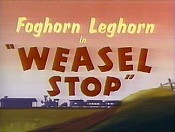
Weasel Stop
- Studio
- Warner Bros. Cartoons, Inc.
- Distributor
- Warner Bros.
Synopsis
The weasel comes to the barnyard trying to get the chickens. Foghorn has a confrontation with the "watchdog," who seems to be lazy and too busy carving wood, but who is really on top of things. Foghorn is miffed that the dog is always sleeping when he should be "guarding us chickens." Playing practical jokes on the dog doesn't work, as this Southern drawling hound is smarter than he acts. When the hyperactive, drooling weasel appears and sets out to catch a hen or two, Foghorn tries to turn the weasel against the dog with elaborate plans that the dog always has a counterpunch for, resulting in disaster for both Foggy and the weasel.
Characters
Foghorn Leghorn, Weasel, Old Southern Dog
Credits
Directing
- Director
- Robert McKimson
Producing
- Producer
- Edward Selzer
Writing
- Writer
- Tedd Pierce
Animation
- Animator
- Keith Darling, Ted Bonnicksen, Russ Dyson
Voices
- Voice
- Mel Blanc (Foghorn Leghorn, Weasel, Old Southern Dog Barking), Lloyd Perryman (Old Southern Dog)
Music
- Music
- Milt Franklyn
Crew
- Layouts And Backgrounds
- Richard H. Thomas
Production notes
In the dark background as the cartoon irises out, the weasel is running around wearing his haystack-shaped fur.
This Looney Tune short was reissued as a Blue Ribbon Merrie Melodie cartoon.
In September of 1943, beginning with A Feud There Was, Warner Bros. began re-releasing select color cartoons in their "Blue Ribbon" program. Typically the Blue Ribbon reissues received new opening sequences with Blue Ribbon title cards and standardized music. Cartoon production credits were also removed. Between ten and fifteen cartoons were released in any given year, with cartoons coming from as far back as 1935. The reissues continued until the close of the studio in the 1960's.
All Blue Ribbon cartoons were released as "Merrie Melodie" cartoons regardless of the original series. The first "Looney Tunes" short to be included in the Blue Ribbon series was The Hep Cat, which was added in 1949. The only current prints of many of these cartoons are the Blue Ribbon releases, although restoration of these cartoons with original elements and titles is always ongoing.
Pictures


Reviews
Weasel Stop
I get real pleasure from watching these 1955-57 McKimson cartoons. He's just built (from scratch) a whole new animation unit, and one can just feel the creative energy burning off the director and his team. McKimson inherited (from Chuck Jones' unit) animator Keith Darling; his animation of the weasel, especially at the very beginning of the film, is simply liquid and dazzling.
My one complaint is the ending: it might've been even more clever if the weasel (with his "clothes" back on) had climbed INTO the iris-out, instead of just running across the screen. As it stands, it's just fairly satisfying.
Weasel Stop
This would have been a better cartoon if McKimson had used the Barnyard Dawg instead of that other dog (probably taken from some old forgotten TV show). But the weasel is still awesome as usual. I LOVE that little guy.
Weasel Stop
I get a lot of pleasure from watching these 1955-57 McKimson cartoons. He'd just built (from scratch) a new animation unit at Warner's, and you can just feel the creative energy burning off the director and his team. McKimson had just obtained animator Keith Darling (from Chuck Jones' unit); Darling's animation of the weasel (especially at the very opening) is simply liquid and dazzling. THe plot set-up is great, too: McKimson adopting the Freleng philosophy of two frustrated fall-guys being more fun than one, and the "victim" character who does little or nothing to outsmart his adversaries.
The ending's neat, too--though I think it would've been even better to have the weasel (with his "clothes" still squared from the haybaler) CLIMB INTO the iris-out. As it is, it's just reasonably clever.