
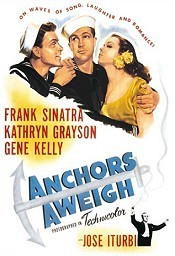
Anchors Aweigh
Anchors Aweigh is a 1945 animated feature film from Metro-Goldwyn-Mayer, directed by George Sidney, released on July 19, 1945.
- Studio
- Metro-Goldwyn-Mayer
- Distributor
- Loew's
Synopsis
Two U.S. Navy men become involved with a small boy who has run away from home to join the navy and will only return home if they can persuade his aunt, with whom he lives, to let him join the navy. Both men agree to his terms and meets his aunt, an aspiring young singer. Both men fall in love with the aunt and try to aid her in her ambition by falsely arranging an audition with noted performer Jose Iturbi. She learns of their deception and becomes disappointed. Iturbi learns of the ploy and meets with her anyway, thus making the false arrangements a reality. All ends well, with only one of the navy men conquering the heart of the aunt.
Characters
Jerry, Tom.
Live-Action Characters: Clarence "Brooklyn" Doolittle, Susan Abbott, Joseph Brady, José Iturbi, Donald Martin, Girl from Brooklyn, Police Sergeant, Cafe Manager, Admiral Hammond, Carlos, Police Captain, Bertram Kraler, Commander, Little Girl Beggar, Radio Cop, Studio Cop, Hamburger Man, Jose Iturbi's Assistant
Credits
Directing
- Director
- George Sidney
Producing
- Producer
- Joe Pasternak
Writing
- Writer
- Isobel Lennart
- Story
- Natalie Marcin
Voices
- Voice
- Sara Berner (Jerry)
- Vocal Talent, Live-Action
- Frank Sinatra (Clarence "Brooklyn" Doolittle), Kathryn Grayson (Susan Abbott), Gene Kelly (Joseph Brady), José Iturbi (Himself), Dean Stockwell (Donald Martin), Pamela Britton (Girl from Brooklyn), Rags Ragland (Police Sergeant), Billy Gilbert (Cafe Manager), Henry O'Neill (Admiral Hammond), Carlos Ramírez (Carlos), Edgar Kennedy (Police Captain), Grady Sutton (Bertram Kraler), Leon Ames (Commander), Sharon McManus (Little Girl Beggar), James Flavin (Radio Cop), James Burke (Studio Cop), Henry Armetta (Hamburger Man), Chester Clute (Jose Iturbi's Assistant)
Music
- Music
- Sammy Cahn, Georgie Stoll, Jule Styne
Animation
- Animation Directors
- William Hanna, Joseph Barbera
- Animator
- Ken Muse, Ray Patterson, Ed Barge
Editing
- Editor
- Adrienne Fazan
Music Department
- Orchestrations
- Axel Stordahl
- Musical Director
- Georgie Stoll
Production notes
In a fantasy sequence mixing live action with animation, Gene Kelly- dressed in a sailor's costume- dances with Jerry the mouse, who portrays both a king and his servant (Tom puts in a brief cameo as well). "I can't sing or dance, so I've imposed a law against it," says Jerry. Responds Kelly: "Anyone can, you just have to want to." After the dance routine, Jerry gives the sailor a medal.
The dance number is "The King Who Couldn't Dance" by Sammy Fain (music) and Arthur Freed (lyrics), sung by Gene Kelly. The sequence includes three musical numbers: "Melancholy Mouse" (Jackson), "I Hadda" (Jackson) and "The Worry Song" (Ralph Freed-Sammy Fain).
MGM Cartoon Studio provided the animation. This was not the first combination of live action and animation, but possibly the first in Technicolor.
"For several days, Stanley Donen and I watched the search for 'this something,' and then, after a long silence, Stanley suggested, 'Why don't we have a dance with a cartoon?" actor Gene Kelly recalled.
As originally conceived, Kelly was supposed to do his famous dance routine with Mickey Mouse. However, Walt Disney would not lend his most famous "star" to a rival studio, so Joe Pasternak had to look "in-house" at MGM, and ultimately used Jerry for the routine.
"I'll always be grateful to Walt, because he telephoned [studio executive] Eddie Mannix to tell him what a fine idea we had, and to assure him of the feasibility of such a sequence," Kelly said.
Animators William Hanna and Joseph Barbera worked under the direction of Fred Quimby. Quimby's assistant, Irving G. Ries, supervised the optical effects department. Donen, working with the camerman, supervised the film's movement. Kelly was filmed against a blue background, with Jerry subsequently rotoscoped. The two images were later fused optically.
The dance routine had to be reanimated when producers noticed that Gene Kelly had a very noticeable reflection on the floor, and Jerry didn't. The animators had to come back and animate a reflection for Jerry.
The scene cost $100,000 and took two months to produced, delaying the film's release.
Photos showing Tom, Jerry and Gene Kelly in the same shot are collages done for publicity puroses; the three are never seen together. Tom and Jerry are seen together, then Gene Kelly and Jerry.
The success of this segment prompted MGM to do a similar experiment in the otherwise live-action 1953 musical "Dangerous When Wet."
Awards
Academy Award Winner, Best Music, Scoring of a Musical Picture, 1945.
Academy Award Nominee, Best Actor in a Leading Role, 1945.
Academy Award Nominee, Best Cinematography, Color, 1945.
Academy Award Nominee, Best Music, Song, 1945.
Academy Award Nominee, Best Picture, 1945
Academy Award Nominee, Best Actor in a Leading Role, 1945.
Academy Award Nominee, Best Cinematography, Color, 1945.
Academy Award Nominee, Best Music, Song, 1945.
Academy Award Nominee, Best Picture, 1945
Elsewhere: Wikipedia