
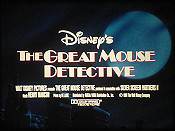
The Great Mouse Detective
Also known as: The Adventures of the Great Mouse Detective
Foreign title: Basil Détective Privé (French)
- Studio
- Walt Disney Studios, Silver Screen Partners II
- Animation studio
- Walt Disney Feature Animation
- Distributor
- Buena Vista Pictures Distribution
Synopsis
In Victorian London, England, a little mouse girl's toymaker father is abducted by a peg-legged bat. She enlists the aid of Basil of Baker Street, the rodent world's answer to Sherlock Holmes. The case expands as Basil uncovers the crime's link to a plot against the Crown itself.
Characters
Basil of Baker Street, Dr. David Q. Dawson, Olivia Flaversham, Hiram Flaversham, Professor Ratigan, Toby, Felicia, Fidget, Queen Moustoria, Bartholomew, Mrs. Judson, Sherlock Holmes, Watson, Lady Mouse, Bar Maid, Dancing Girl, Bar Singer in Rat Trap, Citizen, Thugs, Guards
Credits
Directing
- Director
- John Musker, Ron Clements, Dave Michener, Burny Mattinson
- Assaitant Directors
- Timothy J. O'Donnell, Mark A. Hester
Producing
- Producer
- Burny Mattinson
Writing
- Writer
- Peter Young, Vance Gerry, Steve Hulett, Ron Clements, John Musker, Bruce M. Morris, Matthew O'Callaghan, Burny Mattinson, David Michener, Melvin Shaw
- Book "Basil of Baker Street"
- Eve Titus
Voices
- Voice
- Vincent Price (Professor Ratigan), Barrie Ingham (Basil of Baker Street, Bartholomew), Val Bettin (Dr. David Q. Dawson, Thug, Guard), Candy Candido (Fidget), Alan Young (Hiram Flaversham), Susanne Pollatschek (Olivia Flaversham), Eve Brenner (Queen Moustoria), Diana Chesney (Mrs. Judson), Basil Rathbone (Sherlock Holmes), Laurie Main (Watson), Shani Wallis (Lady Mouse), Ellen Fitzhugh (Bar Maid), Melissa Manchester (Bar Singer in Rat Trap), Walker Edmiston (Citizen, Thug, Guard), Wayne Allwine (Thug, Guard), Tony Anselmo (Thug, Guard)
Music
- Music
- Henry Mancini
- Songs
- Henry Mancini, Larry Grossman, Ellen Fitzhugh, Melissa Manchester
Animation
- Supervising Animators
- Mark Henn, Glen Keane (Ratigan), Rob Minkoff, Hendel Butoy
- Animator
- Matthew O'Callighan, Mike Gabriel, Ruben Aquino (as Ruben A. Aquino), Jay Jackson, Kathy Zielinski, Doug Krohn, Phil Nibbelink, Andreas Deja, Phil Young, Shawn Keller, Ron Husband, Joseph Lanzisero, Rick Farmiloe, David Pruiksma, Sandra Borgmeyer, Cyndee Whitney, Barry Temple, David Block, Ed Gombert, Steven Gordon
- Layouts
- Dan Hansen, David A. Dunnet, Karen A. Keller, Gil Diciccio, Michael A. Peraza, Jr., Edward L. Ghertner
- Coordinating Animators
- Tom Ferriter, Dave Suding, Chuck Williams, Walt Stanchfield, Bill Berg
- Animation Consultant
- Eric Larson
Art Department
- Art Direction
- Guy Vasilovich
- Backgrounds
- David A. Towns, Lisa L. Keene, John Emerson, Brian Sebern, Michael Humphries, Tia Kratter, Andrew Phillipson, Phillip Phillipson
- Computer Generated Graphics
- Tad A. Gielow
- Color Styling
- Jim Coleman
Visual Effects
- Effects Animators
- Ted C. Kierscey, Kelvin Yasuda, Dave Bossert, Patricia Peraza, Mark Dindal
Camera
- Animation Camera
- Ed Austin
Editing
- Editor
- Roy M. Brewster, Jr., James Melton
Music Department
- Music Editor
- Jack Wadsworth
Production notes
The story and planning took four years, but the actual animation was completed in only a year. This remarkably short production span was possible due to new efficiencies in the production process (such as video tests and computer-assisted layouts and graphics), and an increased emphasis on story development prior to the start of production.
All of the moving clock gears were created in a computer "room" and then the hand drawn characters were added, making this the first Disney film with computer animated elements. The movements of the clock's gears were produced as wire-frame graphics on a computer, printed out and traced onto animation cels where colors and the characters were added.
125 artists were involved in making the film.
When Disney re-released the movie in 1992, they gave it the title of "The Adventures of the Great Mouse Detective". When the film was released on video, the title on the box was back to "The Great Mouse Detective", but the title card in the film itself reads "The Adventures of the Great Mouse Detective".
Budgeted at 14 million, the film brought it almost 40 million in its first release. After the failure of The Black Cauldron, this return to basics proved to be a success, and infected the studio with the pride it once had. The new senior management of the company- primarily Michael Eisner and Jeffrey Katzenberg- were convinced that their animation department was still a viable part of the company.
In December 1984, during the production of this film, the animation department was moved out of the the original Walt Disney Studios Animation Building on the lot in Burbank, California. The animators were moved to the Air Way facility in nearby Glendale, California. Following corporate restructuring, the animation department was spun off as a subsidiary of the Walt Disney Studios known as Walt Disney Feature Animation (later Walt Disney Animation Studios). Walt Disney Feature Animation would returned to the Burbank studios lot in the Roy E. Disney Animation Building crowned with the Sorcerer's hat in 1995.
This was the 26th film in the official Disney list of animated films.


