
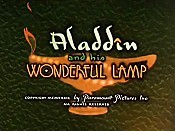
Aladdin And His Wonderful Lamp
Aladdin And His Wonderful Lamp is a 1939 Popeye the Sailor theatrical cartoon from Fleischer Studios, directed by Dave Fleischer, released on April 7, 1939.
Also known as: Popeye Meets Aladdin And His Wonderful Lamp
- Studio
- Fleischer Studios
- Distributor
- Paramount Studios
Synopsis
Olive has a job at Surprise Pictures as a script girl when she dreams up a story of Popeye in the Aladdin tale. Popeye is a poor young man tricked by an evil magician who tries to use him to get the lamp. The plot fails, and Popeye uses the lamp to become a prince and woo the princess of old Persia (played by Olive). The magician tricks the princess into giving him the lamp, and takes her for himself. Even Aladdin/Popeye and the genie of the lamp (who looks and sounds like comedian Lew Lehr) are no match for the wicked villain until spinach defeats his evil power, allowing our hero to marry the princess. In the end, Olive's story is rejected by the movie studio, and the dream ends with Olive in a sea of scripts.
Characters
Popeye/Aladdin, Olive Oyl, Wazzir, Genie
Credits
Directing
- Director
- Dave Fleischer
Producing
- Producer
- Max Fleischer
- Presented By
- Adolph Zukor
Voices
- Voice
- Jack Mercer (Popeye/Aladdin), Margie Hines (Olive Oyl/Princess), Carl Meyer (Wazzir)
Music
- Music
- Sammy Timberg
- Song "What Can I Do or You" by
- Sammy Timberg
Animation
- Animator
- Dave Tendlar, Nick Tafuri, Bill Sturm, Reuben Grossman
Production notes
A two-reel special release, the third of three Popeye color specials. Of the three, this was the only one produced at Fleischers' new Miami Studio.
Many prints of this title are in pretty bad shape. It has been rumored that the negative has deteriorated beyond restoration, but new dye transfers were made in recent years.
The third and last of the two-reel special Popeye releases.
Jack Mercer (as Popeye) sings "What Can I Do For You."
This film contains the classic Popeye line, "I don't know what to say...I've never made love in Technicolor before." This short- along with Popeye The Sailor Meets Sindbad The Sailor (1936) and Popeye The Sailor Meets Ali Baba's Forty Thieves (1937) were the only Fleischer-produced Popeye animated shorts ever to be released in Technicolor. Popeye would not go to color full-time until Famous Studio's 1943 release, Her Honor The Mare.
When Popeye/Aladdin arrives at the palace to rescue Olive/the Princess, Olive makes a mistake and calls for "Popeye" to rescue her, not Aladdin.
Pictures


Reviews
Popeye Meets Aladdin And His Wonderful Lamp
The third and last of the Fleischer two-reelers Aladdin has many good qualities to reccomend it. It also suffers from the lack of some of the quulities which made the first two so memorable. First we miss the tremendous 3-D sterioptical effects so wonderfully used in Sinbad and Ali Baba.
The post synching gives us a delightful "blooper" when Margie Hines in the frenzied rescue scene calls out Popeye's name when she should have said Aladdin! "...Popeye...I mean Aladdin"! I also like the clever refference to Lucky Strike Cigarettes when as Popeye uses a match he mubles that he "hopes he strikes it lucky" and indeed has "rubbed" the magic lamp! The classic line "I never made love in Technicolor before" is good as well the unforgettable "Salami-Salami-Balogna".
It is a shame that the Fleischer's didn't star Popeye in GULLIVER'S TRAVELS imagine a feature length Popeye...WOW!
Popeye Meets Aladdin And His Wonderful Lamp
The last of the Popeye Specials is also the longest, running 22 minutes. This was produced during the Fleischer Studios'
period in Miami. The story has it that it was animated in New York before the move to Miami, possibly begun at the time of their 1937 strike. Nevertheless, it has many things going for it, good and bad. Unfortunely, for this far into the decade, many are bad.
Although the story frame is a clever way of introducing Popeye as Aladdin, the elements in the production seem rather crude and underrealized for 1939.
First, this cartoon seems to have been a
"training" ground for inkers and painters who would be used on the Fleischer's first feature, GULLIVER'S TRAVELS. Accordingly, there are many scenes with bad cel painting. The animation is rather crude compared to the industry standard by 1939, and has a mechanical, formulaic quality to it taht was typical of animation done six years before. However, there are at least three or four scenes of good character animation when the Wazzir climbs the vines to enter the castle, and after rubbing the lamp, whips the Genie.
The rest of the animation in the film is actually below the quality of the black and white shorts. But by 1940, the Popeyes did improve greatly in animation, and had this been released by that time, it might have overcome some of these awkward qualities.
The cartoon is week in that the Wazzir is not really menacing. He is a melodramatic
caricature in a film that is attempting to be an epic. His histrionics and temper tantrums when he looses the lamp are cheap
substitues for handling a situation that required dramatic acting in portraying the combined disappointment and rage the character has. In this case, they put the character through some quasi comical antics to get him off the screen, mostly because it was easier in order to get the picture out faster.
The Wazzir really is not developed as really being evil enough to truly be menacing. He is merely a symbol of villany, but not really fleshed out as such. The Genie, however, is interesting and truly amusing as a nebbish character.
Finally, regarding the music, Sammy Timberg's song is acceptable, but hardly as great as SINBAD THE SAILOR or ABU HASSEN. In addition, the nature of the musical arrangements and recording of the score is odd, and rahter subpar. One of the major elements that made Fleischer animation work so well in New York was the quality of the music and the quality of the recordings. All of this ended when they moved to Miami, where the core of skilled musicians did not exist. The recording engineers tried to cover as best they could, but the lively quality of music that was apparant in the New York period is sadly absent here.
Anyone with a musical ear may even hear dischords in the brass sections, as this music had a sub-circus quality about it, that would soon be replaced in later cartoons when Winston Sharples and Lou Fleischer insisted on making future recordings in New York. This was eventually accomplished with the "Superman" series.
In conclusion, ALADDIN is the weakest of the specials for the specific reasons outlined, and could have been a really great film if the Fleischer crew had had the time and proper vision, to do it right.
Popeye Meets Aladdin And His Wonderful Lamp
Here in the third and the last of the trilogy of "Popeye"Specials.The film starts out as a spoof of the filmaking process."Olive"is busy writting a new script for "Surprise Pictures"latest release.She decides on doing a spoof on "The Aladin Story"With "Popeye"playing the lead and herself as "The Princess".From here.The film recreates the story.With "Popeye"as the poor but honest merchant.Wishing that he could marry "The Beautiful Princess".Little knowing that an Evil Wazzir(Played not by Bluto.But by The Fleischer's own interpretation of the original Abrabian Nights Villian)Wants to use our hero to steal "The Magic Lamp"from an old cave,get rid of "Aladin"and use the lamp's power to capture the princess and her kingdom and make everone his slaves."Popeye"finds the lamp and does get trapped inside the cave.But After he inadvertedly strikes the lamp with his last match.He brings forth The genii(A Goofy combination of Hugh Herbert and Lew Lehr of The Dribble Puss Parade Newsreels).The Gennii not only helps "Aladin"gets out of the cave.He turns him into a prince.And Out hero is soon wooing The royal beauty.Until The Wazzir finds out.And Tries to destroy "Aladin",The Princess and everyone in the kingdom with the poor Gennii at his mercy.But "Popeye"foils the magicial fink with the powers of his spinisch.And Before long.He thwarts the Giant guards, a vulture a dragon and The Wazzir(Who turns himself into a swoard weilding ghost).While this film lacks the fast pacing and excitment of the previous films.It does have charm and a great story.Plus it has "Popeye"and "Olive"going up against a new villian.And It has humor that is toned down.But we still gets laughs from Our favorite Sailor and We get double the laughs from The Gennii.It's too bad that we didn't more Color "Popeye"cartoons from The Fleischers after this one.Can You Imagine.."Popeye"helping "Pinocchio"or "Don Quxite"? Nostalgia Kid
Popeye Meets Aladdin And His Wonderful Lamp
I strongly believe that the film "Popeye Meets
Aladdin and His Wonderful Lamp" not only
signified a milestone along Popeye's cartoon
career, but also set a new standard of
achievement in the entire domain of animation.
There are a number of salient events within the
film that will delight the viewer and prove the
above hypothesis true.
First of all, "Popeye Meets Aladdin and his
Wonderful Lamp" evolves the aspect of cartoon
sexual desire. New cel painting techniques add
the spectral array among the visible color
bands, stretching love beyond the dichroma of
black and white-- It is the first time Popeye
makes love in Technicolor(tm).
The second point is the role of the antagonist,
generally known to Aladdin entheusiasts
as "Jafar." Jafar is a strong archetype for
traditional white male dominance. He controlls
the non-white Arab scrubs, namely Aladdin, (who
liveth at the corner of Chow and Main,) to
achieve his main goal--Obtaining the magical
lamp with which he will rule the world. The
trials Jafar endures to attain the lamp are very
convoluted and those hijinx need not be
mentioned here, but when he finally posesses the
lamp, he further exerts his dominant white male
position by enslaving the Genie of the lamp. The
Genie of the lamp is depicted as blue, perhaps
symbolic of his repressive sorrow of being bound
to the lamp, and ultimately Jafar. Jafar
controls the Genie with a whip--a common
implement of torture used by white slavers in
the slave trade era. This leads me to believe
that the Genie may in fact be a representation
of African peoples--his blue color is alien to
the other characters of the story.
There are many other pertinent issues involved,
but I won't spoil the film anymore. Needless to
say, "Popeye Meets Aladdin And His Wonderful
Lamp" is a wonderful piece full of rich
symbolism with a strong social message for those
willing to listen. I highly reccommend this
video to any person of any age intent on
bettering him/herself, and it's just darn
entertaining.
Animation - 6/10: Though lacking in smoothness
and anthropomorphic articulation, the art is
commendable. Some poor fire effects are used,
however.
Voice - 10/10: "I'M CRAZY, EH? WELL, YOU'LL DO
AS I SAY!" *CRACK!! CRACK!!* ...Need I say more?
Music - 10/10: The track "What Can I do for
You?" is a wonderful piece that I would love to
own on CD. Let's hope a soundtrack becomes
available in the near future.
Story - 8/10: Classic Popeye combined with a
Classic tale. Not much else to say.
Lasting Appeal - 10/10: I've watched this movie
at least twice a year to this day since I first
saw it.
-LiquidNasty
Popeye Meets Aladdin And His Wonderful Lamp
Popeye at his finest, many subtle things to watch for. I think of this movie every time I see bologna because of a line in the movie: "Salami, salami, bologna" A cliché, but it was a movie ahead of it's time"
Elsewhere: Wikipedia