
The Black Cauldron
Also known as: Taran and the Magic Cauldron
Foreign titles: Taram Et Le Chaudron Magique (French), El Caldero Magico (Spanish)
- Studio
- Walt Disney Studios, Silver Screen Partners II
- Animation studio
- Walt Disney Feature Animation
- Distributor
- Buena Vista Pictures Distribution
Synopsis
Centuries ago, in the land of Prydain, a young man named Taran is given the task of protecting Hen Wen, a magical oracular pig, who knows the location of the mystical black cauldron. This is not an easy task for the Evil Horned King will stop at nothing to get the cauldron.
Characters
Taran, Eilonwy, Gurgi, Ffewddur Fflam, Dallben, The Horned King, Creeper, King Eidilleg, Doli, Orgoch, Orddu, Orwen, Hen Wen
Credits
Directing
- Director
- Ted Berman, Richard Rich
- Assistant Directors
- Mark Hester, Terry Noss, Randy Paton
Producing
- Producer
- Joe Hale
- Executive Producer
- Ronny Miller
- Production Manager
- Don Hahn
- Executive In Charge of Production
- Edward Hansen
Writing
- Writer
- David Jonas, Vance Gerry, Al Wilson, Roy Morita, Ted Berman, Peter Young, Richard Rich, Joe Hale
- Additional Story
- Tony Marino, Steve Hulett
- Additional Dialogue
- Rosemary Anne Sisson, Roy Edward Disney
- Books, the five Chronicles of Prydain by
- Lloyd Alexander
Voices
- Voice
- Grant Bardsley (Taran), Susan Sheridan (Eilonwy), Freddie Jones (Dallben), Nigel Hawthorne (Fflam), Arthur Malet (King), John Byner (Gurgi, Doli), John Hurt (Horned King), Phil Fondacaro (Creeper, Henchman), Eda Reiss Merin (Orddu), Adele Malis-Morey (Orwen), Billie Hayes (Orgoch), Lindsay Rich (Fairfolk), Brandon Call (Fairfolk), Gregory Levinson (Fairfolk), Pete Renaday (Henchman), James Almanzar (Henchman), Wayne Allwine (Henchman), Steve Hale (Henchman), Phil Nibbelink (Henchman), Jack Laing (Henchman), John Huston (Narrator)
Music
- Music
- Elmer Bernstein
Animation
- Animator
- Andreas Deja, Phil Nibbelink, Hendel Butoy, Steven Gordon, Dale Baer, Doug Krohn, Ron Husband, Shawn Keller, Jay Jackson, Mike Gabriel, Barry Temple, Phillip Young, Tom Ferriter, Jesse Cosio, Ruben Aquino, Ruben Procopio, Cyndee Whitney, Vicki Anderson, George Schribner, David Block, Mark Henn, Charlie Downs, Terry Harrison, David Pacheco
- Layout Styling
- Mike Hodgson
- Layouts
- Don Griffith, Guy Vasilovich, Dan Hansen, Glen Vilppu, William Frake III
- Assistant Layouts
- David Dunnet, Karen Keller, Greg Martin, Kurt Anderson, Carol Holman Grosvesnor, Frank Frezzo
- Assistant Animators
- Tony Anselmo, Jane Baer, Dorothea Baker, Philo Barnhart, Bill Berg, Ben Burgess, Reed Cardwell, Brian Clift, Jesus Cortez, Rick Farmiloe, June Fujimoto, Terrey Hamada, Ray Harris, Jeffrey Lynch, Mauro Maressa, Michael McKinney, Jim Mitchell, Brett Newton, Gilda Palinginis, Phil Phillipson, David Pruiksma, Natasha Selfridge, Toby Shelton, David Stephan, Russ Stoll, George Sukara, Larry White
- Breakdown Artists
- Sue Adnopoz, Anthony DeRosa, Barbara DeRosa, Denise Ford, Edward Coral, Tina Grusd, Christine Liffers, Elyse Pastel, Karen Spooner, Louis Tate, Peggy Tonkonogy, Jane Tucker, Maria Ramocki-Rosetti, Stephen Zupkas
- Effects Breakdown Artists
- Ed Coffey, Peter Gullerud, Christine Harding
- Clean-Up Artists
- Retta davidson, Tom Ferriter, Dave Suding, Fujiko Miller, Chuck Williams, Isis Thompson, M. Flores Nichols, Lureline Weatherly, Martin Korth, Wesley Chun
- Key Coordinating Animator
- Walt Stanchfield
- Additional Animation
- Kathy Zielinsky, Due Diciccio, Jill Colbert, Richard Hoppe, Kevin Wurzer, David Brain, Sylvia Mattinson, Maurice Hunt
- Assistant Effects Animators
- Gail Finkelde, Tom Hush, Joe Lanzisero, Ronaldo Mercado, Steve Starr, John Tucker
- Animation Consultant
- Eric Larson
Art Department
- Character Design
- Andreas Deja, Mike Ploog, Phil Nibbelink, Al Wilson, David Jonas
- Backgrounds
- Donald Towns, Brian Sebern, Tia Kratter, John Emerson, Lisa Keene, Andrew Phillipson
- Special Photographic Effects
- Phillip Meador, Ron Osenbaugh, Bill Kilduff
- Color Styling
- James Coleman
Visual Effects
- Effects Animators
- Don Paul, Barry Cook, Mark Dindal, Ted Kierscey, Jeff Howard, Kelvin Yasuda, Patricia Peraza, Bruce Woodside, Scott Santoro, Kimberly Kownlton, Glenn Chaika, John Tucker
Editing
- Editor
- James Melton, James Koford, Armetta Jackson
Sound
- Re-recording Mixers
- Richard Portman, Nick Alphin, Frank C. Regula
- Sound Effects Design
- Mike McDonough
- Sound Effects
- Paul Holzborn, Wayne Allwine
- Music Scoring Mixer
- Shawn Murphy
Music Department
- Music Supervisor
- Jay Lawton
- Orchestrations
- Peter Bernstein
- Supervising Musical Editor
- Jack Wadsworth
- Musical Editor
- Kathy Durning
- Music Contractor
- Regnal Hall
- Music Preparation
- Norman Corey
Production Management
- Production Coordinators
- Joseph Morris, Dennis Edwards, Ronald Rocha
Companies and other credits
- Additional Story: Melvin Shaw (as Mel Shaw, Burny Mattinson, John Musker, Ron Clements, Doug Lefler
- Animator: sandra Borgmeyer
Production notes
They spent more on this film- 44 million dollars- thank any previous animated film. It was also the first Disney animated film to receive a PG rating. It was based on the largely unread the first two books in The Chronicles of Prydain series by Lloyd Alexander. Boy, with all that going for it, how could you not want to avoid this at the theaters?
And avoid it the audience did. In its initial release, the film did a mere 21 million in box office. This is despite massive re-edits ordered by newly appointed Disney studio chairman Jeffrey Katzenberg. Katzenberg convinced Disney chairman Michael Eisner of the fatal flaws in the project, and had the release date pushed back six months. During that time, 12 minutes were excised from the film, and some scenes re-animated.
The movie was shot in 70mm with a Dolby Stereo soundtrack.
Nothing would have saved this film. It was too dark, too hard to understand, and too non-Disney.
On the positive side, The Black Cauldron developed the first use of computer generated images in a animated film. A computer was used to animate bubbles, a boat, and even the cauldron itself.
This was also the first Disney film to use the now-familiar Walt Disney Pictures title card featuring a white silhouette of Sleeping Beauty castle over a baby blue background. This logo replaced the previous "Buena Vista Pictures Distribution" card and the "Walt Disney Productions Presents" title card. Instead of the simple "The End" title card at the end of the movie, the movie ends with a full credits roll. This would continue for most Disney animated film releases after The Black Cauldron.
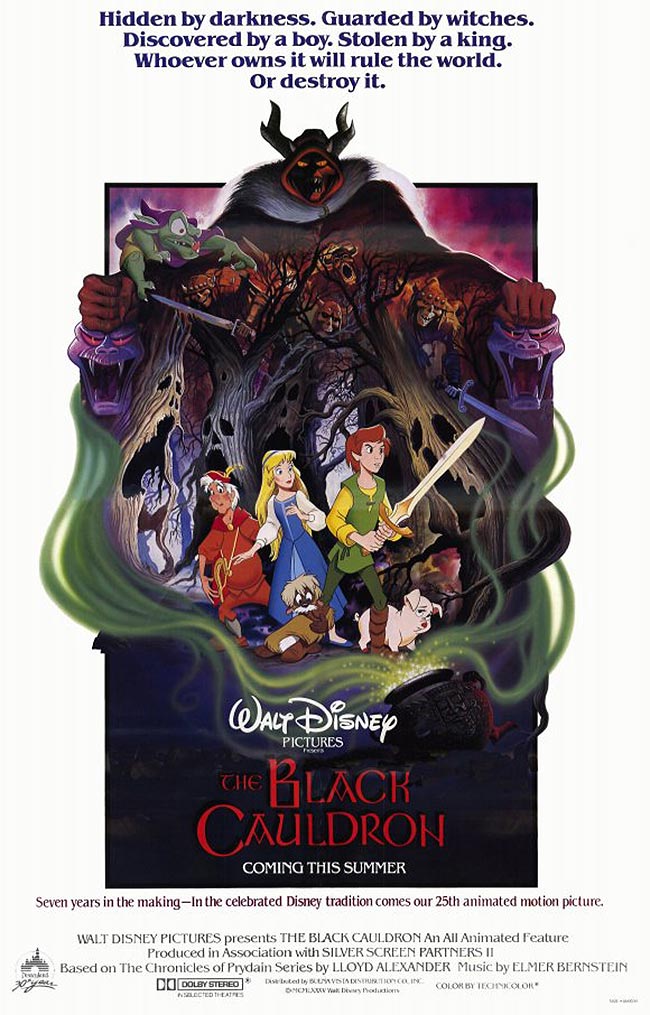
This was the 25th film in the official Disney list of animated films.
Pictures


Reviews
The Black Cauldron
Llyod Alexander wrote 5 books in Pyrdain Series. Disney's attempt to turn this into a major film, was proof that Professor Tolkien was very intelligient. He had put in his will and contracts that the rights to his books could nver be sold to Disney as they would destroy the Characters from the Hobbit & Lord of the Rings.
Disney destroyed the characters and story from Taran the Wanderer & Etc.
The Black Cauldron
The least watchable of all Disney features. Everything that could be wrong with a movie is here. Lifeless characters, muddled story, comic relief not that comic or much of a relief.
Avoid at all costs. Dreadful! Makes one ask "What were they thinking?"
The Black Cauldron
"THE BLACK CAULDRON" production ('85) was designed exclusively to be in wide screen 70mm format. Disney's first animated film with a PG rating!
The VIDEO release ('98) came out in standard full scene format however. In 1881, which was the beginning of actual production, this film was considered Disney's most expensive animated film ever produced at this time. Ron Miller, the executive producer, took a chance and tried to reach an older audience. By allowing more intense violent scenes that would garnish a PG rating, which at the time was against the Disney stockholder corporate policy of ever producing any PG type film.
(The GWYTHANT SEQUENCE, chase sequence, which is a film classic cinema device to advance the film narrative story.)
(On a side note here, I did the assistant animation with Phil during this time.)
The "CREEPER" character was Phil Nibbelink's design and animation approval 100%. This character stole the show from "GURGI" to everyone's surprise. The angular design and creepy look was all Phil's work in clean ruff 3H black normal pencil in which I assisted on all his animation work through there.
Phil would ok his completed scene. Then I would take the finished animation clean ruff scene to Ten Burman's second floor "B" wing office.
Ted Burman was the Director on these sequences in which Ted would always get a first opinion on the assistant animation acting from layout designer Guy Vasolovich.
Ted wanted to cut corners on production by coming up with the idea of having the animator draw in BLACK PENCIL cleaned up in clean ruff form starting with the animator therefore cutting down on repetitive clean up production time to curtail the $25M cost.
("The GWYTHANT CHASE" sequence.) (to note here)
Phil Nibbelink the Supervising Animator, also designed the "Gwythant" dinosaur messenger teridactiles. I assisted him on most of the scenes through that whole sequence with the Gwythants and Taran. Also, Phil did most of the Taran scenes since he designed the character for the production.
Lauraline Waverley worked with Phil on the long scene of Taran wearing an armored knights' suit also she worked with Phil on some creeper scenes opening the door.
Walt Stanchfield was the main Clean-up Supervisor expert that finalized all the sequences and George Sukara cleaned up allot of scenes through out here. Lenard Robinson did a pan scene of the Gwythant with Taran Getting dragged. Jay Jackson's first animation on the Gwthants were at the very end.
3H -Phil's favorite regular pencil, yellow with red band and pink eraser on top.
The animation Phil created was in graphite pencil for the keys and I assisted him on putting in all the missing drawings as charted. The finished scene was on model and eliminated the clean up department therefore after Ted Burman's video approval a b/w positive reel was shot and approved. The drawings ok'ed avoiding clean up straight to xerox and I/P then to color 65mm Technorama film and the theater near you in wide screen format.
--------------------------------------------
(TECHNICAL STUFF HERE)
Disney's camera department would shoot the 65mm length wise on the film. After the scene exposure and developement the Technorama process of animorphing the image to 65mm on regular 35mm film or actural 65mm film copies were produced optically in special optical printers. The optics department term of this is "Perfs per frame". A "PERF" in a technical sence is a "SPROCKET HOLE" for the camera advancement wheel so the film can travel onwards through the camera and eventually the projector system.
Example: A shot 65mm length wise on 35mm film would be "6 Perfs long". After the Technorama process it will be now on regular 35mm film possibly "3 Perfs long" and ready for the theater projector.
-------------------------------------------
(THE GWYTHANT SEQUENCE, chase scene, which is another film device used in film narrative story telling.)
Phil Nibbelink a Directing Supervisor Animator designed and animated all the "Creeper", "Gwythants", "Taran", "Gypsy Dancer" with crowd, and also the moving pan backgrounds that I worked with him on through out the Gwythant chase sequence.
The animating background is rare in Disney films outside of the original Fantasia.
I assisted Phil on his design and animation of the eire walking dead soldiers, "The Cauldron Born". The bauble Eilonwy used was computer generated and a Disney feature animation first time use of CGI. Tron, a special unit, was another group using another outside source MAGI at the time ('81).
In the early eighties WD studio didn't label lead titles or have a strict line of people in a UNIT system in place. Everyone was contributing to the film. There was a footage sheet handed out every week with all production animation footage added up; but, It wasn't listed like a unit with everyone's title and heirarchy.
("Dragon Slyer" may have been good reference for this film.)